Why natalizumab raises the risk of PML, a brain infection
Natalizumab, used for multiple sclerosis and Crohn disease, keeps white blood cells from crossing blood vessel walls into inflamed tissue. It also raises the risk of PML, a brain infection by the JC virus that usually leads to death or severe disability. The risk climbs with antibodies to the virus, longer treatment and earlier immune-suppressing medicines.
- Kind
- Side effect
- Medicines
- Natalizumab
- Sources
- 3
Step 2: possible link
The Stüve 2006 study says: These results may have implications for the observation that some natalizumab-treated patients with MS developed progressive multifocal leukoencephalopathy.
Clinical study: A study of PML among 99,571 people given natalizumab, from postmarketing data, clinical studies and a Swedish registry; it measured the risk by antibodies, earlier treatment and time on the medicine, not why the virus gets its chance: As of February 29, 2012, there were 212 confirmed cases of PML among 99,571 patients treated with natalizumab (2.1 cases per 1000 patients). … Patients who were positive for anti-JC virus antibodies, had taken immunosuppressants before the initiation of natalizumab therapy, and had received 25 to 48 months of natalizumab treatment had the highest estimated risk (incidence, 11.1 cases per 1000 patients [95% CI, 8.3 to 14.5]).
Bloomgren G et al., N Engl J Med 2012 (PMID 22591293)
This study was picked with a literature search and is not yet checked by our reviewer.
For teachers: download this drawing.
Step by step
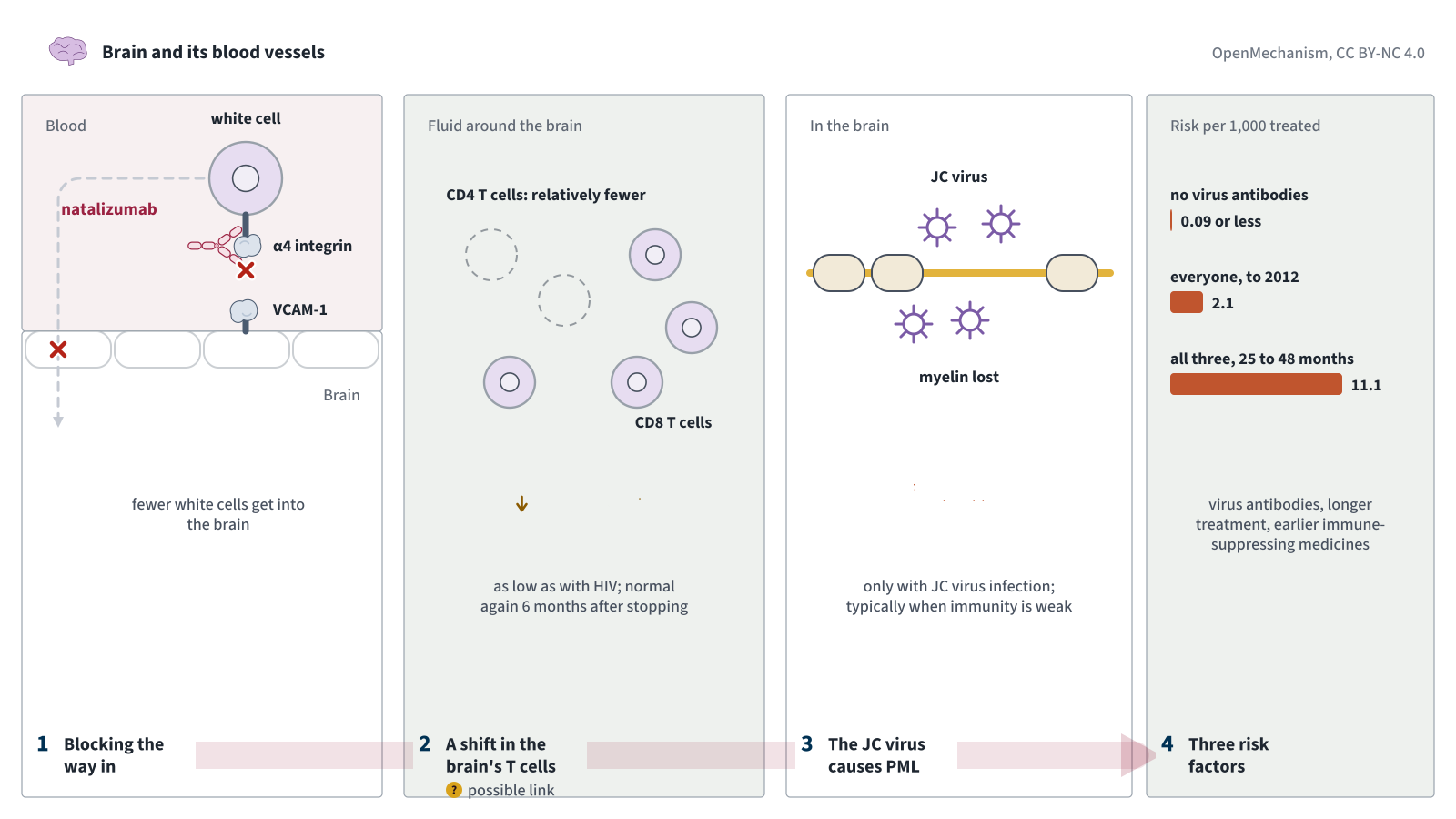
Blocking the way in. Natalizumab, used for relapsing multiple sclerosis and Crohn disease, binds the alpha-4 integrins on white blood cells other than neutrophils, so they cannot stick to on the lining of activated blood vessels and pass through into inflamed tissue. In multiple sclerosis, the lesions are believed to come from activated immune cells crossing the blood-brain barrier.1
What the source says
“TYSABRI is indicated as monotherapy for the treatment of relapsing forms of multiple sclerosis, to include clinically isolated syndrome, relapsing-remitting disease, and active secondary progressive disease, in adults.”
Source 1“TYSABRI is indicated for inducing and maintaining clinical response and remission in adult patients with moderately to severely active Crohn's disease”
Source 1“Natalizumab binds to the α4-subunit of α4β1 and α4β7 integrins expressed on the surface of all leukocytes except neutrophils, and inhibits the α4-mediated adhesion of leukocytes to their counter-receptor(s).”
Source 1“The receptors for the α4 family of integrins include vascular cell adhesion molecule-1 (VCAM-1), which is expressed on activated vascular endothelium”
Source 1“Disruption of these molecular interactions prevents transmigration of leukocytes across the endothelium into inflamed parenchymal tissue.”
Source 1“In multiple sclerosis, lesions are believed to occur when activated inflammatory cells, including T-lymphocytes, cross the blood-brain barrier (BBB).”
Source 1A shift in the brain's T cells. In people with multiple sclerosis, natalizumab lowered the ratio of to CD8 in the fluid around the brain and spinal cord to the level seen in people with , and it was normal again six months after stopping. The authors suggest this may bear on why some people taking it develop PML.2
What the source says
“Natalizumab therapy decreased the CSF CD4(+)/CD8(+) ratio of patients with MS to levels similar to those of human immunodeficiency virus-infected patients.”
Source 2“Six months after the cessation of natalizumab therapy, CSF CD4(+)/CD8(+) ratios normalized.”
Source 2“These results may have implications for the observation that some natalizumab-treated patients with MS developed progressive multifocal leukoencephalopathy.”
Source 2The JC virus causes PML. PML is a demyelinating infection of the brain caused by the JC virus that typically strikes only people whose immune system is weakened, and it usually leads to death or severe disability. Infection by the JC virus is needed for it.1,2
What the source says
“Progressive multifocal leukoencephalopathy (PML), an opportunistic viral infection of the brain caused by the JC virus (JCV) that typically only occurs in patients who are immunocompromised, and that usually leads to death or severe disability, has occurred in patients who have received TYSABRI.”
Source 1“progressive multifocal leukoencephalopathy, a demyelinating disorder of the central nervous system caused by JC virus infection”
Source 2“Infection by the JC virus is required for the development of PML.”
Source 1Three risk factors. The risk rises with antibodies to the JC virus, with longer treatment, especially beyond 2 years, and with earlier immune-suppressing medicines. By 2012 there were 212 cases among 99,571 people treated, 2.1 per 1,000; the risk was 0.09 per 1,000 or less without the antibodies, and 11.1 per 1,000 with all three after 25 to 48 months of treatment.1,3
What the source says
“Three factors that are known to increase the risk of PML in TYSABRI-treated patients have been identified:”
Source 1“The presence of anti-JCV antibodies.”
Source 1“Longer treatment duration, especially beyond 2 years.”
Source 1“Prior treatment with an immunosuppressant (e.g., mitoxantrone, azathioprine, methotrexate, cyclophosphamide, mycophenolate mofetil).”
Source 1“As of February 29, 2012, there were 212 confirmed cases of PML among 99,571 patients treated with natalizumab (2.1 cases per 1000 patients).”
Source 3“the risk of PML was lowest among the patients who were negative for anti-JC virus antibodies, with the incidence estimated to be 0.09 cases or less per 1000 patients”
Source 3“Patients who were positive for anti-JC virus antibodies, had taken immunosuppressants before the initiation of natalizumab therapy, and had received 25 to 48 months of natalizumab treatment had the highest estimated risk (incidence, 11.1 cases per 1000 patients [95% CI, 8.3 to 14.5]).”
Source 3
See also
Medicine pages: natalizumab.
Other side effects (immune system): why eculizumab raises the risk of meningococcal infections, why TNF blockers such as adalimumab raise the risk of tuberculosis and all 65 side effects.
Conditions: multiple sclerosis and Crohn disease.
Sources
- 1Tysabri (natalizumab): FDA labelBoxed Warning; 1 Indications and Usage; 5.1 Progressive Multifocal Leukoencephalopathy; 12.1 Mechanism of Action. Saved copy
- 2Altered CD4+/CD8+ T-cell ratios in cerebrospinal fluid of natalizumab-treated patients with multiple sclerosisStüve O et al. Arch Neurol 2006 (abstract). Saved copy
- 3Risk of natalizumab-associated progressive multifocal leukoencephalopathyBloomgren G et al. N Engl J Med 2012 (abstract). Saved copy
Notes and limits
- In 54 people whose blood was saved before PML was found, all had antibodies to the JC virus. People without them still carry some risk, from a new infection or a false-negative test, and 3 to 8% of people with multiple sclerosis gain the antibodies each year.1,3
Notes that apply to every page are on How to read a page.
Spotted a mistake? Report an error (hello@openmechanism.com). Since launch, every published error we fix is listed on the corrections page.
Cite this page
Tran D. Why natalizumab raises the risk of PML, a brain infection [Internet]. OpenMechanism; 2026 [updated 2026 Oct 21; cited 2026 Oct 21]. Available from: https://openmechanism.com/explained/natalizumab-and-pml