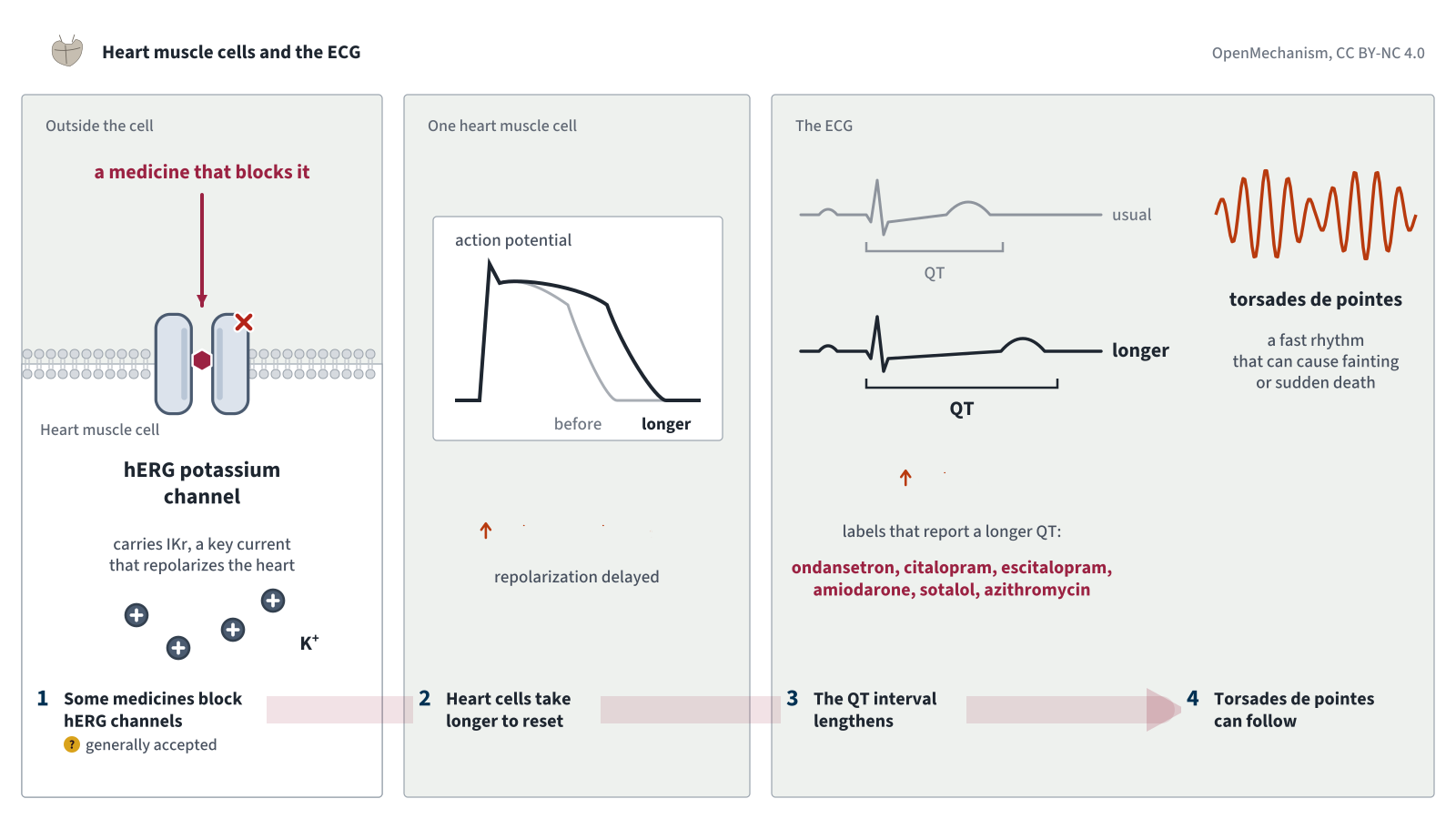
The QT interval on the ECG reflects how the heart's ventricles reset (repolarize). It is generally accepted that medicines commonly lengthen it by blocking hERG, a potassium channel whose current helps heart cells repolarize. Rarely, the QT lengthens much more, and this can set off torsades de pointes, a fast rhythm that can cause fainting or sudden death.
A 2019 review says: The generally accepted common mechanism whereby drugs prolong QT is block of a key repolarizing potassium current in heart, IKr, generated by expression of KCNH2, also known as HERG.
Clinical study: In Johannesen and colleagues' 2014 randomized controlled trial, 22 people took dofetilide, which blocks only the hERG channel, and quinidine, ranolazine and verapamil, which block hERG and also calcium or late sodium currents, and the trial compared them on the ECG: The results show that hERG potassium channel block equally prolongs early and late repolarization, whereas additional inward current block (calcium or late sodium) preferentially shortens early repolarization.Johannesen L et al., Clin Pharmacol Ther 2014 (PMID 25054430)
Some medicines block hERG channels. It is generally accepted that medicines commonly lengthen the by blocking , a key potassium current that repolarizes (resets) the heart. The channel that carries it is made from the gene. The amiodarone label says amiodarone blocks the heart muscle's potassium channels; it also blocks calcium channels, and sodium channels at rapid pacing frequencies.1,2
What the source says
“The generally accepted common mechanism whereby drugs prolong QT is block of a key repolarizing potassium current in heart, IKr, generated by expression of KCNH2, also known as HERG.”
“In addition to blocking sodium channels, amiodarone blocks myocardial potassium channels, which contributes to slowing of conduction and prolongation of refractoriness.”
Heart cells take longer to reset. Medicines that block hERG channels delay the heart's repolarization, so each heart muscle cell's action potential lasts longer. The sotalol and amiodarone labels say they lengthen the action potential, as part of how they work against abnormal heart rhythms (a Class III effect), and the azithromycin label reports prolonged repolarization with macrolide antibiotics, including azithromycin.2,3,4,5
What the source says
“The most common problem is acquired long QT syndrome caused by drugs that block human ether-a-go-go-related-gene (hERG) K(+) channels, delay cardiac repolarization and increase the risk of torsades de pointes arrhythmia (TdP).”
“Prolonged cardiac repolarization and QT interval, imparting a risk of developing cardiac arrhythmia and torsades de pointes, have been seen with treatment with macrolides, including azithromycin.”
“Sotalol has both beta-adrenoreceptor blocking (Vaughan Williams Class II) and cardiac action potential duration prolongation (Vaughan Williams Class III) antiarrhythmic properties.”
The QT interval lengthens. The QT interval on the reflects the ventricles' repolarization, and the cells' longer action potentials show up as a longer QT. The labels report a longer QT with ondansetron, with citalopram (dose-dependent), with escitalopram (in a study in healthy people, where the largest average difference from placebo was 4.5 milliseconds at 10 mg a day and 10.7 milliseconds at 30 mg a day, above the label's highest recommended dose of 20 mg), with amiodarone (about 10%), with sotalol (dose-related) and with macrolide antibiotics, including azithromycin.1,2,4,5,6,7,8
What the source says
“The QT interval, a global index of ventricular repolarization”
“QTcF interval was evaluated in a randomized, placebo and active (moxifloxacin 400 mg) controlled cross-over, escalating multiple dose study in 113 healthy subjects. The maximum mean (95% upper confidence bound) difference from placebo arm were 4.5 (6.4) and 10.7 (12.7) msec for 10 mg and supratherapeutic 30 mg escitalopram given once daily, respectively.”
“Prolonged cardiac repolarization and QT interval, imparting a risk of developing cardiac arrhythmia and torsades de pointes, have been seen with treatment with macrolides, including azithromycin.”
Torsades de pointes can follow. Rarely, the QT lengthens markedly, and this can set off , a fast rhythm of the ventricles (a polymorphic ventricular tachycardia) that can cause fainting or sudden cardiac death. The sotalol and amiodarone labels say these medicines can cause it; the citalopram, ondansetron and azithromycin labels report cases after marketing in their warnings; and the escitalopram label lists it among reports after marketing, whose cause cannot always be established.1,2,4,5,6,7,8
What the source says
“Many drugs produce a small but reproducible effect on QT interval but in rare instances this is exaggerated and marked QT prolongation can provoke the polymorphic ventricular tachycardia 'torsades de pointes', which can cause syncope or sudden cardiac death.”
“Betapace/Betapace AF can cause serious and potentially fatal ventricular arrhythmias such as sustained VT/VF, primarily Torsade de Pointes (TdP) type ventricular tachycardia, a polymorphic ventricular tachycardia associated with QT interval prolongation.”
“Pacerone can exacerbate the presenting arrhythmia in about 2% to 5% of patients or cause new ventricular fibrillation, incessant ventricular tachycardia, increased resistance to cardioversion, and polymorphic ventricular tachycardia associated with QTc prolongation (Torsade de Pointes [TdP]).”
“CELEXA causes dose-dependent QTc prolongation an ECG abnormality that has been associated with Torsade de Pointes (TdP), ventricular tachycardia, and sudden death, all of which have been observed in postmarketing reports for citalopram”
“Because these reactions are reported voluntarily from a population of uncertain size, it is not always possible to reliably estimate their frequency or establish a causal relationship to drug exposure.”
The labels of these six medicines do not name the hERG channel, so this page does not say which of them block it. The escitalopram label says escitalopram does not bind to, or has low affinity for, ion channels including potassium channels.8
Not every medicine that blocks hERG sets off torsades de pointes: some also act on other channels that counter the effect.3
Medicines can lengthen the QT interval in other ways too, which research is still defining.1
The QT interval also varies with sex, age, heart rate, blood salts and diseases such as heart disease and diabetes. Low potassium or magnesium can lengthen it further and raise the chance of torsades de pointes, and the sotalol label says a slow heart rate also raises that chance.1,4
The labels' doses, ECG checks and other advice are left out: this page explains the mechanism, not what to do.
text 3ada23755f06…; drawings e928df1507b8…; notes fae921c9e1ab…
AI source check
Claude Opus 5.5 (AI source check), 7 November 2026: 30 statements compared with their sources, 4 flagged for the reviewer. An automated check, not a medical review.
Conflict of interest
Azithromycin: Pfizer, the reviewer's former employer, makes or markets this medicine. Details
Key terms
Definitions reworded since this review: ECG and IKr. Definitions are shared across pages, so a later rewording does not take the review line off (what a review covers).
Next review due
8 May 2028
Cite this page
Tran D. Why some medicines lengthen the QT interval [Internet]. OpenMechanism; 2026 [updated 2026 Nov 7; cited 2026 Nov 7]. Available from: https://openmechanism.com/explained/qt-prolongation