Ventricular arrhythmias
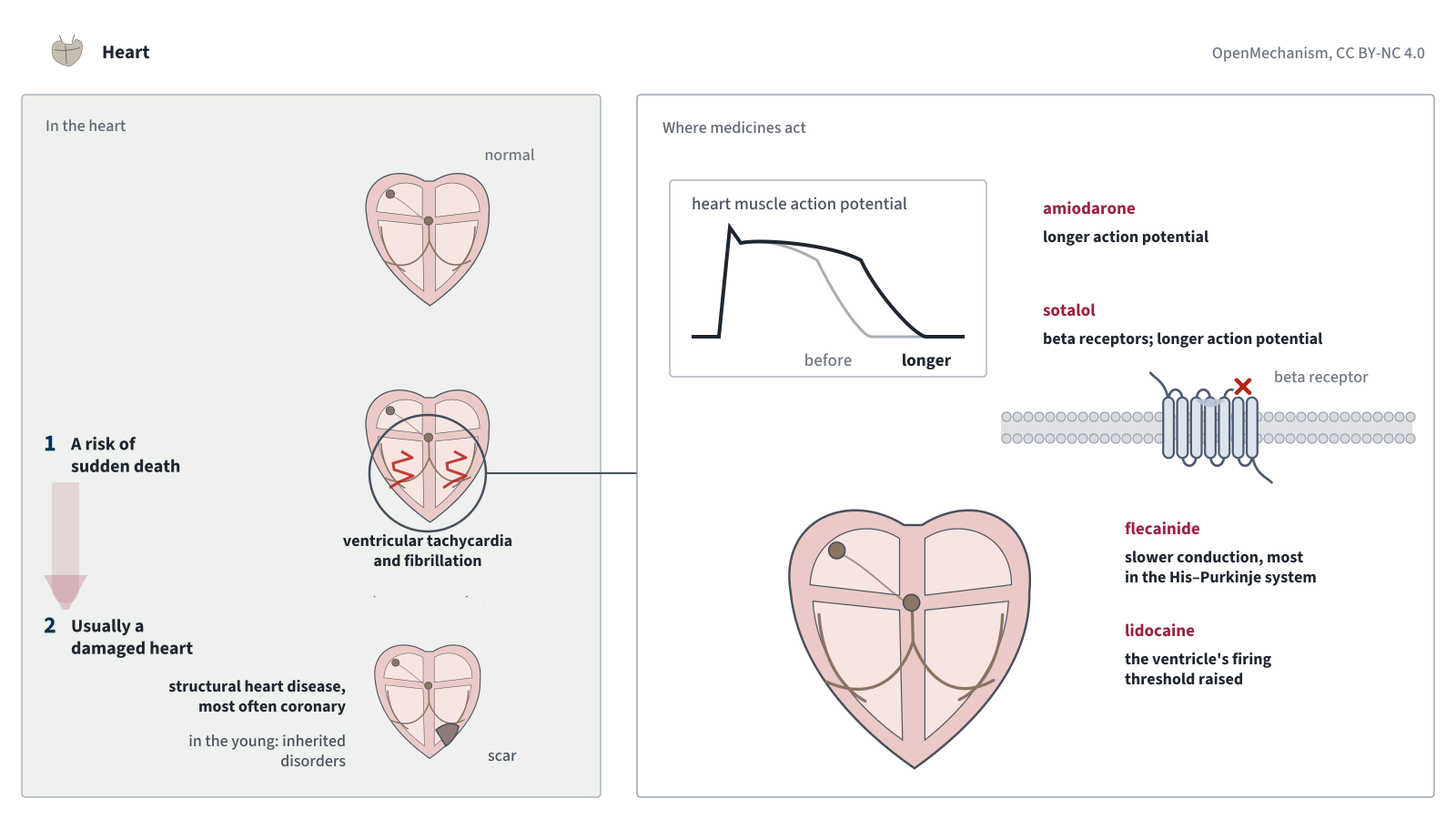
Ventricular tachycardia and ventricular fibrillation are fast, life-threatening rhythms. Sudden cardiac death accounts for an estimated 15-20% of all deaths, mostly in older adults with structural heart disease, most often coronary; most people who have a cardiac arrest do not survive. Amiodarone and sotalol lengthen the heart's action potential, flecainide slows conduction, and lidocaine raises the ventricle's firing threshold.
- Where
- Heart
- Body system
- Heart, vessels & cholesterol
- Medicines
- 4 medicines
For teachers: download this drawing.
What goes wrong
A risk of sudden death. Ventricular fibrillation and ventricular tachycardia are life-threatening rhythms; treatment depends on the risk of sudden death and on symptoms.1,2
Usually a damaged heart. It mostly strikes older adults with structural heart disease, most often coronary heart disease; in the young, inherited disorders are more common.3
What the source says
“SCD most often develops in older adults with acquired structural heart disease, but it also rarely occurs in the young, where it is more commonly because of inherited disorders.”
Source 3“Coronary heart disease is known to be the most common pathology underlying SCD, followed by cardiomyopathies, inherited arrhythmia syndromes, and valvular heart disease.”
Source 3
Where medicines act
- A
Amiodarone: a longer action potential
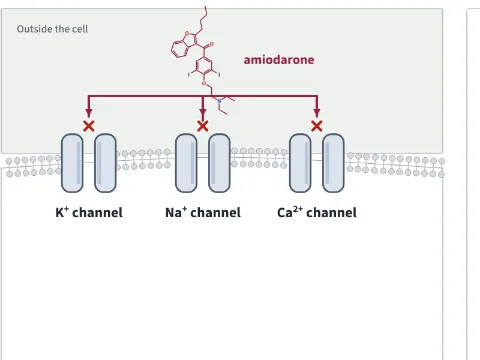
Amiodarone has effects of all four antiarrhythmic classes; with long use, it lengthens the heart's action potential. It treats recurrent ventricular fibrillation and unstable ventricular tachycardia.1
What the source says
“Amiodarone is considered a class III antiarrhythmic drug, but it possesses electrophysiologic characteristics of all four Vaughan Williams classes.”
Source 1“One of its main effects, with prolonged administration, is to lengthen the cardiac action potential, a class III effect.”
Source 1 - B
Sotalol: beta block and a longer action potential
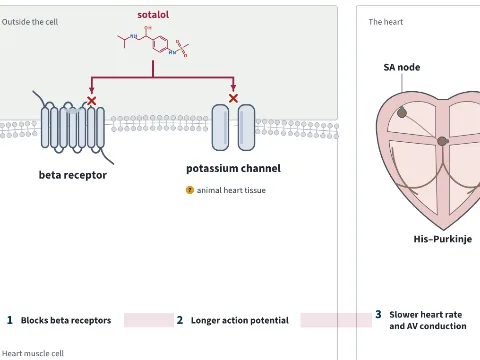
Sotalol blocks beta receptors and lengthens the heart's action potential (classes II and III). It treats life-threatening ventricular arrhythmias.4
- C
Flecainide: conduction slowed
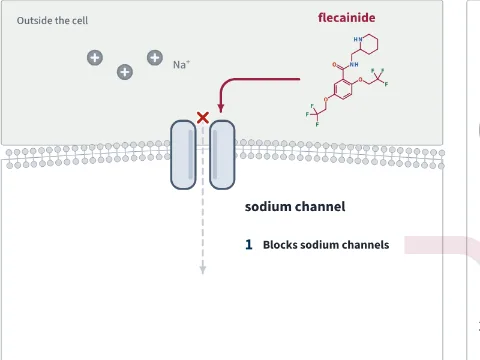
Flecainide slows conduction in all parts of the heart, most in the His-Purkinje system; it prevents documented life-threatening ventricular arrhythmias such as sustained ventricular tachycardia.5
What the source says
“flecainide acetate produces a dose-related decrease in intracardiac conduction in all parts of the heart with the greatest effect on the His-Purkinje system (H-V conduction).”
Source 5“documented ventricular arrhythmias, such as sustained ventricular tachycardia ( sustained VT), that in the judgment of the physician are life-threatening.”
Source 5 - D
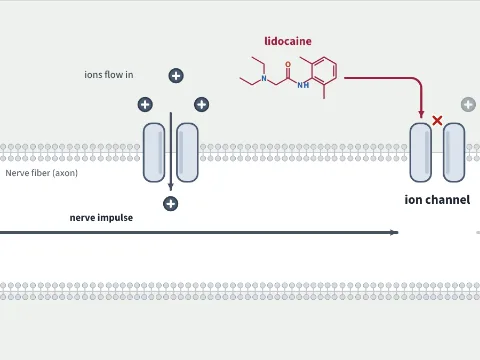
Lidocaine: the ventricle's firing threshold raised
Given into a vein, lidocaine raises the electrical threshold the ventricle needs to fire. It is used for the short-term management of ventricular arrhythmias during heart surgery and of life-threatening ventricular arrhythmias, such as during a heart attack.6
What the source says
“Lidocaine hydrochloride exerts an antiarrhythmic effect by increasing the electrical stimulation threshold of the ventricle during diastole.”
Source 6“Lidocaine hydrochloride administered intravenously is specifically indicated in the acute management of (1) ventricular arrhythmias occurring during cardiac manipulations, such as cardiac surgery and (2) life-threatening arrhythmias which are ventricular in origin, such as occur during acute myocardial infarction.”
Source 6
See also
Body system: heart, vessels & cholesterol.
Other conditions: atrial fibrillation, supraventricular tachycardia (SVT) and nerve pain after shingles.
Side effects: why some medicines lengthen the QT interval.
Sources
- 1Pacerone (amiodarone): FDA label1 Indications and Usage; 12.1 Mechanism of Action. Saved copy
- 2Ventricular arrhythmias and sudden cardiac deathJohn RM et al. Lancet 2012 (abstract). Saved copy
- 3The spectrum of epidemiology underlying sudden cardiac deathHayashi M et al. Circ Res 2015 (abstract). Saved copy
- 4Betapace (sotalol): FDA label1 Indications and Usage; 12.1 Mechanism of Action. Saved copy
- 5Flecainide acetate tablets: FDA labelIndications and Usage; Clinical Pharmacology. Saved copy
- 6Lidocaine hydrochloride and 5% dextrose injection: FDA labelIndications and Usage; Clinical Pharmacology. Saved copy
Notes and limits
- Antiarrhythmic medicines generally do not protect enough against sudden death, though they reduce rhythms that cause symptoms; sotalol has not been shown to improve survival.2,4
Notes that apply to every page are on How to read a page.
Spotted a mistake? Report an error (hello@openmechanism.com). Since launch, every published error we fix is listed on the corrections page.
Cite this page
Tran D. Ventricular arrhythmias [Internet]. OpenMechanism; 2026 [updated 2026 Oct 16; cited 2026 Oct 16]. Available from: https://openmechanism.com/conditions/ventricular-arrhythmias