Methotrexate with NSAIDs or trimethoprim-sulfamethoxazole
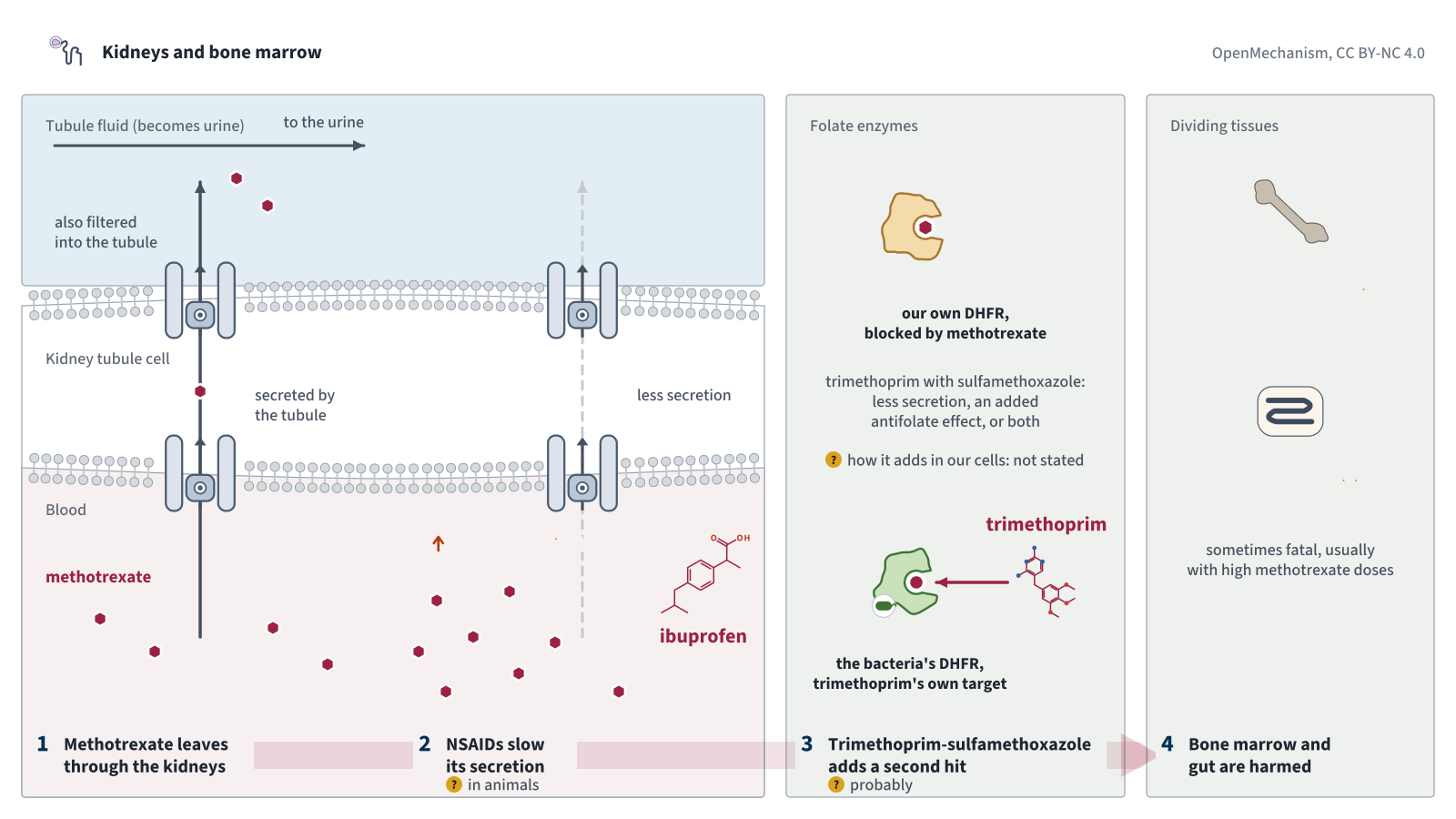
Methotrexate leaves the body mainly in the urine, filtered from the blood and also secreted by the kidney's tubules. NSAIDs such as ibuprofen have been reported to reduce that secretion in an animal model, and trimethoprim with sulfamethoxazole has rarely been reported to deepen methotrexate's bone marrow suppression, probably through less secretion, an added antifolate effect, or both. Methotrexate interferes with how dividing cells make DNA, so as it builds up, the bone marrow and the gut suffer: with some NSAIDs, usually with high doses of methotrexate, severe, sometimes fatal, toxicity has been reported.
Schematic, not to scale. Bacterial DHFR outline from an Escherichia coli structure. License CC BY-NC 4.0.
?Step 2: in animals
The methotrexate label says of NSAIDs and salicylates: These drugs have been reported to reduce the tubular secretion of methotrexate in an animal model and may enhance its toxicity.
Clinical study: In a 1995 study of people taking methotrexate long term, 30 at a 7.5 mg dose and 16 at their usual weekly dose (16.6 mg on average), each studied with and without their NSAIDs; it measured how fast the kidneys cleared methotrexate and creatinine: No significant differences in pharmacokinetic variables were observed with and without NSAID at the 7.5 mg weekly dose of MTX. When patients received usual maintenance doses of MTX the renal clearance of MTX NSAID was 91.7 (26.4) ml/min versus 115.3 (34.4) ml/min without NSAID (p = 0.004). Creatinine clearance in patients taking usual maintenance doses increased from 77.5 (13.9) ml/min with NSAID to 95.3 (26.3) ml/min without NSAID (p = 0.05).Kremer JM, Hamilton RA, J Rheumatol 1995 (PMID 8596147)
?Step 3: probably
The methotrexate label says: Trimethoprim/sulfamethoxazole has been reported rarely to increase bone marrow suppression in patients receiving methotrexate, probably by decreased tubular secretion and/or an additive antifolate effect.
Clinical study: In a 1990 study of nine children with acute lymphoblastic leukemia, each given methotrexate once with and once without trimethoprim-sulfamethoxazole; it measured how much of the methotrexate in the blood was free (not bound to proteins) and how fast it was cleared, not the bone marrow: There was an increase in free MTX fraction during TMP-SMX therapy in all patients, from (mean +/- SD) 37.4 +/- 11% without TMP-SMX to 52.2 +/- 6.4% with TMP-SMX (p less than 0.01). Plasma clearance of total MTX did not change significantly, whereas clearance of free MTX decreased significantly (from 12.5 +/- 4 to 7.6 +/- 1.5 ml/kg/min; p less than 0.05). There was a consistent decrease in the renal clearance of free MTX (from 12.1 +/- 6.8 to 5.6 +/- 2.4 ml/kg/min; p less than 0.05). Elimination half-life of MTX was not affected significantly by TMP-SMX.Ferrazzini G et al., J Pediatr 1990 (PMID 2231218)
?Step 3: how it adds in our cells: not stated
The sources don't say how the added antifolate effect arises in people. The Bactrim label says: Sulfamethoxazole inhibits bacterial synthesis of dihydrofolic acid by competing with para-aminobenzoic acid (PABA). Trimethoprim blocks the production of tetrahydrofolic acid from dihydrofolic acid by binding to and reversibly inhibiting the required enzyme, dihydrofolate reductase. Thus, sulfamethoxazole and trimethoprim blocks two consecutive steps in the biosynthesis of nucleic acids and proteins essential to many bacteria.
Methotrexate leaves through the kidneys. The kidneys are methotrexate's main way out: given into a vein, 80 to 90% of a dose leaves unchanged in the urine within 24 hours, filtered from the blood and also actively secreted by the tubules.1
What the source says
“Renal excretion is the primary route of elimination and is dependent upon dosage and route of administration.”
NSAIDs slow its secretion. Weak organic acids that the tubules also secrete can markedly raise methotrexate levels. Separately, have been reported to reduce methotrexate's tubular secretion in an animal model, and with high-dose methotrexate, some NSAIDs have been reported to raise and prolong its levels.1
What the source says
“Impaired renal function, as well as concurrent use of drugs such as weak organic acids that also undergo tubular secretion, can markedly increase methotrexate serum levels.”
Trimethoprim-sulfamethoxazole adds a second hit. Trimethoprim with sulfamethoxazole has rarely been reported to deepen methotrexate's bone marrow suppression, probably through less tubular secretion, an added antifolate effect, or both. In bacteria, trimethoprim blocks dihydrofolate reductase, the enzyme that methotrexate blocks in our own cells; the sources don't say how the added antifolate effect arises in people.1,2
What the source says
“Trimethoprim/sulfamethoxazole has been reported rarely to increase bone marrow suppression in patients receiving methotrexate, probably by decreased tubular secretion and/or an additive antifolate effect.”
“Trimethoprim blocks the production of tetrahydrofolic acid from dihydrofolic acid by binding to and reversibly inhibiting the required enzyme, dihydrofolate reductase.”
Bone marrow and gut are harmed. Methotrexate interferes with how cells make and repair , and dividing tissues such as the bone marrow and the lining of the mouth and gut are in general more sensitive to this effect. With some NSAIDs, unexpectedly severe, sometimes fatal, bone marrow suppression, aplastic anemia and gut toxicity have been reported, usually with high doses of methotrexate.1
What the source says
“Therefore, methotrexate interferes with DNA synthesis, repair, and cellular replication.”
“Actively proliferating tissues such as malignant cells, bone marrow, fetal cells, buccal and intestinal mucosa, and cells of the urinary bladder are in general more sensitive to this effect of methotrexate.”
“Unexpectedly severe (sometimes fatal) bone marrow suppression, aplastic anemia, and gastrointestinal toxicity have been reported with concomitant administration of methotrexate (usually in high dosage) along with some nonsteroidal anti-inflammatory drugs (NSAIDs).”
Also used for it: leucovorin (for the toxicity of impaired methotrexate elimination: “Leucovorin calcium is also indicated to diminish the toxicity and counteract the effects of impaired methotrexate elimination and of inadvertent overdosages of folic acid antagonists.”3) and glucarpidase (for toxic methotrexate levels when impaired kidney function delays its clearance; not recommended when methotrexate clears as expected: “VORAXAZE is indicated to reduce toxic plasma methotrexate concentration (greater than 1 micromole per liter) in adult and pediatric patients with delayed methotrexate clearance (plasma methotrexate concentrations greater than 2 standard deviations of the mean methotrexate excretion curve specific for the dose of methotrexate administered) due to impaired renal function. Limitations of Use: VORAXAZE is not recommended for use in patients who exhibit the expected clearance and expected plasma methotrexate concentration.”4).
Caldolor (ibuprofen) injection: FDA label7 Drug Interactions. Also used for ibuprofen in the Medicines fact, the summary and the drawing. The label's table of clinically significant interactions with ibuprofen says of methotrexate: “Concomitant use of NSAIDs and methotrexate may increase the risk for methotrexate toxicity (e.g., neutropenia, thrombocytopenia, renal dysfunction).” Saved copy
Notes and limits
The label adds that, despite the potential interactions, studies of methotrexate in rheumatoid arthritis have usually included steady doses of NSAIDs without apparent problems, but that the doses used in rheumatoid arthritis (7.5 to 15 mg a week) are somewhat lower than those used in psoriasis and that larger doses could lead to unexpected toxicity.1
The label notes that probenecid also reduces this tubular transport.1
The label adds that methotrexate is partly bound to albumin in the blood, and that its toxicity may be increased when certain medicines, such as salicylates, phenylbutazone, phenytoin and sulfonamides, displace it.1
The methotrexate label gives its report of severe, sometimes fatal, toxicity with some NSAIDs in its boxed warning.1
text 71c464771ce0…; drawings 355f287a9808…; notes 353d9d3cfb65…
AI source check
Claude Opus 5.5 (AI source check), 14 November 2026: 35 statements compared with their sources, 5 flagged for the reviewer. An automated check, not a medical review.
Next review due
16 May 2028
Cite this page
Tran D. Methotrexate with NSAIDs or trimethoprim-sulfamethoxazole [Internet]. OpenMechanism; 2026 [updated 2026 Nov 15; cited 2026 Nov 15]. Available from: https://openmechanism.com/explained/methotrexate-and-nsaids-or-trimethoprim