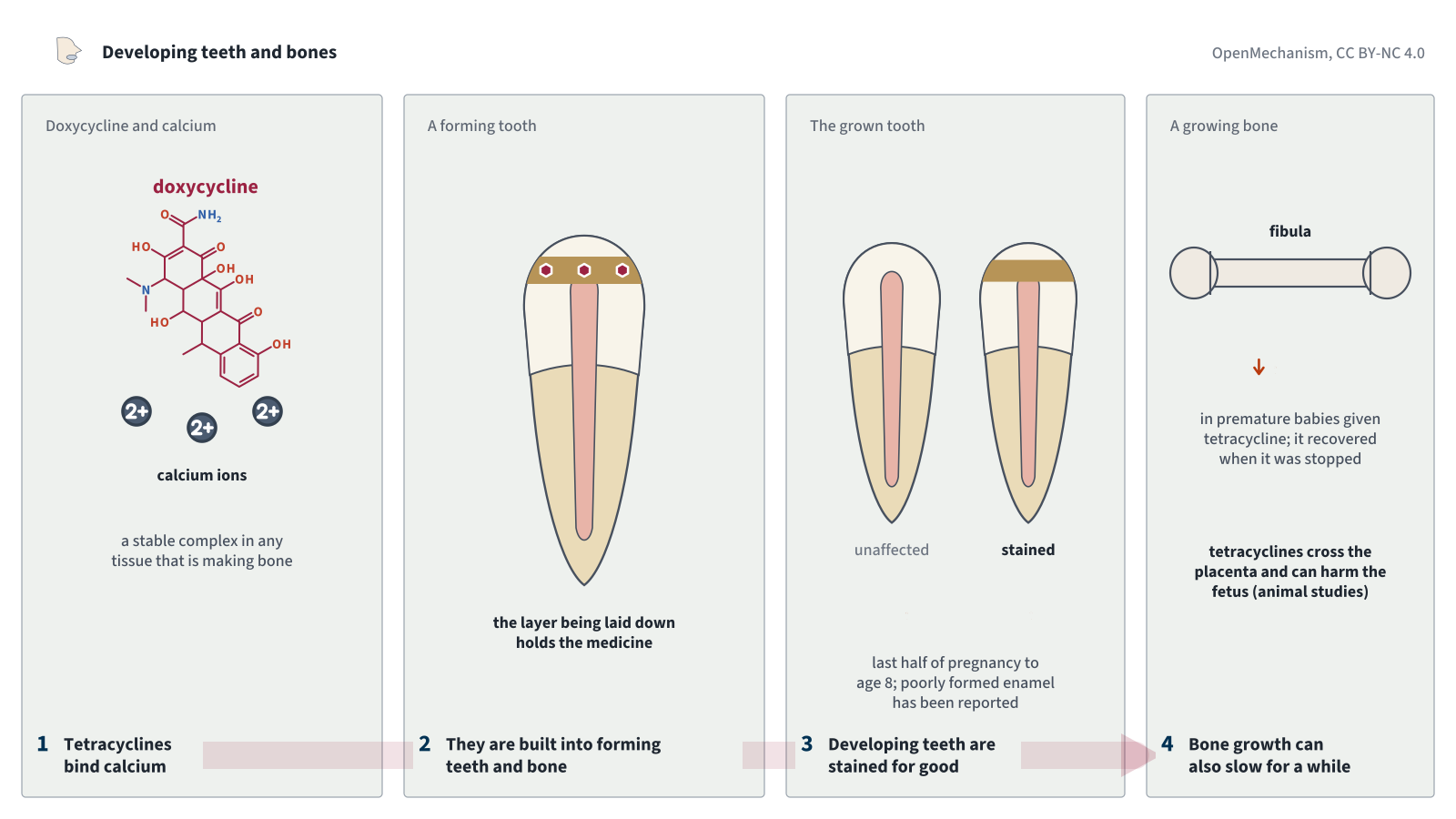
Tetracycline antibiotics such as doxycycline bind calcium and are built into teeth, cartilage and bone that are calcifying while the medicine is taken. Given while the teeth are forming, from the last half of pregnancy to the age of 8, they can leave the teeth permanently yellow-gray-brown, and poorly formed enamel has also been reported. In premature babies given tetracycline, the fibula grew more slowly for a time.
Tetracyclines bind calcium. All tetracyclines form a stable complex with calcium in any tissue that is making bone. The label also says doxycycline itself has a low for calcium binding.1,2
What the source says
“All tetracyclines form a stable calcium complex in any bone-forming tissue.”
“They have the ability to chelate calcium ions and to be incorporated into teeth, cartilage and bone, resulting in discoloration of both the primary and permanent dentitions.”
Developing teeth are stained for good. Taken while the teeth are forming, from the last half of pregnancy through infancy to the age of 8, tetracyclines can discolor the teeth permanently, yellow-gray-brown, more often with long use but also after repeated short courses. Poorly formed enamel (enamel hypoplasia) has also been reported.1
What the source says
“The use of drugs of the tetracycline class during tooth development (last half of pregnancy, infancy and childhood to the age of 8 years) may cause permanent discoloration of the teeth (yellow-gray-brown).”
Bone growth can also slow for a while. In premature babies given oral tetracycline in doses of 25 mg/kg every 6 hours, the fibula grew more slowly, and growth recovered when the medicine was stopped. Animal studies indicate that tetracyclines cross the placenta, are found in the fetus's tissues and can have toxic effects on the developing fetus, often related to slowed skeletal development; harm to the embryo was also noted in animals treated early in pregnancy.1
What the source says
“A decrease in fibula growth rate has been observed in prematures given oral tetracycline in doses of 25 mg/kg every 6 hours.”
“Results of animal studies indicate that tetracyclines cross the placenta, are found in fetal tissues, and can have toxic effects on the developing fetus (often related to retardation of skeletal development). Evidence of embryotoxicity has also been noted in animals treated early in pregnancy.”
The label's advice on when to use doxycycline in children is left out: this page explains the mechanism, not what to do.
The color, from yellow or gray to brown, depends on the dose or the kind of tetracycline relative to body weight; a 2004 review, of literature that was mostly case reports, puts the prevalence of tetracycline and minocycline staining at 3% to 6%; its abstract doesn't say in which people.2
Staining has also been reported in adults after long use of tetracycline and minocycline, and the 2004 review said how minocycline stains was still unknown.2
The slower bone growth was seen with tetracycline, not doxycycline itself, in premature babies, and the placenta and fetal findings come from animal studies.
The sources don't say whether the calcium binding causes the slower bone growth.
Claude Opus 5.5 (AI source check), 6 November 2026: 23 statements compared with their sources, 5 flagged for the reviewer. An automated check, not a medical review.
Claude Opus 5.5 (AI source check), 6 November 2026: 23 statements compared with their sources, 5 flagged for the reviewer. An automated check, not a medical review.
Next review due
7 May 2028
Cite this page
Tran D. Why tetracyclines can stain developing teeth [Internet]. OpenMechanism; 2026 [updated 2026 Nov 6; cited 2026 Nov 6]. Available from: https://openmechanism.com/explained/tetracyclines-and-developing-teeth