Why antibiotics can cause C. difficile diarrhea
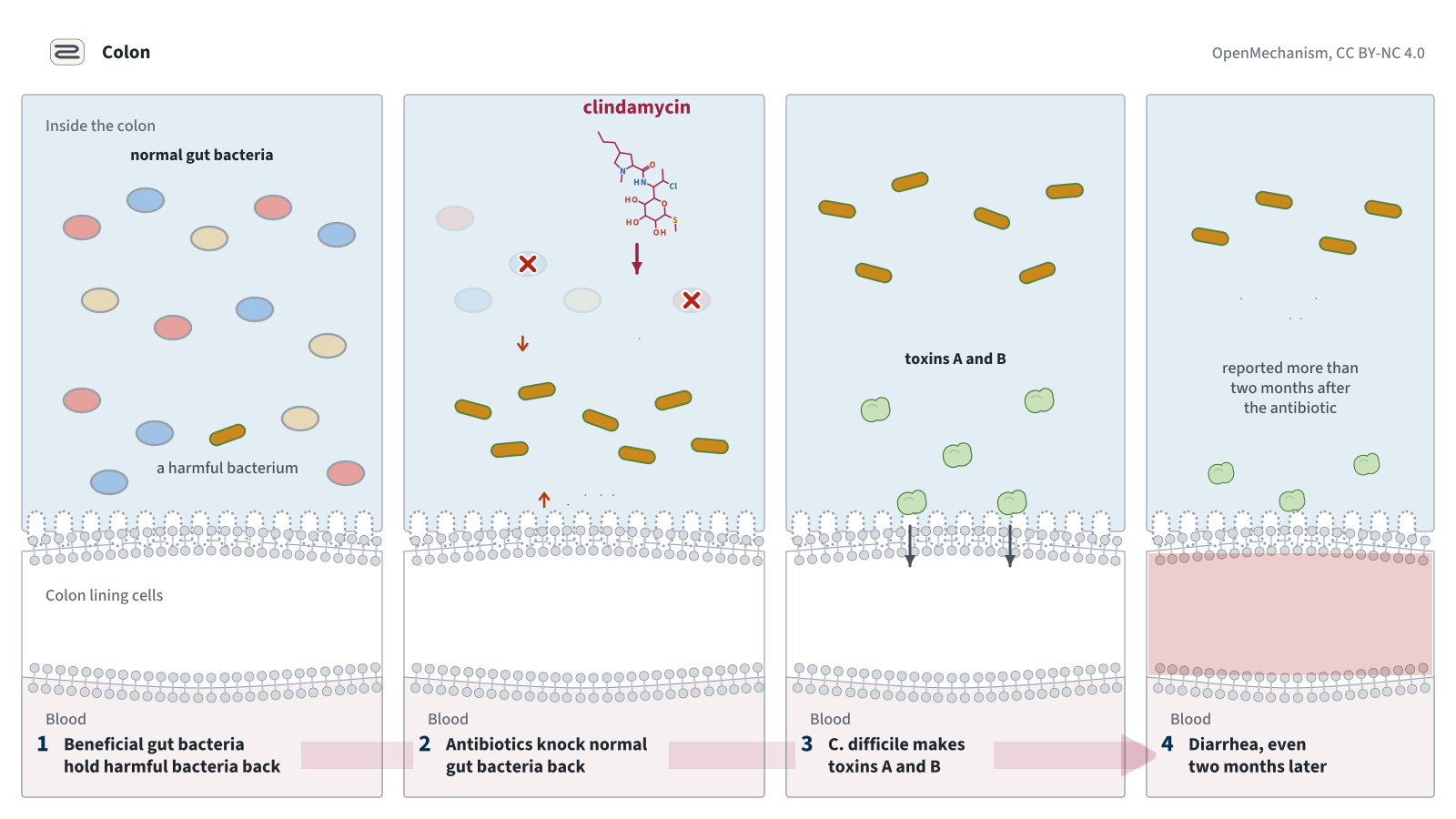
Beneficial gut bacteria compete with harmful bacteria for food and footholds. Antibiotics such as clindamycin can deplete these beneficial bacteria, and C. difficile can then overgrow and make toxins A and B. The diarrhea that follows can range from mild to fatal colitis; it has been reported more than two months after the antibiotic, and with nearly all antibiotics.
- Kind
- Side effect
- Medicines
- Clindamycin
- Sources
- 7
For teachers: download this drawing.
Step by step
Beneficial gut bacteria hold harmful bacteria back. Beneficial bacteria that normally live in the gut help defend it: they compete with harmful bacteria for nutrients and for places to attach.1
What the source says
“Beneficial commensals, including Bifidobacterium, Lactobacillus, and segmented filamentous bacteria, contribute to colonization resistance by competing for nutrients and adhesion sites, producing antimicrobial metabolites, and enhancing epithelial barrier integrity.”
Source 1Antibiotics knock normal gut bacteria back. Antibiotics can deplete the gut's normal bacteria, which can give harmful bacteria the advantage. Clindamycin's label says treatment with antibacterial medicines alters the colon's normal bacteria, leading to overgrowth of C. difficile; C. difficile diarrhea has been reported with nearly all antibacterial medicines.2,3,4
What the source says
“This infection generally results from the loss of normal gut flora secondary to recent antibiotic use”
Source 2“Alterations of the anaerobic intestinal flora by broad-spectrum antibiotics may decrease colonization resistance, thus permitting overgrowth of potential pathogens, eg, Candida and Clostridium species.”
Source 3“Treatment with antibacterial agents alters the normal flora of the colon, leading to overgrowth of C. difficile”
Source 4“Clostridioides difficile -associated diarrhea (CDAD) has been reported with use of nearly all antibacterial agents, including clindamycin hydrochloride”
Source 4C. difficile makes toxins A and B. C. difficile makes toxins A and B, which contribute to the disease: the toxins set off a cascade of responses in the body's cells that cause diarrhea, inflammation and tissue death.4,5
Diarrhea, even two months later. The diarrhea can range from mild to fatal colitis (C. difficile is the most common cause of pseudomembranous colitis), and it has been reported more than two months after the antibiotic was given.2,4
What the source says
“and may range in severity from mild diarrhea to fatal colitis”
Source 4“C. difficile is the most common cause of pseudomembranous colitis”
Source 2“Careful medical history is necessary since CDAD has been reported to occur over two months after the administration of antibacterial agents.”
Source 4
See also
Medicine pages: clindamycin.
Also used for it: vancomycin (for C. difficile diarrhea, by mouth: “Vancomycin Hydrochloride Capsules are indicated for the treatment of C. difficile -associated diarrhea.”7).
Can raise or cause it: sulfamethoxazole and trimethoprim (“Clostridioides difficile associated diarrhea (CDAD) has been reported with use of nearly all antibacterial agents, including sulfamethoxazole and trimethoprim”6).
Other side effects (infections): why amphotericin B can harm the kidneys; why fast vancomycin infusions cause flushing; why fluoroquinolones such as ciprofloxacin can damage tendons; why gentamicin can damage hearing and balance; why isoniazid can damage nerves; why linezolid can cause lactic acidosis and nerve damage; why tetracyclines can stain developing teeth; why trimethoprim can raise potassium; why vancomycin can harm the kidneys; and all 65 side effects.
Conditions: C. difficile infection.
Sources
- 1Pathogenesis and therapeutic strategies in the interaction between gut microbiota and enterohemorrhagic Escherichia coli infectionLi X et al. FEMS Microbiol Rev 2026 (abstract). Saved copy
- 2Clostridium difficile colitis: NCI Thesaurus definitionNCI definition, concept C35286. Saved copy
- 3Azactam (aztreonam): FDA labelMicrobiology. Saved copy
- 4Clindamycin hydrochloride capsules: FDA labelBoxed Warning; Warnings. Saved copy
- 5Clostridium difficile infectionSmits WK et al. Nat Rev Dis Primers 2016 (abstract). Saved copy
- 6
- 7Vancomycin hydrochloride capsules: FDA label1 Indications and Usage. Saved copy
Notes and limits
- Strains that make more toxin cause more illness and death; the infection can resist treatment and the colon may need to be removed.4
- Because of the colitis risk, clindamycin's label reserves it for serious infections where less toxic antibiotics are not suitable.4
Notes that apply to every page are on How to read a page.
Spotted a mistake? Report an error (hello@openmechanism.com). Since launch, every published error we fix is listed on the corrections page.
Cite this page
Tran D. Why antibiotics can cause C. difficile diarrhea [Internet]. OpenMechanism; 2026 [updated 2026 Nov 13; cited 2026 Nov 13]. Available from: https://openmechanism.com/explained/antibiotics-and-c-difficile