Why fast vancomycin infusions cause flushing
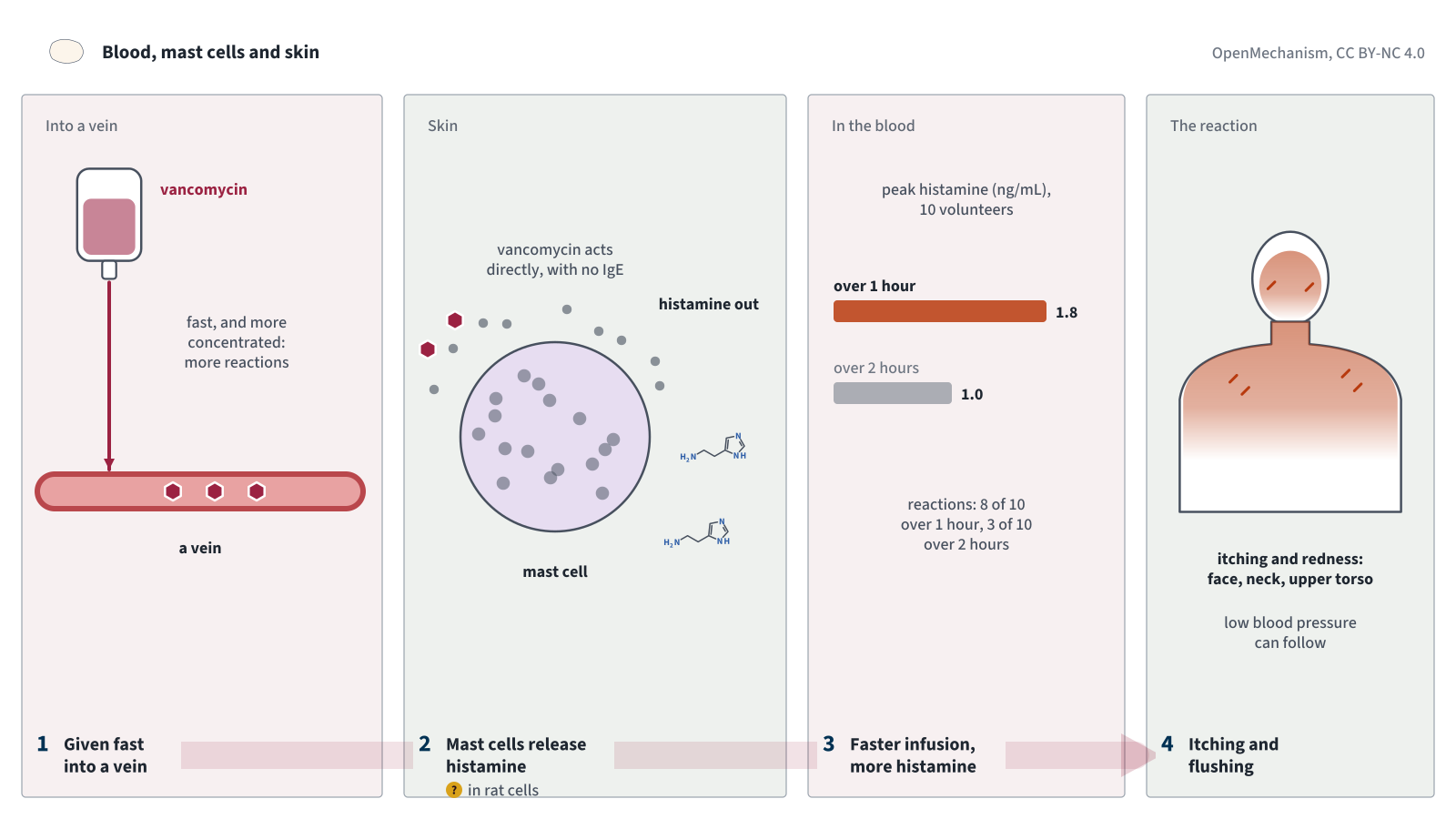
Given fast into a vein, vancomycin may bring on the vancomycin infusion reaction: itching and redness of the face, neck and upper torso, and sometimes low blood pressure. The reaction goes with both the concentration and the rate of the infusion. It is mediated in part by histamine: in volunteers, histamine in the blood rose with the infusion rate, and its rise matched the reaction's severity. In rat cells vancomycin released histamine from mast cells directly, without IgE.
- Kind
- Side effect
- Medicines
- Vancomycin
- Sources
- 6
Step 2: in rat cells
Williams and colleagues' laboratory study says: Vancomycin induced a time- and dose-dependent release of histamine into the culture media from both cell types.
Clinical study: In a trial in 33 patients given vancomycin over an hour, pretreated at random with an antihistamine (diphenhydramine) or a placebo; it tested histamine's part in patients, not which cells release it: Of 17 patients with placebo pretreatment, 8 (47%) had RMS. None of the 16 pretreated with diphenhydramine had a first-dose reaction (P = .003).
Wallace MR et al., J Infect Dis 1991 (PMID 1955716)
This study was picked with a literature search and is not yet checked by our reviewer.
For teachers: download this drawing.
Step by step
Given fast into a vein. Giving vancomycin rapidly into a vein may be associated with the vancomycin infusion reaction. Such reactions go with both the concentration and the rate of the infusion, though they can occur at any rate or concentration.1
What the source says
“Rapid intravenous administration of Vancomycin Hydrochloride for Injection may also be associated with “vancomycin infusion reaction”, which manifests as pruritus and erythema that involves the face, neck and upper torso.”
Source 1“Infusion-related adverse reactions are related to both the concentration and the rate of administration of vancomycin.”
Source 1“Infusion-related adverse reactions may occur, however, at any rate or concentration.”
Source 1Mast cells release histamine. In rat cells in the laboratory, vancomycin released histamine from directly, more with time and dose. Mast cells are classically set off by , but drugs can also activate them directly, through receptors on the cells.2,3
What the source says
“Vancomycin induced a time- and dose-dependent release of histamine into the culture media from both cell types.”
Source 2“The direct effects of vancomycin on histamine release were therefore investigated in rat peritoneal mast cells and rat leukemic basophils (RBL-1 cells).”
Source 2“classically elicited by antigen crosslinking of antigen-specific IgE bound to the high-affinity IgE receptor FcεRI on mast cells and basophils”
Source 3“direct activation of mast cells by drugs that interact with receptors on these cells”
Source 3Faster infusion, more histamine. The reaction is mediated in part by histamine. In volunteers, histamine in the blood rose with the infusion rate, and its rise matched the reaction's severity: over 1 hour rather than 2, vancomycin gave a higher histamine peak (1.8 against 1.0 ng/mL) and more reactions (8 of 10 against 3 of 10).4,5
What the source says
“Vancomycin-induced "red man syndrome" (RMS) is mediated in part by histamine release”
Source 4“vancomycin causes an infusion rate-dependent increase in plasma histamine concentration, and that the increase in plasma histamine concentration is correlated with the severity of the reaction.”
Source 5“The 1-h infusion was associated with a significantly greater peak concentration of histamine in plasma (1.8 +/- 0.7 versus 1.0 +/- 0.3 ng/ml, P = 0.004)”
Source 4“Of 10 subjects, 8 had evidence of RMS during the 1-h infusion (3 mild, 3 moderate, and 2 severe), whereas only 3 of the 10 subjects (all mild) had RMS during the 2-h infusion (P less than 0.05).”
Source 4Itching and flushing. The reaction shows as itching and redness of the face, neck and upper torso. Low blood pressure, even shock, wheezing and chest pain may also occur with rapid infusion, and the reactions may be more severe in children.1
What the source says
“Rapid intravenous administration of Vancomycin Hydrochloride for Injection may also be associated with “vancomycin infusion reaction”, which manifests as pruritus and erythema that involves the face, neck and upper torso.”
Source 1“Hypotension, including shock and cardiac arrest, wheezing, dyspnea, urticaria, muscular and chest pain may occur with rapid Vancomycin Hydrochloride for Injection administration.”
Source 1“The reactions may be more severe in younger patients, particularly children, and in patients receiving concomitant muscle relaxant anesthetics.”
Source 1
See also
Medicine pages: vancomycin.
Other side effects (infections): why amphotericin B can harm the kidneys; why antibiotics can cause C. difficile diarrhea; why fluoroquinolones such as ciprofloxacin can damage tendons; why gentamicin can damage hearing and balance; why isoniazid can damage nerves; why linezolid can cause lactic acidosis and nerve damage; why tetracyclines can stain developing teeth; why trimethoprim can raise potassium; why vancomycin can harm the kidneys; and all 65 side effects.
Conditions: food allergy; skin and soft-tissue infections; and bloodstream infections and endocarditis.
Sources
- 1Vancomycin hydrochloride for injection: FDA label5.1 Infusion Reactions; 6 Adverse Reactions. Saved copy
- 2Vancomycin-induced release of histamine from rat peritoneal mast cells and a rat basophil cell line (RBL-1)Williams PD et al. Agents Actions 1991 (abstract). Saved copy
- 3Human IgE-independent systemic anaphylaxisFinkelman FD et al. J Allergy Clin Immunol 2016 (abstract). Saved copy
- 4Vancomycin-induced histamine release and "red man syndrome": comparison of 1- and 2-hour infusionsHealy DP et al. Antimicrob Agents Chemother 1990 (abstract). Saved copy
- 5Vancomycin and the red-man syndrome: pharmacodynamics of histamine releasePolk RE et al. J Infect Dis 1988 (abstract). Saved copy
- 6Red man syndrome: incidence, etiology, and prophylaxisWallace MR et al. J Infect Dis 1991 (abstract). Saved copy
Notes and limits
- The label's infusion times and advice are left out: this page explains the mechanism, not what to do.
- Histamine accounts for the reaction in part, and the mast cell findings come from rat cells.2,4
- Vancomycin can also cause true allergic reactions, anaphylaxis among them; this page is about the infusion reaction.1
Notes that apply to every page are on How to read a page.
Spotted a mistake? Report an error (hello@openmechanism.com). Since launch, every published error we fix is listed on the corrections page.
Cite this page
Tran D. Why fast vancomycin infusions cause flushing [Internet]. OpenMechanism; 2026 [updated 2026 Oct 19; cited 2026 Oct 19]. Available from: https://openmechanism.com/explained/vancomycin-infusion-reaction