Why fluoroquinolones such as ciprofloxacin can damage tendons
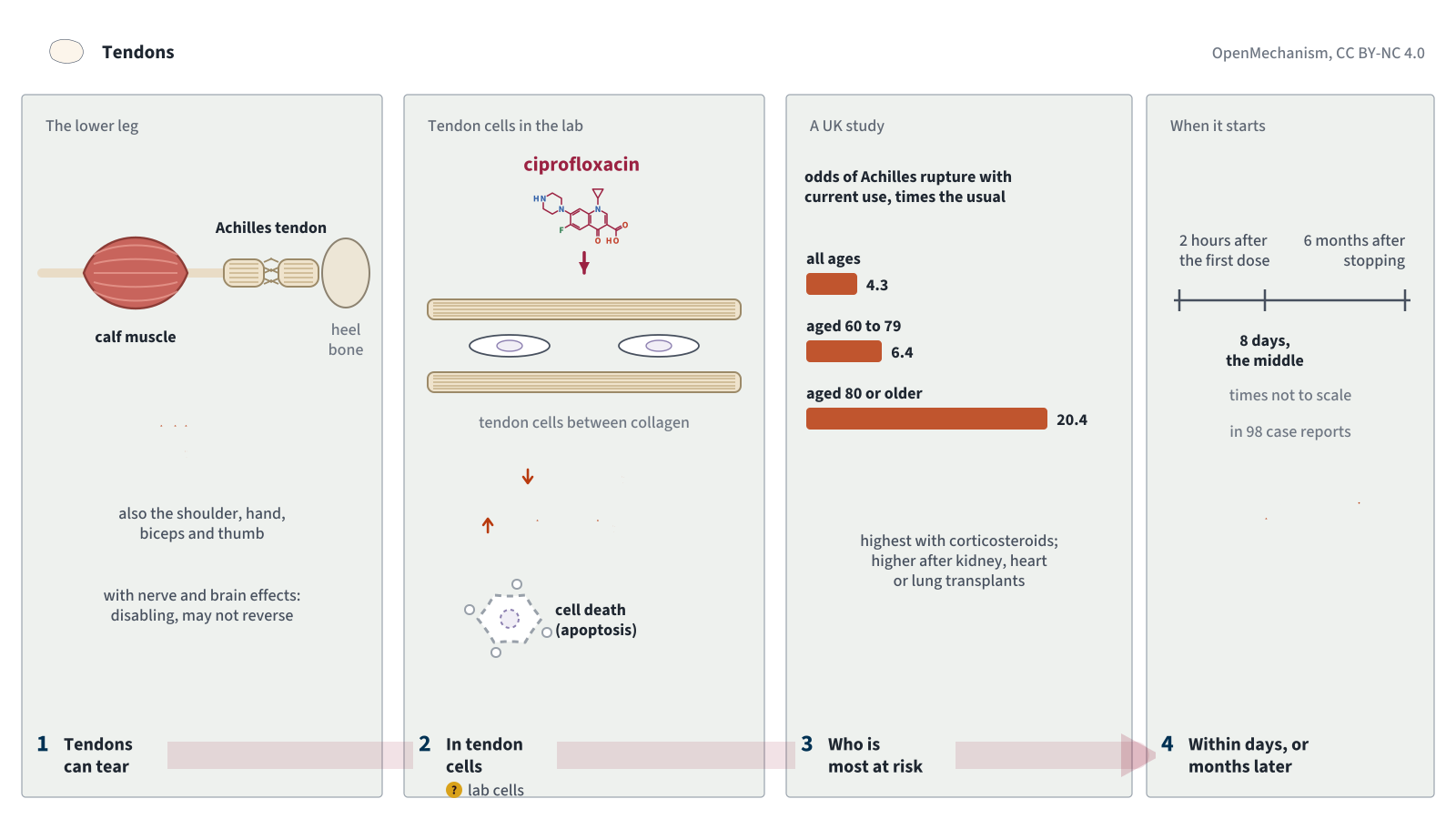
Fluoroquinolone antibiotics such as ciprofloxacin raise the risk of tendinitis and tendon rupture, most often of the Achilles tendon, at any age. In tendon cells grown in the lab, ciprofloxacin cut collagen, raised the enzymes that break the tendon's matrix down and triggered cell death. The risk is highest over 60 and with corticosteroids.
- Kind
- Side effect
- Medicines
- Ciprofloxacin
- Sources
- 6
Step 2: lab cells
The Corps 2002 study says: Ciprofloxacin can selectively enhance MMP expression in tendon-derived cells. Such effects might compromise tendon microstructure and integrity.
Clinical study: In a UK case-control study of 1,367 people with a first Achilles tendon rupture and 50,000 controls, which measured the odds of rupture with quinolone use, not what happens in the tendon: The adjusted odds ratio (OR) for Achilles tendon rupture was 4.3 (95% confidence interval [CI], 2.4-7.8) for current exposure to quinolones, 2.4 (95% CI, 1.5-3.7) for recent exposure, and 1.4 (95% CI, 0.9-2.1) for past exposure. … Approximately 2% to 6% of all Achilles tendon ruptures in people older than 60 years can be attributed to quinolones.<h4>Conclusions</h4>Current exposure to quinolones increased the risk of Achilles tendon rupture.
van der Linden PD et al., Arch Intern Med 2003 (PMID 12912715)
This study was picked with a literature search and is not yet checked by our reviewer.
For teachers: download this drawing.
Step by step
Tendons can tear. Fluoroquinolones, ciprofloxacin among them, raise the risk of tendinitis and tendon rupture at all ages, in the Achilles tendon most often but also the shoulder, hand, biceps and thumb. With nerve and brain effects, these harms can be disabling and may not reverse.1
What the source says
“Fluoroquinolones, including CIPRO, have been associated with an increased risk of tendinitis and tendon rupture in all ages [see Warnings and Precautions ( 5.1 ) and Adverse Reactions ( 6.2 )] .”
Source 1“This adverse reaction most frequently involves the Achilles tendon, and has also been reported with the rotator cuff (the shoulder), the hand, the biceps, the thumb, and other tendons.”
Source 1“Fluoroquinolones, including CIPRO ® , have been associated with disabling and potentially irreversible serious adverse reactions that have occurred together [see Warnings and Precautions ( 5.1 )], including: • Tendinitis and tendon rupture [see Warnings and Precautions ( 5.2 )].”
Source 1In tendon cells. In human tendon cells grown in the lab, ciprofloxacin cut type I collagen, raised the matrix metalloproteinases that break down the tendon's matrix, and set off apoptosis, a programmed cell death; it also amplified the matrix-degrading enzyme that an inflammatory signal switches on. Such effects might weaken the tendon's structure.2,3
What the source says
“At concentrations, which are achievable during quinolone therapy, 3mg ciprofloxacin/L medium significantly decreased type I collagen; similar changes were observed with 3mg ciprofloxacin or 10mg levofloxacin/L medium for the beta(1)- integrin receptors.”
Source 2“Furthermore, time- and concentration-dependent increases of matrix metalloproteinases as well as of the apoptosis marker activated caspase-3 were found.”
Source 2“Our results provide evidence that besides changes in receptor and signalling proteins apoptosis has to be considered as a final event in the pathogenesis of fluoroquinolone-induced tendopathies.”
Source 2“Preincubation with ciprofloxacin potentiated IL-1beta-stimulated MMP-3 output, reflecting a similar effect on MMP-3 mRNA expression.”
Source 3“Ciprofloxacin can selectively enhance MMP expression in tendon-derived cells. Such effects might compromise tendon microstructure and integrity.”
Source 3Who is most at risk. The risk is higher over 60, with corticosteroids and after a kidney, heart or lung transplant; strenuous activity, kidney failure and earlier tendon disorders may add to it, but it also happens without these. In a UK study, current use raised the odds of Achilles rupture 4.3 times overall, 6.4 times at 60 to 79 and 20.4 times at 80 or older, most of all with corticosteroids.1,4
What the source says
“The risk of developing fluoroquinolone-associated tendinitis and tendon rupture is increased in patients over 60 years of age, in patients taking corticosteroid drugs, and in patients with kidney, heart or lung transplants.”
Source 1“Other factors that may independently increase the risk of tendon rupture include strenuous physical activity, renal failure, and previous tendon disorders such as rheumatoid arthritis.”
Source 1“Tendinitis and tendon rupture have also occurred in patients taking fluoroquinolones who do not have the above risk factors.”
Source 1“The adjusted odds ratio (OR) for Achilles tendon rupture was 4.3 (95% confidence interval [CI], 2.4-7.8) for current exposure to quinolones”
Source 4“The OR of Achilles tendon rupture was 6.4 (95% CI, 3.0-13.7) in patients aged 60 to 79 years and 20.4 (95% CI, 4.6-90.1) in patients aged 80 years or older.”
Source 4“The risk is highest among elderly patients who were concomitantly treated with corticosteroids.”
Source 4Within days, or months later. It can start within hours or days of starting ciprofloxacin, or months after the course has ended, and can affect both sides. In 98 case reports the median time was 8 days, from 2 hours after the first dose to 6 months after stopping, and up to half of the tendons ruptured.1,5
What the source says
“Tendinitis or tendon rupture can occur, within hours or days of starting CIPRO, or as long as several months after completion of fluoroquinolone therapy.”
Source 1“Tendinitis and tendon rupture can occur bilaterally.”
Source 1“Ninety-eight case reports were available for review.”
Source 5“The median duration of fluoroquinolone treatment before the onset of tendon injury was 8 days, although symptoms occurred as early as 2 hours after the first dose and as late as 6 months after treatment was stopped.”
Source 5“Up to one-half of patients experienced tendon rupture, and almost one-third received long-term corticosteroid therapy.”
Source 5
See also
Medicine pages: ciprofloxacin.
Other side effects (infections): why amphotericin B can harm the kidneys; why antibiotics can cause C. difficile diarrhea; why fast vancomycin infusions cause flushing; why gentamicin can damage hearing and balance; why isoniazid can damage nerves; why linezolid can cause lactic acidosis and nerve damage; why tetracyclines can stain developing teeth; why trimethoprim can raise potassium; why vancomycin can harm the kidneys; and all 65 side effects.
Interactions: tizanidine with ciprofloxacin or fluvoxamine; and antibiotics and antacids, calcium or iron.
Conditions: myasthenia gravis and urinary tract infections.
Sources
- 1Cipro (ciprofloxacin): FDA labelBoxed Warning; 5.2 Tendinitis and Tendon Rupture. Saved copy
- 2Fluoroquinolones cause changes in extracellular matrix, signalling proteins, metalloproteinases and caspase-3 in cultured human tendon cellsSendzik J et al. Toxicology 2005 (abstract). Saved copy
- 3Ciprofloxacin enhances the stimulation of matrix metalloproteinase 3 expression by interleukin-1beta in human tendon-derived cellsCorps AN et al. Arthritis Rheum 2002 (abstract). Saved copy
- 4Increased risk of Achilles tendon rupture with quinolone antibacterial use, especially in elderly patients taking oral corticosteroidsvan der Linden PD et al. Arch Intern Med 2003 (abstract). Saved copy
- 5Fluoroquinolone-associated tendinopathy: a critical review of the literatureKhaliq Y, Zhanel GG. Clin Infect Dis 2003 (abstract). Saved copy
- 6Tendon injury and fluoroquinolone use: a systematic reviewStephenson AL et al. Drug Saf 2013 (abstract). Saved copy
Notes and limits
- The evidence comes from observational studies that may undercount tendon injury; the complication appears to be rare.6
- Because of these harms, the label keeps ciprofloxacin for people with no other option when the infection is a flare of chronic bronchitis, a simple bladder infection or sinusitis, and warns that it may worsen myasthenia gravis.1
Notes that apply to every page are on How to read a page.
Spotted a mistake? Report an error (hello@openmechanism.com). Since launch, every published error we fix is listed on the corrections page.
Cite this page
Tran D. Why fluoroquinolones such as ciprofloxacin can damage tendons [Internet]. OpenMechanism; 2026 [updated 2026 Oct 20; cited 2026 Oct 20]. Available from: https://openmechanism.com/explained/fluoroquinolones-and-tendons