Why amphotericin B can harm the kidneys
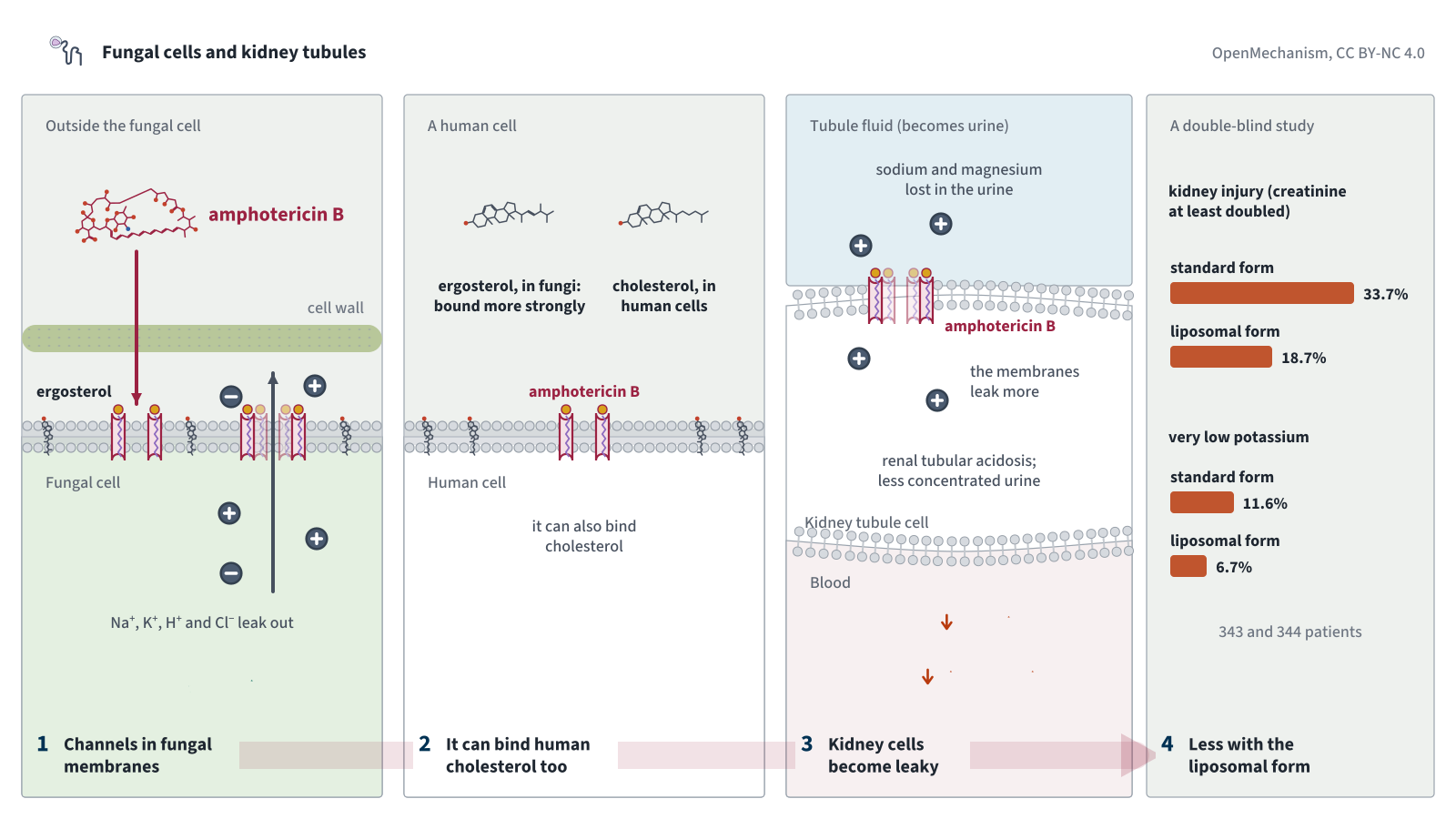
Amphotericin B kills fungi by binding ergosterol in their cell membranes and forming channels that let ions leak out. It binds the cholesterol of human cell membranes less strongly, but enough to harm cells. In the kidneys it makes cell membranes leakier: potassium in the blood falls, sodium and magnesium are lost in the urine, and kidney function falls. In one double-blind study, kidney injury was less common with the liposomal form (18.7% against 33.7%).
- Kind
- Side effect
- Medicines
- Amphotericin B
- Sources
- 4
For teachers: download this drawing.
Step by step
Channels in fungal membranes. Amphotericin B binds ergosterol, the sterol in fungal cell membranes, and forms channels through the membrane. Singly charged ions (sodium, potassium, hydrogen and chloride) leak out through them, and the fungal cell dies.1
What the source says
“Amphotericin B, the active ingredient of amphotericin B liposome for injection, acts by binding to the sterol component, ergosterol, of the cell membrane of susceptible fungi.”
Source 1“It forms transmembrane channels leading to alterations in cell permeability through which monovalent ions (Na + , K + , H + , and Cl - ) leak out of the cell resulting in cell death.”
Source 1It can bind human cholesterol too. Amphotericin B binds ergosterol more strongly, but it can also bind cholesterol, the sterol in human cell membranes, and harm the cells. The label for the standard form says it has been suggested that the damage to human cells and to fungal cells may share common mechanisms.1,2
What the source says
“While amphotericin B has a higher affinity for the ergosterol component of the fungal cell membrane, it can also bind to the cholesterol component of the mammalian cell leading to cytotoxicity.”
Source 1“Mammalian cell membranes also contain sterols and it has been suggested that the damage to human cells and fungal cells may share common mechanisms.”
Source 2Kidney cells become leaky. In the kidneys, amphotericin B acts directly on cell membranes to make them more permeable. A 1990 review lists what follows, to varying degrees, in almost all patients given the medicine: low potassium in the blood, sodium and magnesium lost in the urine, renal tubular acidosis, urine that is less concentrated, and falling kidney function. Its other effects on the kidney presumably also lower the kidney's blood flow and filtration.2,3
What the source says
“Amphotericin B-induced nephrotoxicity is manifested as azotaemia, renal tubular acidosis, impaired renal concentrating ability and electrolyte abnormalities like hypokalaemia and sodium and magnesium wasting.”
Source 3“All these abnormalities occur to varying degrees in almost all patients receiving the drug.”
Source 3“The mechanism of nephrotoxicity involves direct cell membrane actions to increase permeability, as well as indirect effects secondary to activation of intrarenal mechanisms (tubuloglomerular feedback) and/or release of mediators (thromboxane A2).”
Source 3“The latter effects are presumably responsible for the observed acute decreases in renal blood flow and filtration rate”
Source 3“Renal: decreased renal function and renal function abnormalities including: azotemia, hypokalemia, hyposthenuria, renal tubular acidosis; and nephrocalcinosis.”
Source 2Less with the liposomal form. In a double-blind study of 343 patients on the liposomal form and 344 on the standard form, kidney injury (creatinine at least doubling) was less common with the liposomal form, 18.7% against 33.7%, and so was very low potassium, 6.7% against 11.6%. Lipid forms may protect by changing how strongly amphotericin B binds human cell membranes.1,4
What the source says
“Incidence of nephrotoxicity, mean peak serum creatinine concentration, mean change from baseline in serum creatinine, and incidence of hypokalemia in the double-blind, randomized study were lower in the amphotericin B liposome for injection group”
Source 1“Nephrotoxicity was defined as creatinine values increasing 100% or more over pretreatment levels in pediatric patients, and creatinine values increasing 100% or more over pretreatment levels in adult patients, provided the peak creatinine concentration was >1.2 mg/dL.”
Source 1“Total number of patients receiving at least one dose of study drug 343 344 Nephrotoxicity 64 (18.7%) 116 (33.7%)”
Source 1“Hypokalemia was defined as potassium levels ≤ 2.5 mmol/L any time during treatment.”
Source 1“Hypokalemia 23 (6.7%) 40 (11.6%)”
Source 1“Liposomal AmB and the formulation of an emulsion of AmB in lipid may provide a protective effect based on altering the affinity of AmB for mammalian cell membranes”
Source 4
See also
Medicine pages: amphotericin B.
Other side effects (infections): why antibiotics can cause C. difficile diarrhea; why fast vancomycin infusions cause flushing; why fluoroquinolones such as ciprofloxacin can damage tendons; why gentamicin can damage hearing and balance; why isoniazid can damage nerves; why linezolid can cause lactic acidosis and nerve damage; why tetracyclines can stain developing teeth; why trimethoprim can raise potassium; why vancomycin can harm the kidneys; and all 65 side effects.
Conditions: invasive fungal infections and leishmaniasis.
Sources
- 1Amphotericin B liposome for injection (Avet): FDA labelMechanism of Action; Adverse Reactions (Study 94-0-002, Clinical Laboratory Values). Saved copy
- 2Amphotericin B for injection (XGen): FDA labelClinical Pharmacology; Adverse Reactions. Saved copy
- 3Amphotericin B nephrotoxicitySabra R et al. Drug Saf 1990 (abstract). Saved copy
- 4Amphotericin B nephrotoxicity: the adverse consequences of altered membrane propertiesSawaya BP et al. J Am Soc Nephrol 1995 (abstract). Saved copy
Notes and limits
- These kidney changes usually improve when treatment stops, but some permanent damage often occurs, especially after large amounts (over 5 g) or with other medicines that harm the kidneys.2
- A 1995 review says that less blood flow to the kidneys appears to play a major role in the fall in filtration.4
Notes that apply to every page are on How to read a page.
Spotted a mistake? Report an error (hello@openmechanism.com). Since launch, every published error we fix is listed on the corrections page.
Cite this page
Tran D. Why amphotericin B can harm the kidneys [Internet]. OpenMechanism; 2026 [updated 2026 Oct 20; cited 2026 Oct 20]. Available from: https://openmechanism.com/explained/amphotericin-b-and-the-kidneys