Why sulfonylureas can cause low blood sugar
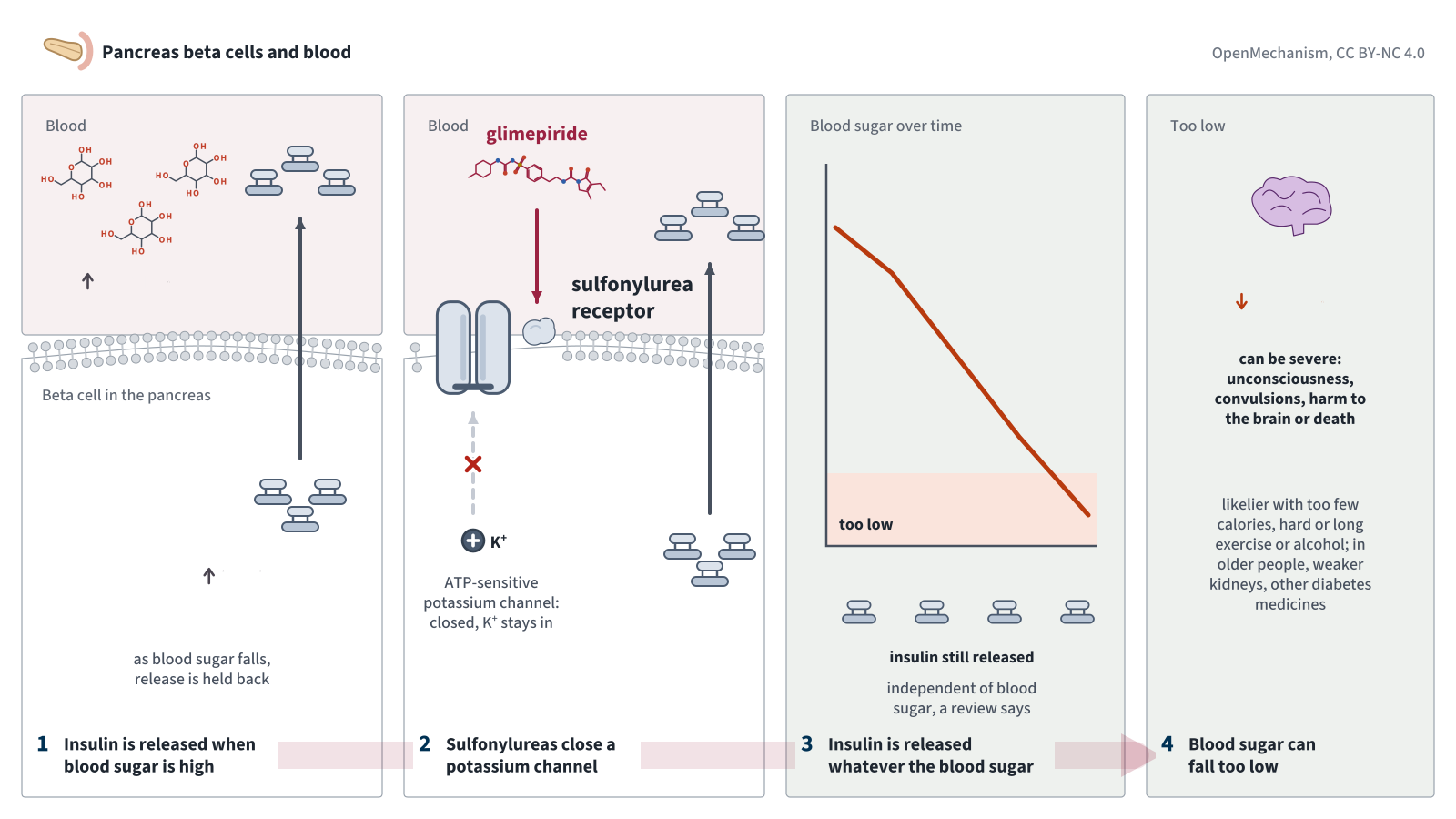
Normally the pancreas's beta cells release insulin when blood sugar is high and hold it back as blood sugar falls. Sulfonylureas such as glipizide and glimepiride close a potassium channel on the beta cells, which makes them release insulin independent of blood sugar. Blood sugar can then fall too low (hypoglycemia), sometimes severely, and more often with too little food, hard exercise or alcohol.
- Kind
- Side effect
- Medicines
- Glipizide, Glimepiride
- Sources
- 6
For teachers: download this drawing.
Step by step
Insulin is released when blood sugar is high. The pancreas's beta cells make insulin. High blood sugar makes them release it, insulin helps body cells take up sugar, and as blood sugar falls, insulin release is held back.1,2,3
What the source says
“the high metabolic rate required by beta-cells to synthesize and secrete insulin”
Source 1“Pancreatic islet α-cell glucagon secretion is critically dependent on pancreatic islet β-cell insulin secretion.”
Source 2“an increase in the plasma glucose concentration, among other stimuli, causes an increase in β-cell insulin secretion”
Source 2“Insulin and its analogs lower blood glucose by stimulating peripheral glucose uptake, especially by skeletal muscle and fat, and by inhibiting hepatic glucose production.”
Source 3“Normally, a decrease in the plasma glucose concentration causes a decrease in β-cell insulin secretion”
Source 2Sulfonylureas close a potassium channel. Sulfonylureas bind the sulfonylurea receptor on the beta cell, which closes its and makes it release insulin. This is mainly how glipizide and glimepiride lower blood sugar; the glipizide label adds that it needs working beta cells.4,5
What the source says
“Glimepiride primarily lowers blood glucose by stimulating the release of insulin from pancreatic beta cells.”
Source 4“Sulfonylureas bind to the sulfonylurea receptor in the pancreatic beta-cell plasma membrane, leading to closure of the ATP-sensitive potassium channel, thereby stimulating the release of insulin.”
Source 4“Glipizide primarily lowers blood glucose by stimulating the release of insulin from the pancreas, an effect dependent upon functioning beta cells in the pancreatic islets.”
Source 5Insulin is released whatever the blood sugar. A review describes sulfonylureas as making the beta cells release insulin independent of blood sugar, and says they cause hypoglycemia. Insulin lowers blood sugar by helping cells take it up.3,6
What the source says
“Classical insulin-secreting agents such as sulfonlyureas stimulate insulin secretion independent of glucose and cause hypoglycemia.”
Source 6“Insulin and its analogs lower blood glucose by stimulating peripheral glucose uptake, especially by skeletal muscle and fat, and by inhibiting hepatic glucose production.”
Source 3Blood sugar can fall too low. All sulfonylureas can cause severe hypoglycemia, which can lead to unconsciousness or convulsions and to temporary or lasting harm to the brain, or death. It is more likely with too few calories, after hard or long exercise, or with alcohol, and in older people, people with weaker kidneys and people taking other diabetes medicines.4,5
What the source says
“All sulfonylureas, including glimepiride, can cause severe hypoglycemia”
Source 4“Severe hypoglycemia can lead to unconsciousness or convulsions and may result in temporary or permanent impairment of brain function or death.”
Source 4“Hypoglycemia is also more likely to occur when caloric intake is deficient, after severe or prolonged exercise, or when alcohol is ingested.”
Source 4“patients who may be predisposed to hypoglycemia (e.g., the elderly, patients with renal impairment, patients on other anti-diabetic medications)”
Source 4“All sulfonylurea drugs, including GLUCOTROL XL, are capable of producing severe hypoglycemia”
Source 5
See also
Medicine pages: glipizide and glimepiride.
Other side effects (hormones & metabolism): why GLP-1 medicines slow the stomach; why insulin and albuterol can lower potassium; why metformin can cause lactic acidosis; why SGLT2 inhibitors can cause genital yeast infections; why steroid medicines can raise blood sugar; why steroid medicines can suppress the adrenal glands; why steroid medicines can weaken bones; and all 65 side effects.
Conditions: type 2 diabetes and low blood sugar (hypoglycemia).
The medicine in the body: what the body does with metformin.
Interactions: why beta-blockers can hide low blood sugar.
Sources
- 1The importance of intra-islet communication in the function and plasticity of the islets of Langerhans during health and diabetesHill TG, Hill DJ. Int J Mol Sci 2024 (abstract). Saved copy
- 2Minireview: glucagon in the pathogenesis of hypoglycemia and hyperglycemia in diabetesCryer PE. Endocrinology 2012 (abstract). Saved copy
- 3Lantus (insulin glargine): FDA label12.1 Mechanism of Action. Saved copy
- 4Glimepiride tablets: FDA label5.1 Hypoglycemia; 12.1 Mechanism of Action. Saved copy
- 5Glucotrol XL (glipizide): FDA label5.1 Hypoglycemia; 12.1 Mechanism of Action. Saved copy
- 6Investigational insulin secretagogues for type 2 diabetesScheen AJ. Expert Opin Investig Drugs 2016 (abstract). Saved copy
Notes and limits
- The labels' doses and management advice are left out: this page explains the mechanism, not what to do.
- The labels do not say that insulin release goes on when blood sugar is low; that comes from a review.
- Low blood sugar's warning signs may be different or weaker in older people, in people with autonomic neuropathy (damage to the nerves that run the body's automatic functions) and in people taking beta-blockers or similar medicines, so it can become severe before it is noticed.4
- Weak, poorly nourished people and people with adrenal, pituitary or liver problems are particularly susceptible.4
Notes that apply to every page are on How to read a page.
Spotted a mistake? Report an error (hello@openmechanism.com). Since launch, every published error we fix is listed on the corrections page.
Cite this page
Tran D. Why sulfonylureas can cause low blood sugar [Internet]. OpenMechanism; 2026 [updated 2026 Nov 13; cited 2026 Nov 13]. Available from: https://openmechanism.com/explained/sulfonylureas-and-low-blood-sugar