Ondansetron
Chemotherapy appears to be associated with the release of serotonin from cells of the small intestine, and the serotonin may start the vomiting reflex through on the vagus nerve. Ondansetron selectively blocks 5-HT3 receptors, found on vagal nerve endings and in the chemoreceptor trigger zone (area postrema); the label says it is not certain whether it acts there, on the nerve endings or both. The label for ondansetron tablets lists them for preventing nausea and vomiting with cancer chemotherapy that is highly likely to cause vomiting (including cisplatin at 50 mg/m² or more), with first and repeat courses of chemotherapy moderately likely to cause it, and with radiotherapy to the whole body, or to the abdomen in one high dose or in daily doses, and for preventing nausea or vomiting after surgery.
- Acts on
- Serotonin 5-HT3 receptors
- Where
- The gut, the vagus nerve and the chemoreceptor trigger zone
- Medicine type
- Small molecule
- Used for
- Digestion
- Drug class
- 5-HT3 receptor antagonists
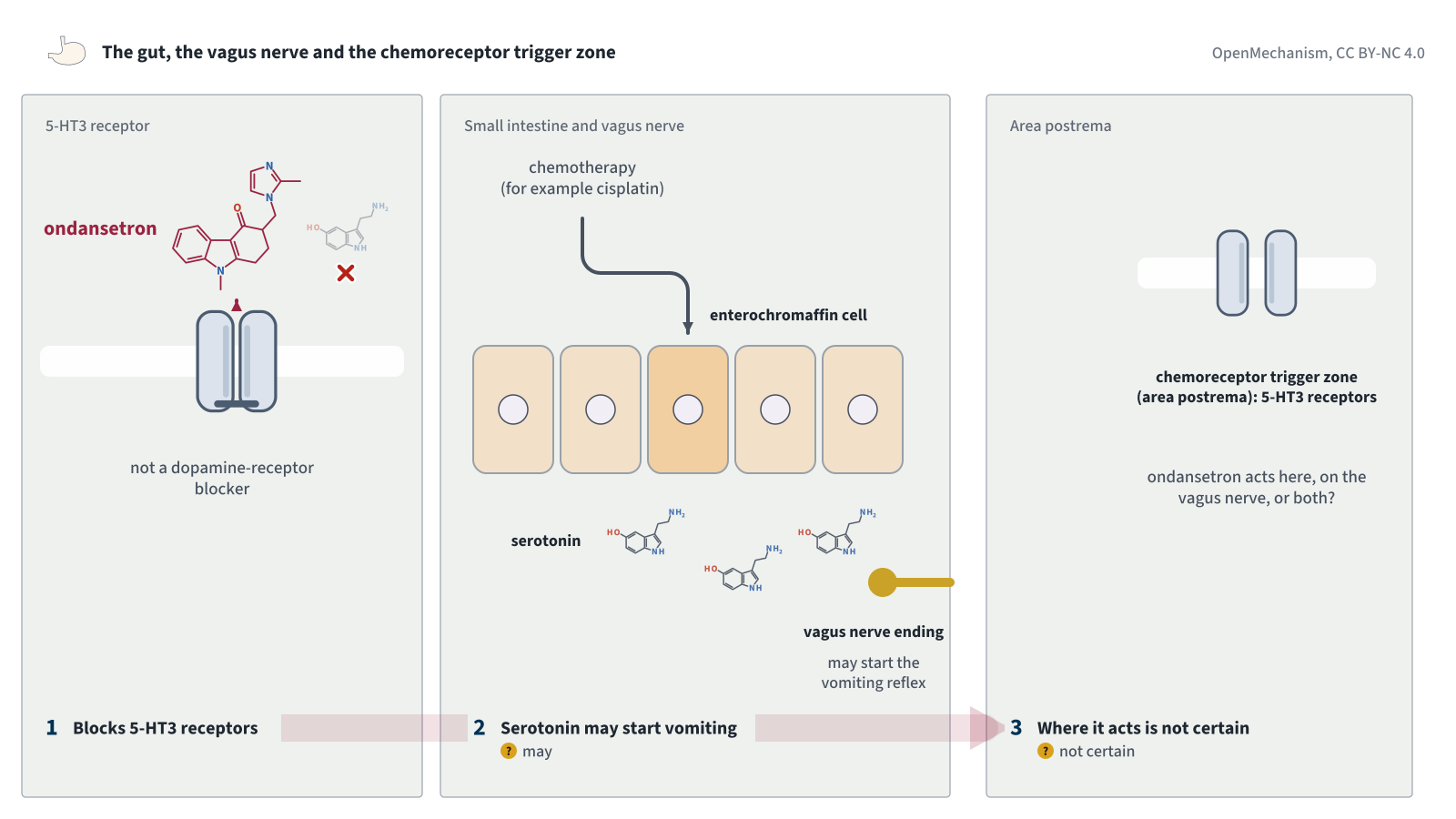
Step 2: may
The ondansetron tablets label says: However, cytotoxic chemotherapy appears to be associated with release of serotonin from the enterochromaffin cells of the small intestine. … The released serotonin may stimulate the vagal afferents through the 5-HT 3 receptors and initiate the vomiting reflex.
Source 1: Ondansetron tablets: FDA label, 1 Indications and Usage; 12.1 Mechanism of Action
Clinical study: In a 1990 trial comparing ondansetron (three doses of 0.15 mg per kilogram of body weight into a vein, four hours apart, starting 30 minutes before cisplatin) with placebo in 28 people with cancer given cisplatin: The urinary excretion of 5-hydroxyindoleacetic acid, the main metabolite of serotonin, was increased in all patients two to six hours after they received cisplatin chemotherapy, and the increases paralleled the episodes of emesis.
Cubeddu LX et al., N Engl J Med 1990 (PMID 1689807)
Step 3: not certain
The ondansetron tablets label says: While its mechanism of action has not been fully characterized, ondansetron is not a dopamine-receptor antagonist. … It is not certain whether ondansetron’s antiemetic action is mediated centrally, peripherally, or in both sites.
Source 1: Ondansetron tablets: FDA label, 1 Indications and Usage; 12.1 Mechanism of Action
Clinical study: In a 1990 double-blind crossover trial in 97 people with cancer who had not had chemotherapy before and were to receive cisplatin (80 to 100 mg per square meter of body-surface area), ondansetron was compared with high-dose metoclopramide; the trial measured acute vomiting and nausea, not where ondansetron acts: Among the 76 patients who satisfactorily completed both parts of the study, complete or nearly complete control of emesis (i.e., no episodes of emesis occurred, or only one or two) was achieved in 57 of 76 treatments (75 percent) with ondansetron and in 32 of 76 treatments (42 percent) with metoclopramide (P less than 0.001).
Marty M et al., N Engl J Med 1990 (PMID 2137902)
Key terms in this drawing
- 5-HT3 receptor
- Serotonin 3 receptor. A serotonin receptor on vagus nerve endings and in the brain's vomiting trigger zone; ondansetron blocks it.
How it works
Blocks 5-HT3 receptors. Ondansetron selectively blocks (antagonizes) 5-HT3 ; it is not a dopamine-receptor blocker. 5-HT3 receptors are found on the endings of the vagus nerve and in the chemoreceptor trigger zone (area postrema).1
Serotonin may start vomiting. Cancer chemotherapy appears to be associated with the release of serotonin from cells of the small intestine (enterochromaffin cells); in people given cisplatin, a serotonin breakdown product (5-HIAA) rises in the urine as vomiting begins. The released serotonin may stimulate the vagus nerve through 5-HT3 receptors and start the vomiting reflex.1,2
Where it acts is not certain. The label says ondansetron's mechanism has not been fully characterized and that it is not certain whether it prevents vomiting by acting in the chemoreceptor trigger zone, on the vagus nerve endings, or in both places.1
For teachers: download this drawing.
See also
Condition pages: chemotherapy nausea and vomiting.
Explained: why some medicines lengthen the QT interval.
Related drawings: aprepitant (blocks NK1 receptors and adds to ondansetron's effect).
Sources
- 1Ondansetron tablets: FDA label1 Indications and Usage; 12.1 Mechanism of Action
- 2Efficacy of ondansetron (GR 38032F) and the role of serotonin in cisplatin-induced nausea and vomitingCubeddu LX et al., N Engl J Med 1990 (abstract)
- 3ChEMBL CHEMBL46Target and action classification: Serotonin 3a (5-HT3a) receptor antagonist
- 4Comparison of the 5-hydroxytryptamine3 (serotonin) antagonist ondansetron (GR 38032F) with high-dose metoclopramide in the control of cisplatin-induced emesisMarty M et al. N Engl J Med 1990 (abstract)
Spotted a mistake? Report an error (hello@openmechanism.com). Since launch, every published error we fix is listed on the corrections page.
Notes and limits
- A schematic teaching drawing: not to scale, not exact structures, binding poses or a complete pathway, and not a guide to dosing, treatment or how a person will respond.
- The label says chemotherapy appears to be associated with release of serotonin, and that the released serotonin may stimulate the vagal afferents through 5-HT3 receptors and initiate the vomiting reflex.
- The label says ondansetron's mechanism of action has not been fully characterized, and that it is not certain whether its antiemetic action is mediated centrally, peripherally, or in both sites.
All recorded limits are on the evidence page, and notes that apply to every page are on How to read a page. Version 1.0.1, medically reviewed by Daniel Tran, PharmD, on 14 November 2026.
Cite this page
Tran D. Ondansetron [Internet]. OpenMechanism; 2026 [updated 2026 Nov 14; cited 2026 Nov 14]. Available from: https://openmechanism.com/medicines/ondansetron