Aprepitant
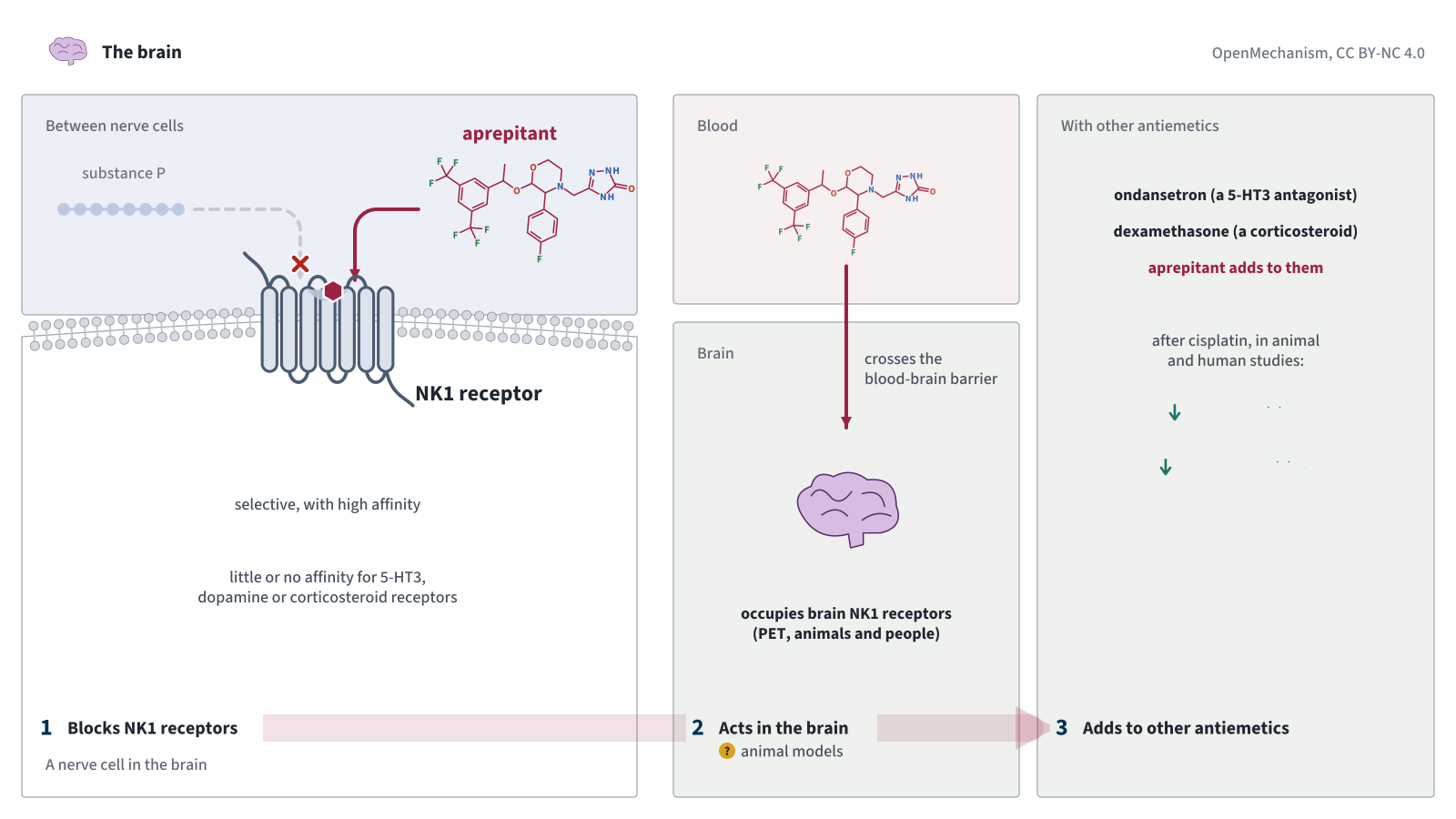
Aprepitant selectively blocks substance P/neurokinin 1 (NK1) receptors and has little or no for the serotonin, dopamine and corticosteroid receptors that other antiemetics act on. It crosses into the brain and occupies NK1 receptors there; in animal models it blocked vomiting caused by chemotherapy through these central actions. With ondansetron and dexamethasone, it blocks both the acute and the delayed phase of vomiting after cisplatin.
- Acts on
- Substance P/neurokinin 1 (NK1) receptors
- Where
- The brain
- Medicine type
- Small molecule
- Used for
- Digestion
Also called Emend.
Step 2: animal models
The Emend label says: Aprepitant has been shown in animal models to inhibit emesis induced by cytotoxic chemotherapeutic agents, such as cisplatin, via central actions.
Clinical study: In a randomized, double-blind trial in patients given high-dose cisplatin for the first time, adding aprepitant to ondansetron and dexamethasone; the trial measured how many had no vomiting and no rescue treatment, not how aprepitant works: The percentage of patients with complete response on days 1 to 5 was significantly higher in the aprepitant group (72.7% [n = 260] v 52.3% in the standard therapy group [n = 260])
Hesketh PJ et al., J Clin Oncol 2003 (PMID 14559886)
This study was picked with a literature search and is not yet checked by our reviewer.
Key terms in this drawing
- 5-HT3 receptor
- Serotonin 3 receptor. A serotonin receptor on vagus nerve endings and in the brain's vomiting trigger zone; ondansetron blocks it.
- affinity
- Binding affinity. How strongly a molecule binds its target.
- antagonist
- Antagonist. A molecule that blocks a receptor (or another target). Irbesartan, for example, binds its receptor without activating it.
How it works
Blocks NK1 receptors. Aprepitant selectively blocks substance P/neurokinin 1 (NK1) receptors with high affinity. It has little or no affinity for serotonin (), dopamine or corticosteroid receptors, the targets of other medicines for chemotherapy-induced nausea and vomiting.1
Acts in the brain. It crosses the blood-brain barrier and occupies NK1 receptors in the brain, as PET studies in animals and people show. In animal models it blocked vomiting caused by chemotherapy such as cisplatin through these central actions.1
Adds to other antiemetics. In animal and human studies it added to the antiemetic effect of ondansetron, a 5-HT3 , and dexamethasone, a corticosteroid, and blocked both the acute and the delayed phase of vomiting after cisplatin.1
For teachers: download this drawing.
See also
Condition pages: chemotherapy nausea and vomiting.
Related drawings: ondansetron (blocks 5-HT3 receptors; aprepitant adds to its effect).
Sources
- 1Emend (aprepitant): FDA label1 Indications and Usage; 12.1 Mechanism of Action; 12.2 Pharmacodynamics
- 2ChEMBL CHEMBL1471Target and action classification: Neurokinin 1 receptor antagonist
- 3The oral neurokinin-1 antagonist aprepitant for the prevention of chemotherapy-induced nausea and vomiting: a multinational, randomized, double-blind, placebo-controlled trial in patients receiving high-dose cisplatin--the Aprepitant Protocol 052 Study GroupHesketh PJ et al. J Clin Oncol 2003 (abstract)
Spotted a mistake? Report an error (hello@openmechanism.com). Since launch, every published error we fix is listed on the corrections page.
Notes and limits
- A schematic teaching drawing: not to scale, not exact structures, binding poses or a complete pathway, and not a guide to dosing, treatment or how a person will respond.
- How fully the usual doses occupy the brain's NK1 receptors has not been measured, and how occupancy relates to the effect has not been established (the label, 12.2).
- That it blocks vomiting through central actions comes from animal models (the label, 12.1).
All recorded limits are on the evidence page, and notes that apply to every page are on How to read a page. Version 1.0.0, not yet medically reviewed.
Cite this page
Tran D. Aprepitant [Internet]. OpenMechanism; 2026 [updated 2026 Oct 18; cited 2026 Oct 18]. Available from: https://openmechanism.com/medicines/aprepitant