Tizanidine
Tizanidine stimulates in the central nervous system. The label presumes it eases spasticity by increasing presynaptic inhibition of motor neurons, mostly in polysynaptic pathways, so that spinal motor neurons are less driven. Much of each dose is broken down by the liver (mainly ) before it reaches the blood.
- Acts on
- Central alpha-2 adrenergic receptors
- Where
- Spinal cord
- Medicine type
- Small molecule
- Used for
- Muscles, bones & joints
- Drug class
- Muscle relaxants (centrally acting)
Also called Zanaflex.
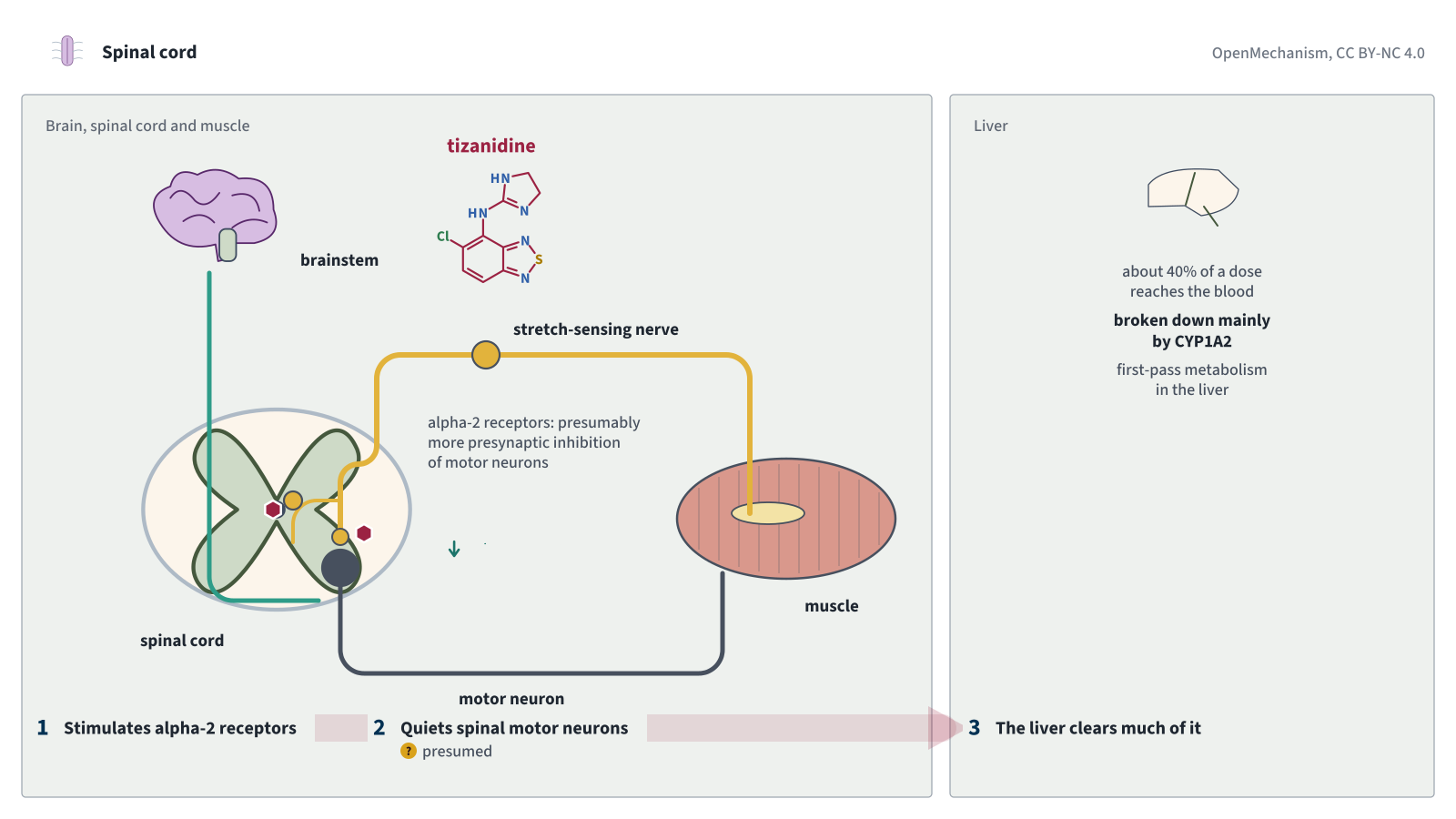
Step 2: presumed
The Zanaflex label says: Tizanidine is a central alpha-2-adrenergic receptor agonist and presumably reduces spasticity by increasing presynaptic inhibition of motor neurons. … The overall effect of these actions is thought to reduce facilitation of spinal motor neurons.
Source 1: Zanaflex (tizanidine): FDA label, 12.1 Mechanism of Action; 12.3 Pharmacokinetics
Clinical study: In a randomized, double-blind, placebo-controlled trial in spasticity caused by multiple sclerosis; the trial measured spasms and muscle tone, not how tizanidine works: Tizanidine produced a significantly greater reduction than placebo in spasms and clonus (patient diaries) but no significant differences in Ashworth scores.
Smith C et al., Neurology 1994 (PMID 7970009)
This study was picked with a literature search and is not yet checked by our reviewer.
Key terms in this drawing
- alpha-2 receptor
- Alpha-2 adrenergic receptor. An adrenergic receptor. Brimonidine switches it on and lowers the pressure inside the eye.
- CYP1A2
- Cytochrome P450 1A2. One of the cytochrome P450 enzymes that break down medicines; the main one for tizanidine.
How it works
Stimulates alpha-2 receptors. Tizanidine is a central alpha-2-adrenergic receptor .1
Quiets spinal motor neurons. It presumably reduces spasticity by increasing presynaptic inhibition of motor neurons, with the greatest effects on polysynaptic pathways; overall this is thought to reduce facilitation of spinal motor neurons.1
The liver clears much of it. It is essentially completely absorbed, but extensive first-pass metabolism in the liver leaves an oral bioavailability of about 40%; about 95% of a dose is metabolized, mainly by CYP1A2.1
For teachers: download this drawing.
See also
Condition pages: spasticity and dystonia.
Other muscle relaxants (centrally acting): baclofen, cyclobenzaprine and methocarbamol.
Explained: tizanidine with ciprofloxacin or fluvoxamine.
Body system: muscles, bones & joints.
Sources
- 1Zanaflex (tizanidine): FDA label12.1 Mechanism of Action; 12.3 Pharmacokinetics
- 2ChEMBL CHEMBL1079Target and action classification: Adrenergic receptor alpha-2 agonist
- 3Tizanidine treatment of spasticity caused by multiple sclerosis: results of a double-blind, placebo-controlled trial. US Tizanidine Study GroupSmith C et al. Neurology 1994 (abstract)
Spotted a mistake? Report an error (hello@openmechanism.com). Since launch, every published error we fix is listed on the corrections page.
Notes and limits
- A schematic teaching drawing: not to scale, not exact structures, binding poses or a complete pathway, and not a guide to dosing, treatment or how a person will respond.
- The label says tizanidine presumably reduces spasticity this way, and that the overall effect is thought to reduce facilitation of spinal motor neurons.
All recorded limits are on the evidence page, and notes that apply to every page are on How to read a page. Version 1.0.0, not yet medically reviewed.
Cite this page
Tran D. Tizanidine [Internet]. OpenMechanism; 2026 [updated 2026 Oct 11; cited 2026 Oct 11]. Available from: https://openmechanism.com/medicines/tizanidine