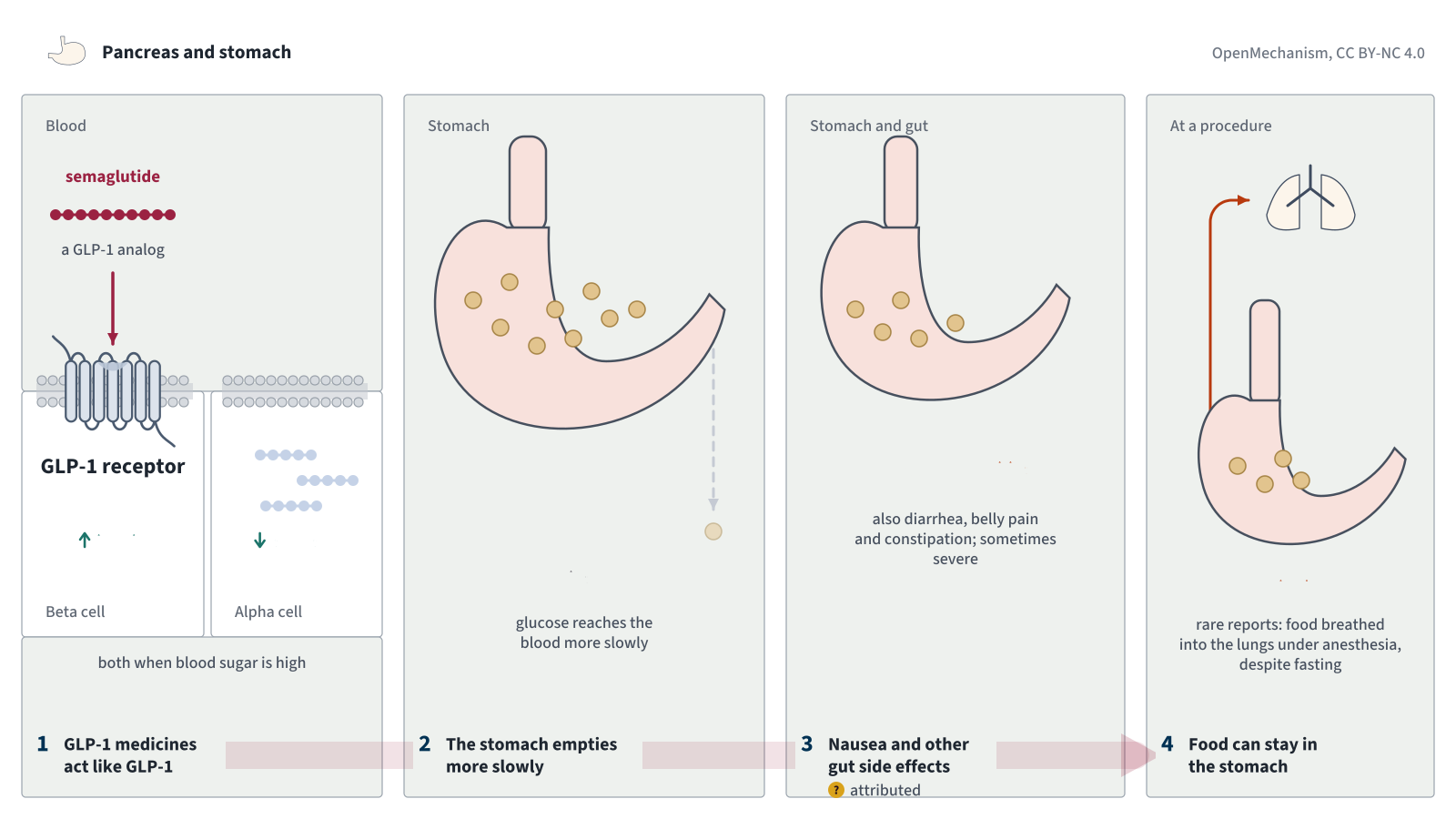
Semaglutide and the other GLP-1 medicines act like the body's own hormone GLP-1 (glucagon-like peptide-1): they raise insulin and lower glucagon when blood sugar is high, and they slow the stomach's emptying. Gut side effects such as nausea are the most common, and there have been rare reports of food left in the stomach being inhaled into the lungs during anesthesia or deep sedation.
Kalas and colleagues' 2023 paper on GLP-1 medicines and slow stomach emptying says: The most common side effects of GLP-1 receptor (GLP-1R) agonists are nausea and vomiting which have been attributed to delayed gastric emptying.
Clinical study: In Jones and colleagues' 2020 randomized physiology study, 32 healthy, overweight people took exenatide, another GLP-1 medicine, 2 mg once a week, or a placebo for 8 weeks; it measured stomach emptying by scintigraphy, and nausea: Scores for nausea were consistently low, with no difference between the EXE once weekly and PBO groups. … In healthy participants, 8 weeks' administration of the "long-acting" glucagon-like peptide-1 receptor agonist EXE, slowed gastric emptying of solids and liquids substantiallyJones KL et al., Diabetes Obes Metab 2020 (PMID 31903712)
GLP-1 medicines act like GLP-1. Semaglutide is a analog: it binds and switches on the GLP-1 receptor, the target of the body's own hormone GLP-1. When blood sugar is high, it raises insulin and lowers glucagon.1
What the source says
“Semaglutide is a GLP-1 analogue with 94% sequence homology to human GLP-1.”
“Semaglutide reduces blood glucose through a mechanism where it stimulates insulin secretion and lowers glucagon secretion, both in a glucose-dependent manner.”
The stomach empties more slowly. Semaglutide causes a minor delay in the stomach's emptying early after a meal, so glucose reaches the blood more slowly. With tirzepatide, which switches on both the and GLP-1 receptors, the delay is largest after the first dose and grows smaller over time.1,2
What the source says
“The mechanism of blood glucose lowering also involves a minor delay in gastric emptying in the early postprandial phase.”
“Semaglutide causes a delay of early postprandial gastric emptying, thereby reducing the rate at which glucose appears in the circulation postprandially.”
Nausea and other gut side effects. The most common side effects are nausea, vomiting, diarrhea, belly pain and constipation, sometimes severe, and the label does not recommend semaglutide for people with severe gastroparesis. Nausea and vomiting have been attributed to the slower emptying.3,4
What the source says
“The most common adverse reactions reported in ≥5% of patients treated with OZEMPIC are: nausea, vomiting, diarrhea, abdominal pain and constipation.”
Food can stay in the stomach. The label's warning starts from the slower emptying: there have been rare reports of food from the stomach being inhaled into the lungs during general anesthesia or deep sedation, in people whose stomachs still held food although they reported fasting. The slower emptying may also change how medicines taken by mouth are absorbed, though in the label's trials at the 1 mg dose semaglutide did not affect the absorption of the medicines tested to any clinically relevant degree.1,3
“There have been rare postmarketing reports of pulmonary aspiration in patients receiving GLP-1 receptor agonists undergoing elective surgeries or procedures requiring general anesthesia or deep sedation who had residual gastric contents despite reported adherence to preoperative fasting recommendations.”
“The potential effect of semaglutide on the absorption of co-administered oral medications was studied in trials at semaglutide 1 mg steady-state exposure. No clinically relevant drug-drug interaction with semaglutide ( Figure 4 ) was observed based on the evaluated medications”
Can raise or cause it: tirzepatide (“Tirzepatide delays gastric emptying. The delay is largest after the first dose and this effect diminishes over time.”2) and dulaglutide (“Dulaglutide causes a delay of gastric emptying. The delay in gastric emptying is dose-dependent but is attenuated with adequate dose escalation to higher doses of TRULICITY. The delay is largest after the first dose and diminishes with subsequent doses.”5).
Januvia (sitagliptin): FDA label12.1 Mechanism of Action. The drawing's beta cell, where GLP-1 raises insulin, and alpha cell, where it lowers glucagon, rest on this label. Saved copy
In one study, the 2.4 mg dose of semaglutide had no apparent effect on how fast the stomach emptied.1
The label says there are not enough data to say how to lower the risk of aspiration, including whether changing fasting before a procedure or pausing semaglutide helps.3
text d3112b71d89e…; drawings 3c3df3939c34…; notes 324c54f12d7c…
AI source check
Claude Opus 5.5 (AI source check), 30 October 2026: 26 statements compared with their sources, 7 flagged for the reviewer. An automated check, not a medical review.
Next review due
30 April 2028
Cite this page
Tran D. Why GLP-1 medicines slow the stomach [Internet]. OpenMechanism; 2026 [updated 2026 Oct 30; cited 2026 Oct 30]. Available from: https://openmechanism.com/explained/glp-1-medicines-and-the-stomach