Why SGLT2 inhibitors can cause genital yeast infections
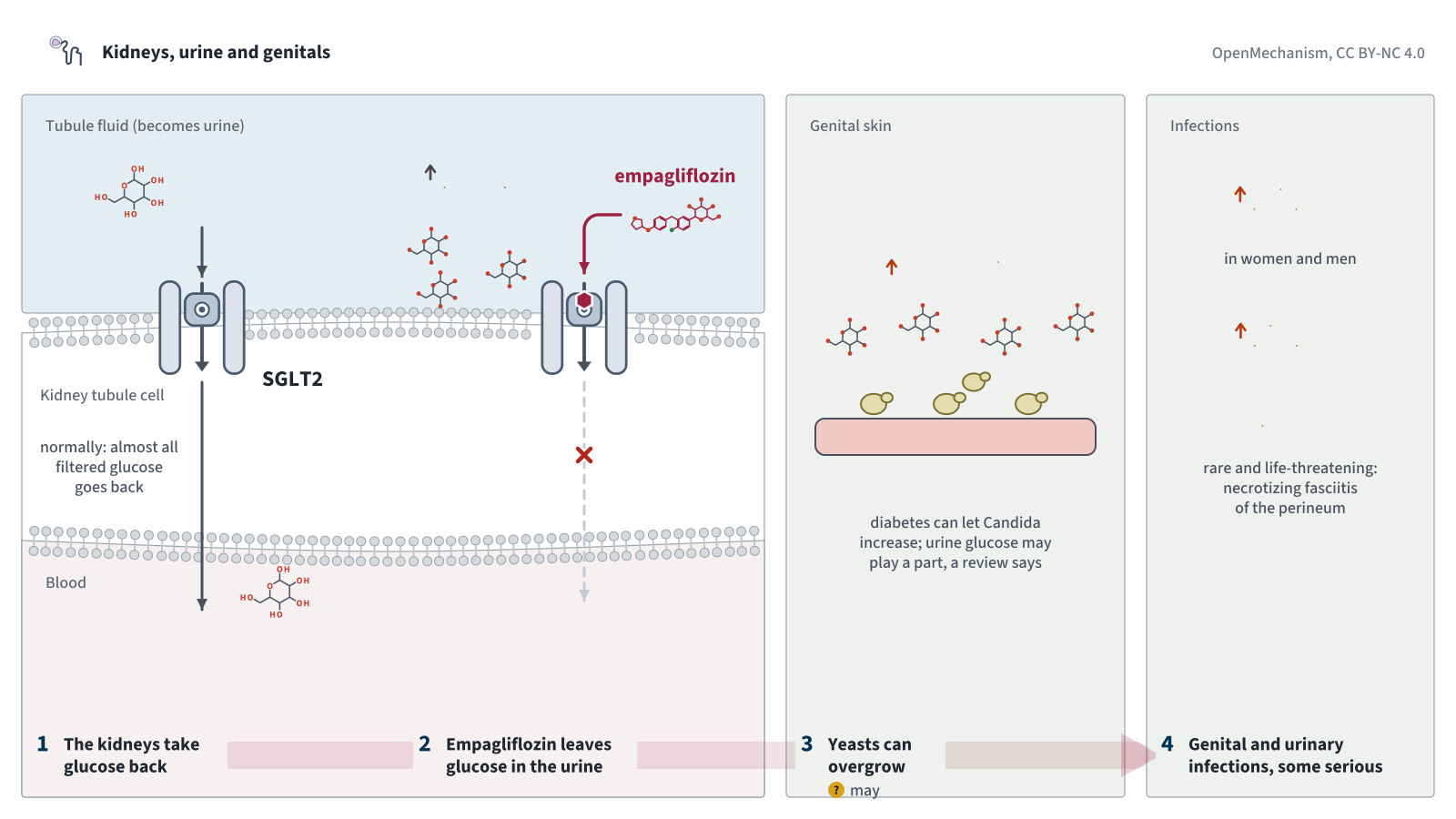
The kidneys normally take back almost all the glucose they filter, mostly through SGLT2. Empagliflozin blocks SGLT2, so more glucose leaves in the urine, and it raises the risk of genital yeast infections in women and men; the glucose in the urine may play a part. Serious genital and urinary infections, among them Fournier's gangrene, a rare but life-threatening infection, have occurred.
A 2018 review of SGLT2 inhibitors and genital infections in type 2 diabetes says: Even though abnormalities in immune system, high urine glucose, and bladder dysfunction are important contributors for the increased risk of genitourinary symptoms, yet the possible role of pharmacologically induced glucosuria cannot be completely overlooked in such patients.
Clinical study: In a 2014 analysis pooling four placebo-controlled studies of canagliflozin, another SGLT2 inhibitor, in 2,313 people with type 2 diabetes treated for about 24 weeks, the authors found: In Population 1, genital mycotic infection incidence was higher with canagliflozin 100 and 300 mg than placebo (95% confidence intervals excluded zero) in females (10.4%, 11.4%, 3.2%) and males (4.2%, 3.7%, 0.6%). These were generally mild to moderate in intensity, none were serious, and few led to discontinuation.Nyirjesy P et al., Curr Med Res Opin 2014 (PMID 24517339)
The kidneys take glucose back. Normally, almost all the glucose the kidneys filter is taken back into the blood, mostly by , the main transporter that returns it.1,2
What the source says
“Under normal circumstances, up to 180 g/day of glucose is filtered by the renal glomerulus and virtually all of it is subsequently reabsorbed in the proximal convoluted tubule.”
“Empagliflozin is an inhibitor of SGLT2, the predominant transporter responsible for reabsorption of glucose from the glomerular filtrate back into the circulation.”
Empagliflozin leaves glucose in the urine. By blocking SGLT2, empagliflozin lets less of the filtered glucose back, so more glucose leaves in the urine.2
What the source says
“By inhibiting SGLT2, empagliflozin reduces renal reabsorption of filtered glucose and lowers the renal threshold for glucose, and thereby increases urinary glucose excretion.”
Yeasts can overgrow. Candida, a fungal yeast, normally lives on the skin and in the vagina. Some medicines and certain health conditions, including diabetes, can let it increase in the vagina and cause a yeast infection. In diabetes, a review says, problems with the immune system, high urine glucose and bladder problems are important contributors to the higher risk of genital and urinary symptoms, and the glucose that medicines put in the urine may play a part.3,4,5
What the source says
“Candidiasis is an infection caused by the overgrowth of Candida, a fungal yeast naturally living in the body.”
“Some factors that increase the risk for vaginal candidiasis include: Pregnancy Use of hormonal contraceptives (birth control pills) Diabetes Weakened immune system Current or recent antibiotic use”
“Genital infection is one such complication that is often associated with diabetes mellitus (DM). Even though abnormalities in immune system, high urine glucose, and bladder dysfunction are important contributors for the increased risk of genitourinary symptoms, yet the possible role of pharmacologically induced glucosuria cannot be completely overlooked in such patients.”
Genital and urinary infections, some serious. Empagliflozin raises the risk of genital fungal (mycotic) infections and urinary tract infections in women and men. Serious genital and urinary infections, among them Fournier's gangrene of the perineum, a rare life-threatening infection, have occurred in people with and without diabetes taking SGLT2 inhibitors, including empagliflozin, some needing hospital care.6
What the source says
“JARDIANCE increases urinary glucose excretion [see Clinical Pharmacology (12.2) ] and increases the risk of genitourinary infections including urinary tract infections and genital mycotic infections in both male and female patients”
“Serious genitourinary infections, including urosepsis, pyelonephritis, and necrotizing fasciitis of the perineum (Fournier's gangrene, a rare life-threatening infection requiring urgent surgical intervention), have occurred in patients with and without diabetes mellitus receiving SGLT2 inhibitors, including JARDIANCE”
Candidiasis basicsCDC, October 5, 2026 (Key points; Overview). Source: CDC. Use of this material does not imply endorsement by CDC, ATSDR, HHS or the United States Government; the material is available free of charge on cdc.gov. Saved copy
4
Risk factors for candidiasisCDC, October 19, 2026 (Medications and health conditions; Vaginal candidiasis). Source: CDC. Use of this material does not imply endorsement by CDC, ATSDR, HHS or the United States Government; the material is available free of charge on cdc.gov. Saved copy
text 9bcd873e83b0…; drawings 1e5ec05ccc75…; notes 3ad77f6d2982…
AI source check
Claude Opus 5.5 (AI source check), 30 October 2026: 34 statements compared with their sources, 12 flagged for the reviewer. An automated check, not a medical review.
text 786c93774fe2…; drawings 1e5ec05ccc75…; notes 3ad77f6d2982…
AI source check
The file of this review’s AI source check was later saved over by the check for the review of 12 November 2026, so its own date and counts are not shown. An automated check, not a medical review.
Next review due
29 April 2028
Cite this page
Tran D. Why SGLT2 inhibitors can cause genital yeast infections [Internet]. OpenMechanism; 2026 [updated 2026 Nov 12; cited 2026 Nov 12]. Available from: https://openmechanism.com/explained/sglt2-inhibitors-and-genital-infections