Why finasteride halves PSA
The prostate grows under DHT, which 5-alpha-reductase makes from testosterone. Finasteride blocks that enzyme: DHT falls by about 70%, the prostate shrinks and holds less PSA, and in clinical studies blood PSA fell by about half within six months.
- Kind
- In the body
- Medicines
- Finasteride
- Sources
- 3
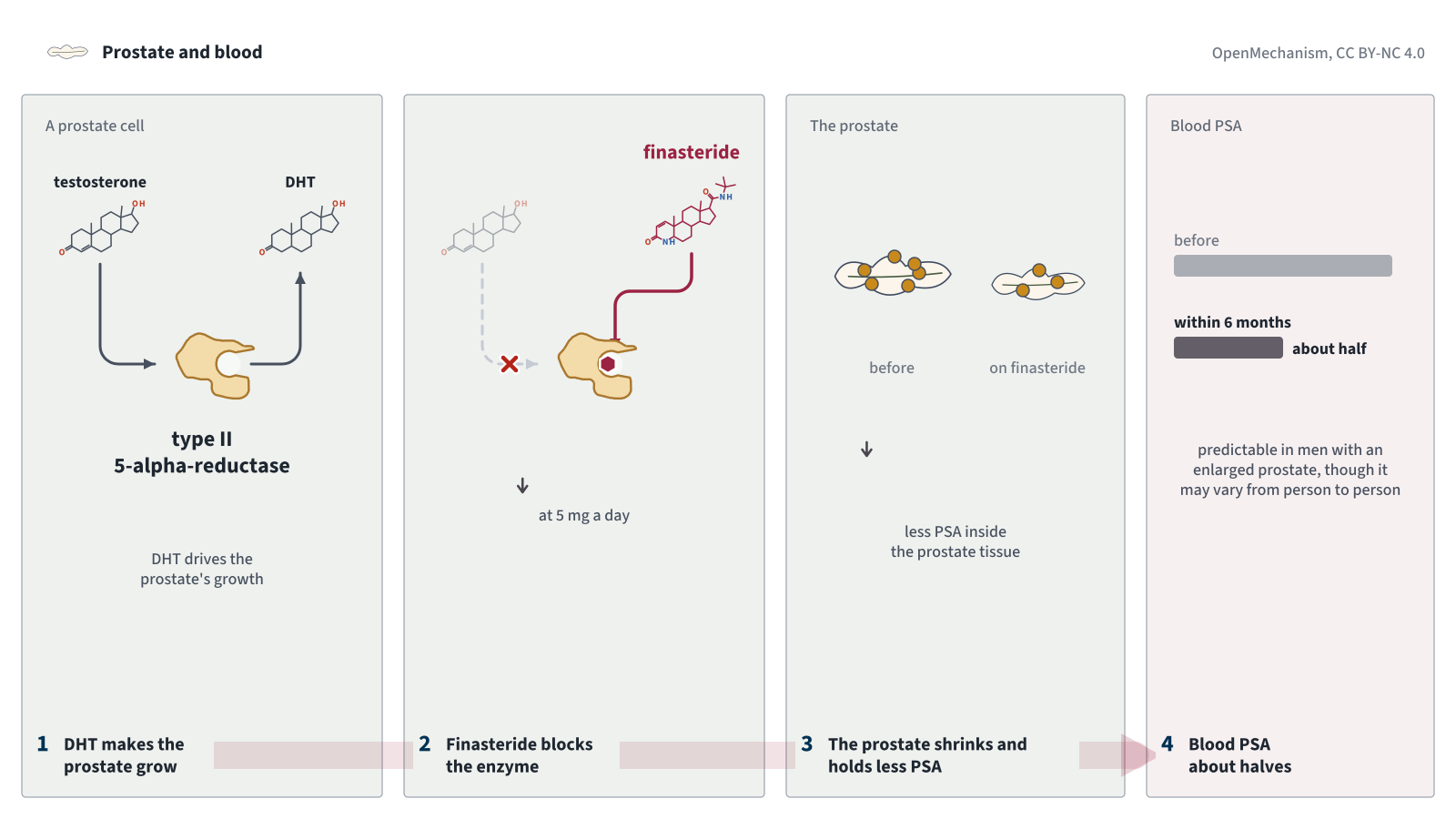
For teachers: download this drawing.
Step by step
DHT makes the prostate grow. The prostate's growth depends on (dihydrotestosterone), which the enzyme type II 5-alpha-reductase makes from testosterone in the prostate, liver and skin.1
Finasteride blocks the enzyme. Finasteride blocks type II 5-alpha-reductase and slowly forms a stable complex with it, which comes apart extremely slowly ( about 30 days). At 5 mg a day, blood DHT falls by about 70%.1
What the source says
“Finasteride is a competitive and specific inhibitor of Type II 5α-reductase with which it slowly forms a stable enzyme complex.”
Source 1“Turnover from this complex is extremely slow (t ½ ~ 30 days).”
Source 1“Daily dosing of PROSCAR at 5 mg/day for up to 4 years has been shown to reduce the serum DHT concentration by approximately 70%.”
Source 1The prostate shrinks and holds less PSA. In men with an enlarged prostate who took finasteride for 7 to 10 days before prostate surgery, the prostate tissue held less DHT and less PSA. In men treated for three months, prostate volume fell by about 20%.1
What the source says
“In patients with BPH treated with finasteride (1-100 mg/day) for 7-10 days prior to prostatectomy, an approximate 80% lower DHT content was measured in prostatic tissue removed at surgery, compared to placebo; testosterone tissue concentration was increased up to 10 times over pretreatment levels, relative to placebo. Intraprostatic content of PSA was also decreased.”
Source 1“In patients treated for three months, prostate volume, which declined by approximately 20%”
Source 1Blood PSA about halves. In clinical studies, blood PSA fell by about half within six months. In men with an enlarged prostate the fall is predictable across the range of PSA values, though it may vary from person to person.2
See also
Medicine pages: finasteride.
Other pages on what the body does with a medicine: all 16 pages on what the body does with a medicine.
Conditions: enlarged prostate (BPH) and prostate cancer.
Side effects: why spironolactone can cause breast growth.
Sources
- 1Proscar (finasteride): FDA label12.1 Mechanism of Action; 12.2 Pharmacodynamics. Saved copy
- 2Proscar (finasteride): FDA label5.1 Effects on Prostate Specific Antigen; 5.2 Increased Risk of High-Grade Prostate Cancer. Saved copy
- 3Human steroid 5-alpha-reductase 2 with finasteride bound to its cofactorPDB 7BW1; Xiao, Q. et al. Res Sq 2020. The type II 5-alpha-reductase outline in the drawing is traced from this structure. Saved copy
Notes and limits
- Any confirmed rise from the lowest PSA value while taking finasteride may signal prostate cancer, the label says, even if PSA is still in the normal range for men not taking it.2
- In a 7-year trial in men aged 55 and over, those taking finasteride had a higher risk of high-grade (Gleason 8 to 10) prostate cancer: 1.8% against 1.1% on placebo.2
Notes that apply to every page are on How to read a page.
Spotted a mistake? Report an error (hello@openmechanism.com). Since launch, every published error we fix is listed on the corrections page.
Cite this page
Tran D. Why finasteride halves PSA [Internet]. OpenMechanism; 2026 [updated 2026 Oct 20; cited 2026 Oct 20]. Available from: https://openmechanism.com/explained/finasteride-and-psa