Why CAR T cells can cause cytokine release syndrome
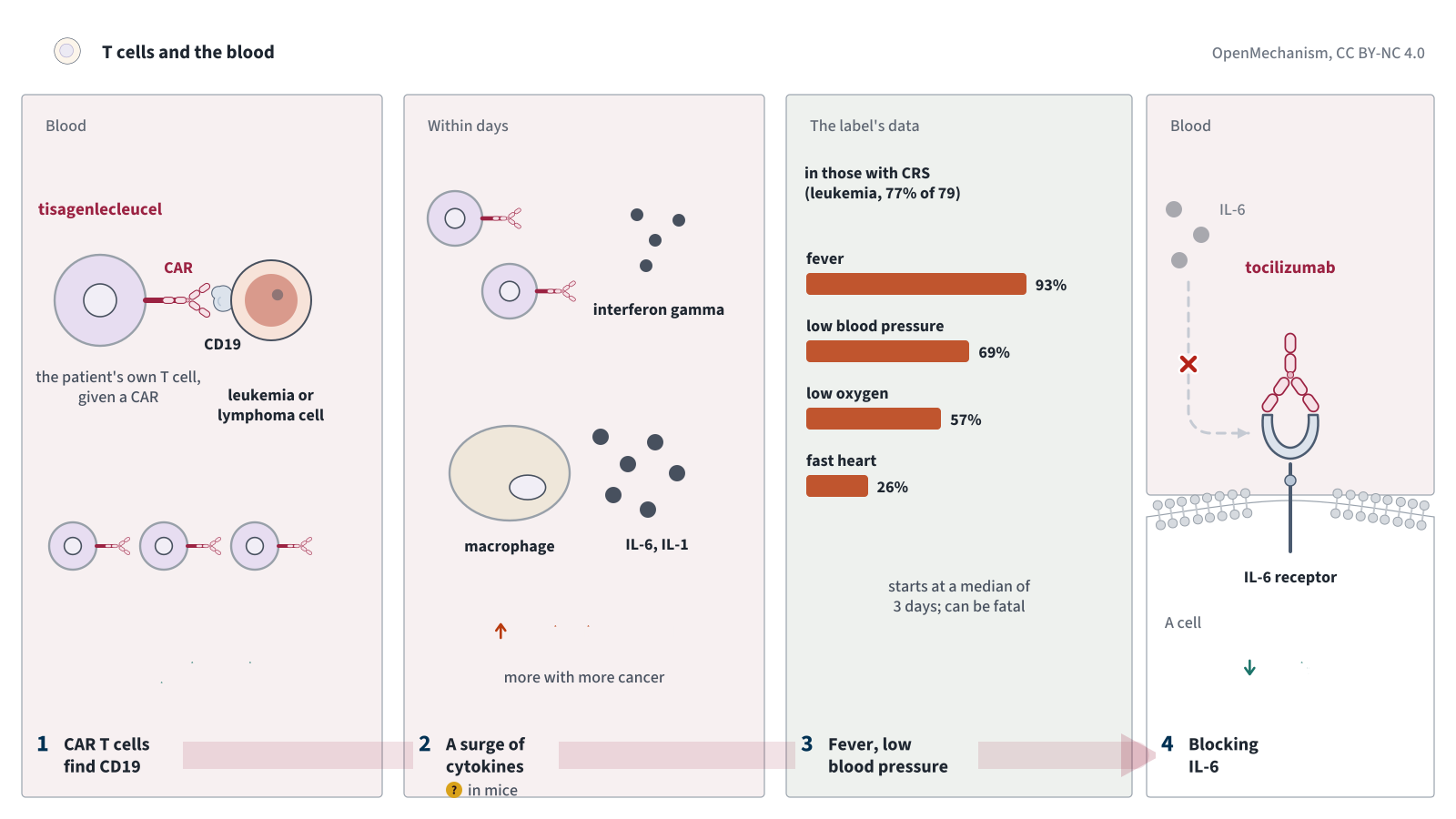
Tisagenlecleucel is made from a patient's own T cells, engineered to find CD19 on leukemia and lymphoma cells. As the cells multiply, usually within days, cytokines such as IL-6 rise in the blood: cytokine release syndrome, with fever, low blood pressure and low oxygen, sometimes fatal. Tocilizumab, which blocks the IL-6 receptor, is approved for severe cases.
- Kind
- Side effect
- Medicines
- Tisagenlecleucel, Tocilizumab
- Sources
- 7
Step 2: in mice
The Giavridis 2018 study, in a mouse model, says: We show that its severity is mediated not by CAR T cell-derived cytokines, but by IL-6, IL-1 and nitric oxide (NO) produced by recipient macrophages
Clinical study: A study of 51 people given CD19 CAR T cells for leukemia, which measured cytokines in their blood; it linked them to severe CRS but did not trace which cells made them: Peak levels of 24 cytokines, including IFNγ, IL6, sgp130, and sIL6R, in the first month after infusion were highly associated with severe CRS.
Teachey DT et al., Cancer Discov 2016 (PMID 27076371)
This study was picked with a literature search and is not yet checked by our reviewer.
For teachers: download this drawing.
Step by step
CAR T cells find CD19. Tisagenlecleucel is made from a patient's own , given a chimeric antigen receptor () that finds on cancer cells and on normal cells that carry it; it is used for some B-cell leukemias and lymphomas. When the CAR binds CD19, it signals the T cells to multiply, activate and kill the cell.1
What the source says
“KYMRIAH is a CD19-directed genetically modified autologous T cell immunotherapy which involves reprogramming a patient’s own T cells with a transgene encoding a chimeric antigen receptor (CAR) to identify and eliminate CD19-expressing malignant and normal cells.”
Source 1“Patients up to 25 years of age with B-cell precursor acute lymphoblastic leukemia (ALL) that is refractory or in second or later relapse.”
Source 1“Adult patients with relapsed or refractory (r/r) large B-cell lymphoma after two or more lines of systemic therapy, including diffuse large B-cell lymphoma (DLBCL) not otherwise specified, high grade B-cell lymphoma and DLBCL arising from follicular lymphoma.”
Source 1“Upon binding to CD19-expressing cells, the CAR transmits a signal to promote T cell expansion, activation, target cell elimination, and persistence of the KYMRIAH cells.”
Source 1A surge of cytokines. Cytokine release syndrome usually comes within days of the infusion, as the CAR T cells reach their peak numbers, with high blood levels of such as and interferon gamma; in leukemia it is more common and more severe when there is more cancer. In mouse models, its severity came from IL-6, and made by macrophages and monocytes, not from the CAR T cells' own cytokines.2,3,4
What the source says
“CRS usually occurs within days of T cell infusion at the peak of CAR T cell expansion.”
Source 2“CRS is associated with elevated circulating levels of several cytokines including interleukin (IL)-6 and interferon γ”
Source 3“In ALL, it is most frequent and more severe in patients with high tumor burden”
Source 2“Here we report a murine model of CRS that develops within 2-3 d of CAR T cell infusion”
Source 2“We show that its severity is mediated not by CAR T cell-derived cytokines, but by IL-6, IL-1 and nitric oxide (NO) produced by recipient macrophages”
Source 2“Human monocytes were the major source of IL-1 and IL-6 during CRS.”
Source 4Fever, low blood pressure. In the label's data, CRS came in 61 of 79 children and young adults with leukemia (77%), at grade 3 or higher in 48%, with a median time to onset of 3 days and to resolution of 8. Of those with it, 93% had fever, 69% low blood pressure, 57% low oxygen and 26% a fast heart; it may come with liver, kidney or heart problems and with clotting problems, and has been fatal.1
What the source says
“CRS occurred in 61 (77%) of the 79 pediatric and young adult patients with r/r ALL receiving KYMRIAH, including ≥ Grade 3 CRS (Penn grading system 1 ) occurring in 48% of patients.”
Source 1“The median times to onset and resolution of CRS were 3 days (range, 1 to 22; 1 patient with onset after Day 10) and 8 days (range, 1 to 36), respectively.”
Source 1“Among patients with CRS, key manifestations include fever (93% in r/r ALL; 85% in r/r DLBCL; 92% in r/r FL), hypotension (69% in r/r ALL; 45% in r/r DLBCL; 40% in r/r FL), hypoxia (57% in r/r ALL; 35% in r/r DLBCL; 19% in r/r FL), and tachycardia (26% in r/r ALL; 13% in r/r DLBCL; 2% in r/r FL).”
Source 1“CRS may be associated with hepatic, renal, and cardiac dysfunction, and coagulopathy.”
Source 1“Cytokine Release Syndrome (CRS), including fatal or life-threatening reactions, occurred in patients receiving KYMRIAH.”
Source 1Blocking IL-6. Tocilizumab binds the IL-6 receptor, both the free and the cell-bound forms, and blocks IL-6 signaling. It is approved for severe or life-threatening CRS caused by CAR T cells, and the tisagenlecleucel label names it, alone or with corticosteroids, for severe CRS. In an early trial of CD19 CAR T cells, severe CRS came in 27% and was effectively treated with it.1,5,6
What the source says
“Tocilizumab binds to both soluble and membrane-bound IL-6 receptors (sIL-6R and mIL-6R), and has been shown to inhibit IL-6-mediated signaling through these receptors.”
Source 5“Adults and pediatric patients 2 years of age and older with chimeric antigen receptor (CAR) T cell-induced severe or life-threatening cytokine release syndrome.”
Source 5“Treat severe or life-threatening CRS with tocilizumab or tocilizumab and corticosteroids”
Source 1“We infused autologous T cells transduced with a CD19-directed chimeric antigen receptor (CTL019) lentiviral vector in patients with relapsed or refractory ALL”
Source 6“Severe cytokine-release syndrome, which developed in 27% of the patients, was associated with a higher disease burden before infusion and was effectively treated with the anti-interleukin-6 receptor antibody tocilizumab.”
Source 6
See also
Medicine pages: tisagenlecleucel and tocilizumab.
Other side effects (cancer): why bleomycin can scar the lungs, why checkpoint inhibitors can inflame healthy organs, why cisplatin can harm hearing, why cisplatin can harm the kidneys, why cyclophosphamide can make the bladder bleed, why doxorubicin can damage the heart, why rituximab can bring hepatitis B back, why trastuzumab can weaken the heart, why vincristine can damage nerves and all 65 side effects.
Conditions: acute lymphoblastic leukemia and B-cell lymphomas.
Sources
- 1Kymriah (tisagenlecleucel): FDA labelBoxed Warning; 1 Indications and Usage; 5.1 Cytokine Release Syndrome; 12.1 Mechanism of Action. Saved copy
- 2CAR T cell-induced cytokine release syndrome is mediated by macrophages and abated by IL-1 blockadeGiavridis T et al. Nat Med 2018 (abstract). Saved copy
- 3Current concepts in the diagnosis and management of cytokine release syndromeLee DW et al. Blood 2014 (abstract). Saved copy
- 4Monocyte-derived IL-1 and IL-6 are differentially required for cytokine-release syndrome and neurotoxicity due to CAR T cellsNorelli M et al. Nat Med 2018 (abstract). Saved copy
- 5Actemra (tocilizumab): FDA label1 Indications and Usage; 12.1 Mechanism of Action. Saved copy
- 6Chimeric antigen receptor T cells for sustained remissions in leukemiaMaude SL et al. N Engl J Med 2014 (abstract). Saved copy
- 7Identification of Predictive Biomarkers for Cytokine Release Syndrome after Chimeric Antigen Receptor T-cell Therapy for Acute Lymphoblastic LeukemiaTeachey DT et al. Cancer Discov 2016 (abstract). Saved copy
Notes and limits
- A 2014 report notes that the evidence that tocilizumab can reverse CRS came from uncontrolled studies, and that early, strong immune suppression could limit how well the treatment works.3
- Nerve and brain toxicity can come too, sometimes at the same time as CRS; in mice, tocilizumab did not protect against a delayed, lethal form of it.1,4
- In adults with lymphoma severe CRS was less common: 74% of 115 with large B-cell lymphoma had CRS, at grade 3 or higher in 23%, and 53% of 97 with follicular lymphoma had it, all at grade 1 or 2 on another grading scale.1
Notes that apply to every page are on How to read a page.
Spotted a mistake? Report an error (hello@openmechanism.com). Since launch, every published error we fix is listed on the corrections page.
Cite this page
Tran D. Why CAR T cells can cause cytokine release syndrome [Internet]. OpenMechanism; 2026 [updated 2026 Oct 21; cited 2026 Oct 21]. Available from: https://openmechanism.com/explained/car-t-cells-and-cytokine-release-syndrome