Baclofen
Baclofen is a look-alike of the inhibitory transmitter . It damps both simple and multi-step spinal reflexes, possibly by reducing transmitter release from sensory nerve endings through , though the precise mechanism is not fully understood; this helps spasticity. It also slows the brain (sedation, sleepiness, unsteadiness) and leaves the body unchanged in the urine.
- Acts on
- Spinal reflex circuits (possibly GABA-B receptors on sensory nerve terminals)
- Where
- Spinal cord
- Medicine type
- Small molecule
- Used for
- Muscles, bones & joints
- Drug class
- Muscle relaxants (centrally acting)
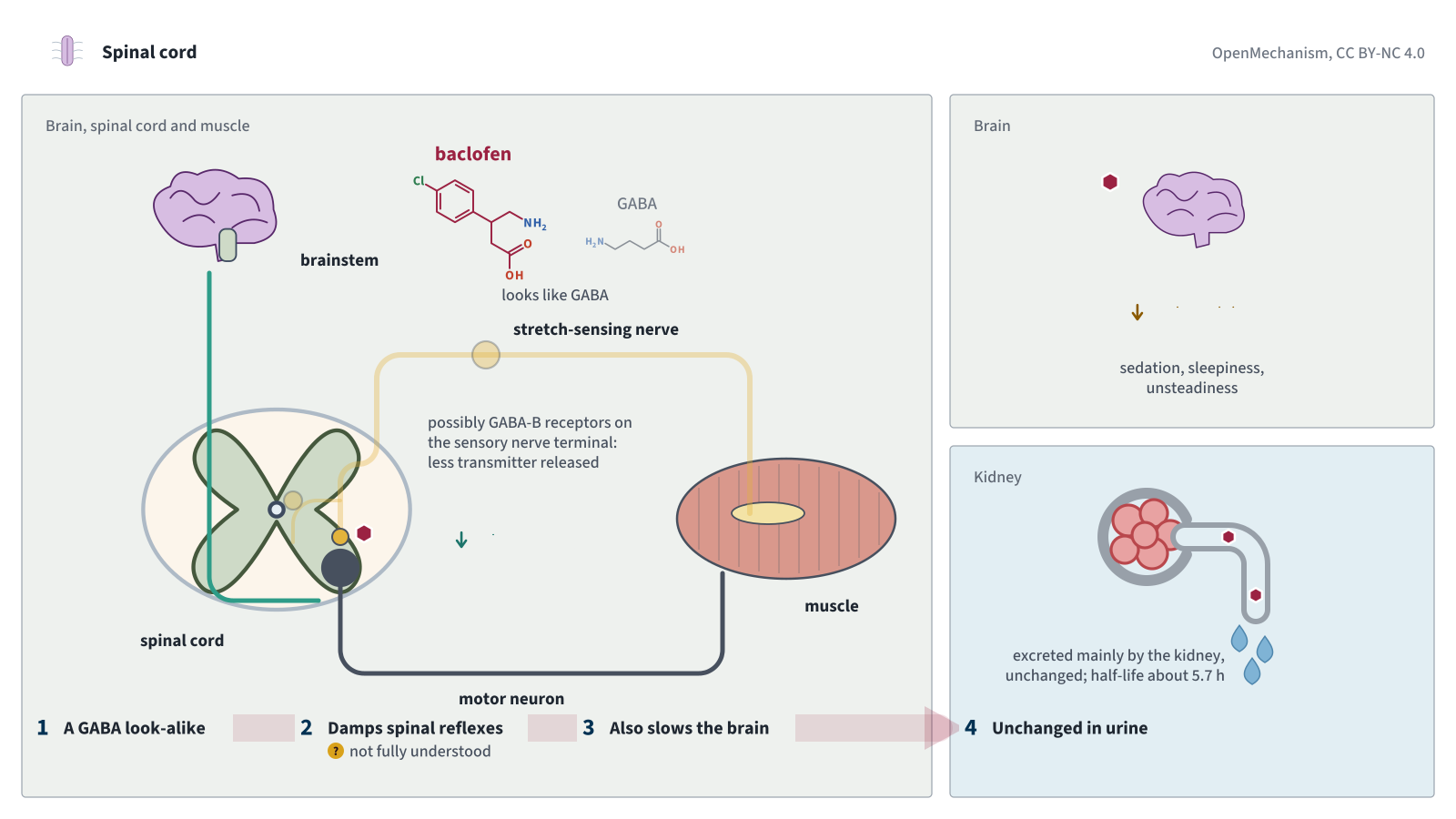
Step 2: not fully understood
The baclofen label says: The precise mechanism of action of baclofen is not fully understood. Baclofen inhibits both monosynaptic and polysynaptic reflexes at the spinal level, possibly by decreasing excitatory neurotransmitter release from afferent terminals, although actions at supraspinal sites may also occur and contribute to its clinical effect.
Clinical study: In a double-blind crossover study with 3 years of follow-up in spasticity from multiple sclerosis; the study measured spasms, clonus and joint movement, not how baclofen works: A statistically significant reduction was noted in frequency of spasms, and clonus, and there was improved range of joint movement
Feldman RG et al., Neurology 1978 (PMID 362234)
This study was picked with a literature search and is not yet checked by our reviewer.
Key terms in this drawing
- GABA
- Gamma-aminobutyric acid. The main inhibitory messenger in the central nervous system.
- GABA-B receptor
- Gamma-aminobutyric acid type B receptor. A subtype of receptor for GABA, the brain's main inhibitory messenger; baclofen may act by stimulating it.
- half-life
- Half-life. The time it takes for the amount in the blood to fall by half.
How it works
A GABA look-alike. Baclofen is a structural analog of the inhibitory neurotransmitter gamma-aminobutyric acid (GABA).1
Damps spinal reflexes. It inhibits both monosynaptic and polysynaptic reflexes at the spinal level, possibly by decreasing excitatory transmitter release from sensory nerve terminals, and may act by stimulating GABA-B receptors; actions above the spinal cord may also contribute. The precise mechanism is not fully understood.1
Also slows the brain. Baclofen has general depressant properties, causing sedation, somnolence and ataxia.1
Unchanged in urine. It is excreted mainly by the kidney, unchanged; its is about 5.7 hours.1
For teachers: download this drawing.
See also
Condition pages: multiple sclerosis; and spasticity and dystonia.
Other muscle relaxants (centrally acting): cyclobenzaprine, methocarbamol and tizanidine.
Body system: muscles, bones & joints.
Sources
- 1Baclofen oral solution: FDA label12.1 Mechanism of Action; 12.2 Pharmacodynamics; 12.3 Pharmacokinetics
- 2ChEMBL CHEMBL701Target and action classification: GABA-B receptor agonist
- 3Baclofen for spasticity in multiple sclerosis. Double-blind crossover and three-year studyFeldman RG et al. Neurology 1978 (abstract)
Spotted a mistake? Report an error (hello@openmechanism.com). Since launch, every published error we fix is listed on the corrections page.
Notes and limits
- A schematic teaching drawing: not to scale, not exact structures, binding poses or a complete pathway, and not a guide to dosing, treatment or how a person will respond.
- The label says the precise mechanism of action of baclofen is not fully understood.
All recorded limits are on the evidence page, and notes that apply to every page are on How to read a page. Version 1.0.0, not yet medically reviewed.
Cite this page
Tran D. Baclofen [Internet]. OpenMechanism; 2026 [updated 2026 Oct 11; cited 2026 Oct 11]. Available from: https://openmechanism.com/medicines/baclofen