Primaquine and G6PD deficiency
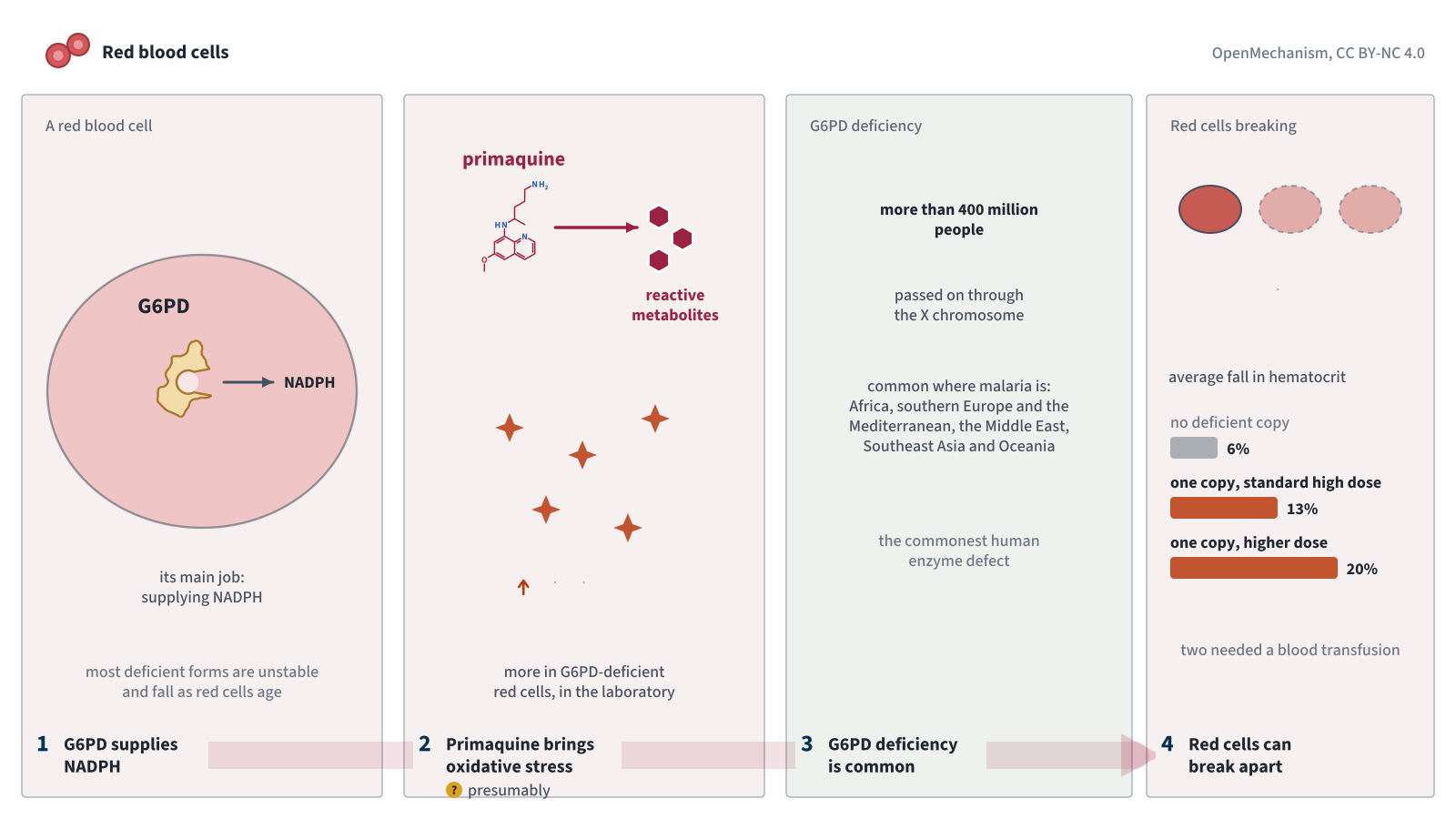
G6PD's main job is to supply NADPH. Primaquine is thought to work partly through oxidative stress from its reactive metabolites. G6PD deficiency, the commonest human enzyme defect, leaves red cells exposed, and in people with it primaquine may cause moderate to severe hemolysis.
- Kind
- In the body
- Medicines
- Primaquine
- Sources
- 7
Step 2: presumably
A laboratory study of primaquine and red cells says: Primaquine, presumably through redox active hemotoxic metabolites generated in situ in human liver microsomal metabolism-linked assay, induced a dose-dependent methemoglobin accumulation and oxidative stress, which were almost similar in normal and G6PD-deficient erythrocytes.
Clinical study: In a trial of treatments for vivax malaria, the authors followed 241 women, 34 of them carrying one G6PD-deficient copy (the Mahidol variant); they found: Haemolysis was substantially greater and a larger proportion of participants reached the threshold of clinically significant haemolysis (fractional haematocrit reduction >25%) in G6PD heterozygotes taking the higher (7 d) primaquine dose (9/17 [53%]) compared with G6PD heterozygotes taking the standard high (14 d) dose (2/16 [13%]; p = 0.022).
Chu CS et al., PLoS Med 2017 (PMID 28170391)
This study was picked with a literature search and is not yet checked by our reviewer.
For teachers: download this drawing.
Step by step
G6PD supplies NADPH. G6PD, an enzyme of the pentose phosphate pathway made in every cell, has as its main job supplying NADPH. Most of the changes behind its deficiency make it less stable, so its level falls as red cells age.1
What the source says
“G6PD is a housekeeping gene expressed in all cells.”
Source 1“Glucose-6-phosphate dehydrogenase (G6PD) is part of the pentose phosphate pathway, and its main physiologic role is to provide NADPH.”
Source 1“G6PD deficiency, one of the commonest inherited enzyme abnormalities in humans, arises through one of many possible mutations, most of which reduce the stability of the enzyme and its level as red cells age.”
Source 1Primaquine brings oxidative stress. How primaquine works is not fully established; one main idea is oxidative stress from its reactive metabolites in infected cells. In laboratory tests on red cells, primaquine alone caused oxidative stress, more in G6PD-deficient cells; with liver enzymes at work, presumably through its metabolites, it also built up methemoglobin and caused oxidative stress about equally in normal and deficient cells. A 2008 review says that in G6PD deficiency, acute hemolytic anemia is usually triggered by an outside agent, and that the most effective management is to prevent hemolysis by avoiding oxidative stress.2,3,4
What the source says
“The mechanism of action has not been fully established.”
Source 2“The major assumptions are an inhibition of the mitochondrial system of dormant parasites, and an oxidative stress generated through reactive metabolites in infected cells.”
Source 2“Primaquine alone though did not induce noticeable methemoglobin accumulation, but produced significant oxidative stress, which was higher in G6PD-deficient than in normal erythrocytes.”
Source 3“Primaquine, presumably through redox active hemotoxic metabolites generated in situ in human liver microsomal metabolism-linked assay, induced a dose-dependent methemoglobin accumulation and oxidative stress, which were almost similar in normal and G6PD-deficient erythrocytes.”
Source 3“The most frequent clinical manifestations of G6PD deficiency are neonatal jaundice, and acute haemolytic anaemia, which is usually triggered by an exogenous agent.”
Source 4“The most effective management of G6PD deficiency is to prevent haemolysis by avoiding oxidative stress.”
Source 4G6PD deficiency is common. G6PD deficiency is the commonest human enzyme defect, in more than 400 million people, passed on through the X chromosome, and found where malaria is common: Africa, southern Europe and the Mediterranean, the Middle East, Southeast Asia and Oceania.4,5
What the source says
“Glucose-6-phosphate dehydrogenase (G6PD) deficiency is the most common human enzyme defect, being present in more than 400 million people worldwide.”
Source 4“The global distribution of this disorder is remarkably similar to that of malaria, lending support to the so-called malaria protection hypothesis.”
Source 4“G6PD deficiency is an X-linked, hereditary genetic defect due to mutations in the G6PD gene”
Source 4“Areas of high prevalence of G6PD deficiency are Africa, Southern Europe, Mediterranean region, Middle East, South-East Asia, and Oceania.”
Source 5Red cells can break apart. In people with G6PD deficiency, or with a family or personal history of favism, primaquine may cause moderate to severe hemolysis, red cells breaking apart: hemolytic anemia. In a trial, the hematocrit (the share of the blood that is red cells) of women carrying one G6PD-deficient copy fell on average by 13% on the standard high dose and 20% on a higher one, against about 6% in women without it; two needed a blood transfusion.5,6
What the source says
“Hemolytic reactions (moderate to severe) may occur in individuals with G6PD deficiency and in individuals with a family or personal history of favism.”
Source 5“People from these regions have a greater tendency to develop hemolytic anemia due to a congenital deficiency of erythrocytic G6PD while receiving primaquine and related drugs.”
Source 5“In heterozygotes, the mean fractional haematocrit reductions were correspondingly greater with the higher primaquine dose (7-d regimen): -20.4% (95% CI -26.0% to -14.8%) (nadir on day 5) compared with the standard high (14 d) dose: -13.1% (95% CI -17.6% to -8.6%) (nadir day 6).”
Source 6“Two heterozygotes taking the higher (7 d) primaquine dose required blood transfusion.”
Source 6“In wild-type participants, mean haematocrit reductions were clinically insignificant and similar with both doses: -5.8 (95% CI -7.2% to -4.4%) (nadir day 3)”
Source 6
See also
Medicine pages: primaquine.
Other pages on what the body does with a medicine: all 16 pages on what the body does with a medicine.
Conditions: malaria and methemoglobinemia.
Sources
- 1Glucose-6-phosphate dehydrogenase deficiencyLuzzatto L et al. Hematol Oncol Clin North Am 2016 (abstract). Saved copy
- 2Primaquine phosphate (Sanofi): FDA labelClinical Pharmacology: Mechanism of Action. Saved copy
- 3Understanding the mechanisms for metabolism-linked hemolytic toxicity of primaquine against glucose 6-phosphate dehydrogenase deficient human erythrocytesGanesan S et al. Toxicology 2012 (abstract). Saved copy
- 4Glucose-6-phosphate dehydrogenase deficiencyCappellini MD, Fiorelli G. Lancet 2008 (abstract). Saved copy
- 5Primaquine phosphate (Sanofi): FDA labelWarnings: Hemolytic Anemia. Saved copy
- 6Haemolysis in G6PD heterozygous females treated with primaquine for Plasmodium vivax malariaChu CS et al. PLoS Med 2017 (abstract). Saved copy
- 7Human glucose-6-phosphate dehydrogenase (G6PD) with its structural NADPPDB 6E08; Hwang, S. et al. Nat Commun 2018;9:4045. The G6PD outline in the drawing is traced from this structure. Saved copy
Notes and limits
- G6PD tests have limits, so some risk of hemolysis remains even after testing, the label says.5
- Most people with G6PD deficiency have no symptoms; newborns can develop severe jaundice.1
Notes that apply to every page are on How to read a page.
Spotted a mistake? Report an error (hello@openmechanism.com). Since launch, every published error we fix is listed on the corrections page.
Cite this page
Tran D. Primaquine and G6PD deficiency [Internet]. OpenMechanism; 2026 [updated 2026 Nov 18; cited 2026 Nov 18]. Available from: https://openmechanism.com/explained/primaquine-and-g6pd