Muscle spasm
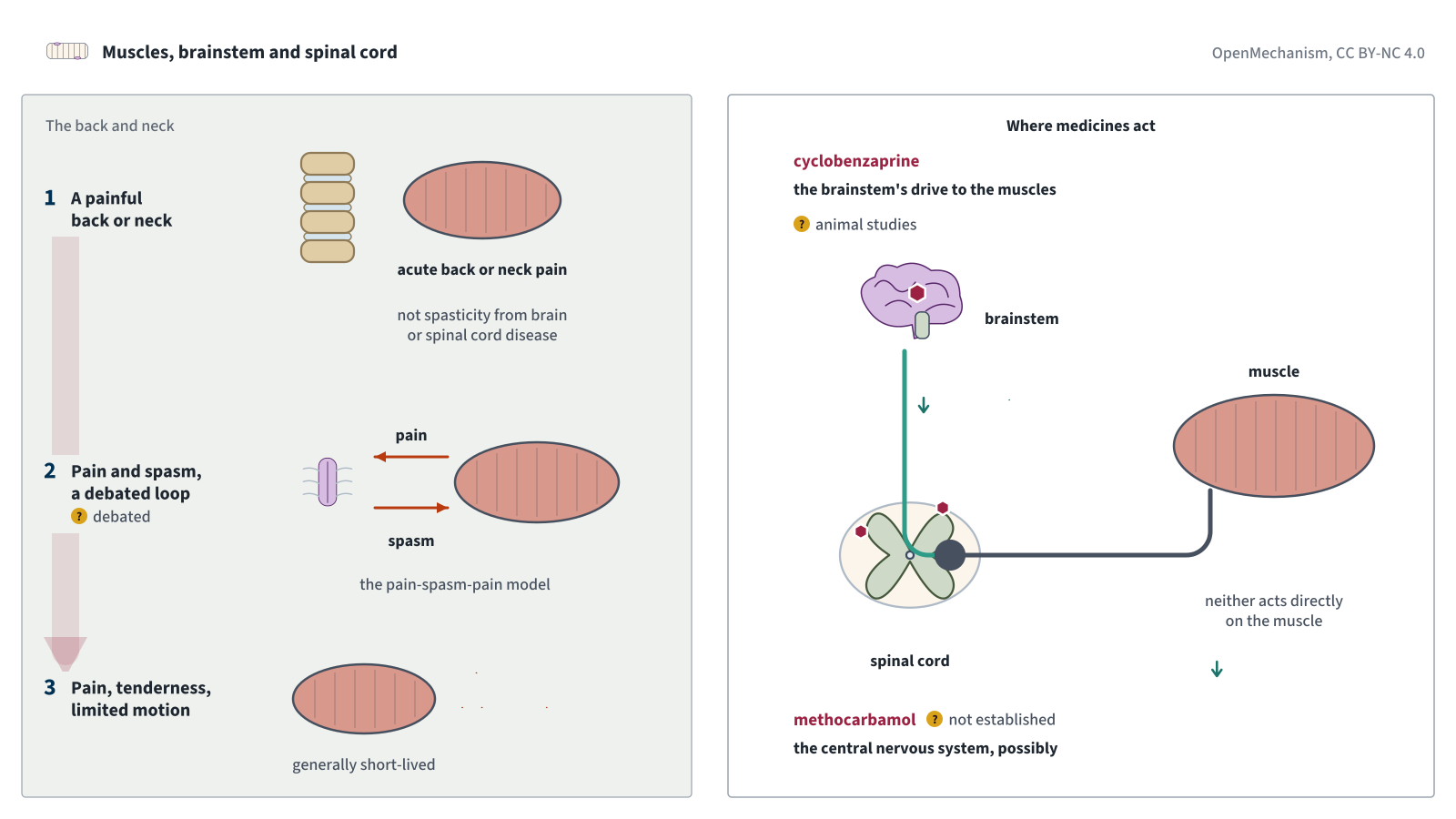
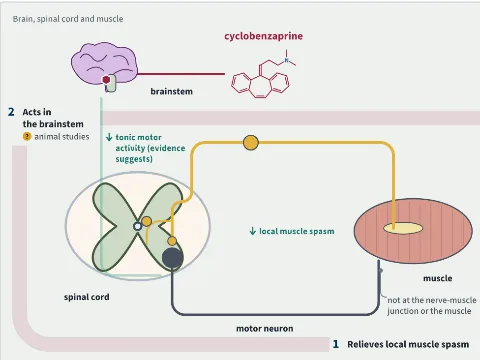
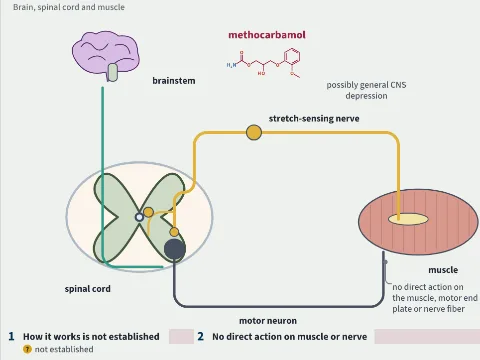
Muscle spasm comes with acute, painful conditions of the muscles and bones, mainly acute back or neck pain, bringing pain, tenderness and limited motion; it is generally short-lived. Neither medicine acts directly on the muscle: cyclobenzaprine acts mainly in the brainstem in animal studies, and how methocarbamol works is not established.
- Where
- Muscles, brainstem and spinal cord
- Body system
- Muscles, bones & joints
- Medicines
- 2 medicines
Step 2: debated
The van Dieën 2003 review says: Neither of the two models is unequivocally supported by the literature.
Clinical study: In a study of back muscle activity during walking in 10 people with chronic low back pain and in 10 volunteers given experimental back muscle pain; the study measured muscle activity, not spasm itself: When the results are compared to sex- and age-matched controls, the CLBP patients showed significantly increased EMG activity in the swing phase; a phase where the lumbar muscles are normally silent. … Initially, these EMG changes may be interpreted as a functional adaptation to muscle pain, but the consequences of chronic altered muscle performance are not known.
Arendt-Nielsen L et al., Pain 1996 (PMID 8740599)
This study was picked with a literature search and is not yet checked by our reviewer.
Animal studies
The cyclobenzaprine label says: Animal studies indicate that cyclobenzaprine does not act at the neuromuscular junction or directly on skeletal muscle. … Evidence suggests that the net effect of cyclobenzaprine is a reduction of tonic somatic motor activity, influencing both gamma (γ) and alpha (α) motor systems.
Clinical study: A meta-analysis of randomized, placebo-controlled trials in adults with back pain, which measured symptom improvement, not where cyclobenzaprine acts, found: Patients treated with cyclobenzaprine were nearly 5 times (odds ratio, 4.7; 95% confidence interval, 2.7-8.1) as likely to report symptom improvement by day 14 as were those treated with placebo. … The magnitude of this improvement was modest
Browning R et al., Arch Intern Med 2001 (PMID 11434793)
This study was picked with a literature search and is not yet checked by our reviewer.
Not established
The methocarbamol label says: The mechanism of action of methocarbamol in humans has not been established, but may be due to general central nervous system (CNS) depression.
Clinical study: In a randomized, double-blind trial in emergency department patients with acute low back pain, all of whom took naproxen, methocarbamol or placebo was added; the trial measured function a week later, not how methocarbamol works: Among ED patients with acute, nontraumatic, nonradicular low back pain, combining naproxen with either orphenadrine or methocarbamol did not improve functional outcomes compared with naproxen+placebo.
Friedman BW et al., Ann Emerg Med 2018 (PMID 29089169)
This study was picked with a literature search and is not yet checked by our reviewer.
For teachers: download this drawing.
What goes wrong
A painful back or neck. Muscle relaxants treat two different kinds of condition: spasticity, from upper motor neuron syndromes such as brain or spinal cord disease, and muscle pain or spasm from musculoskeletal conditions, mainly acute back or neck pain. Most low back pain has no known cause in the body's structures (it is non-specific).1,2,3
What the source says
“Skeletal muscle relaxants are a heterogeneous group of medications used to treat two different types of underlying conditions: spasticity from upper motor neuron syndromes and muscular pain or spasms from peripheral musculoskeletal conditions.”
Source 1“There is fair evidence that cyclobenzaprine, carisoprodol, orphenadrine, and tizanidine are effective compared to placebo in patients with musculoskeletal conditions (primarily acute back or neck pain).”
Source 1“Cyclobenzaprine hydrochloride extended-release capsules have not been found effective in the treatment of spasticity associated with cerebral or spinal cord disease or in children with cerebral palsy.”
Source 2“Because non-specific low back pain does not have a known pathoanatomical cause, treatment focuses on reducing pain and its consequences.”
Source 3Pain and spasm, a debated loop. A commonly held view is that the pain is kept going by tight, overactive muscles, as in the pain-spasm-pain model. Reviews do not clearly support it: in several long-lasting muscle pain conditions the data do not support it, and studies of the back muscles in low back pain support neither this model nor its rival, the pain-adaptation model, unequivocally.4,5
What the source says
“Articles describing motor function in five chronic musculoskeletal pain conditions (temporomandibular disorders, muscle tension headache, fibromyalgia, chronic lower back pain, and postexercise muscle soreness) were reviewed.”
Source 4“It was concluded that the data do not support the commonly held view that the pain of these conditions is maintained by some form of tonic muscular hyperactivity.”
Source 4“Two models proposed in the literature, the pain-spasm-pain model and the pain adaptation model, yield conflicting predictions on how low- back pain would affect trunk muscle recruitment in various activities.”
Source 5“Neither of the two models is unequivocally supported by the literature.”
Source 5Pain, tenderness, limited motion. The spasm comes with pain, tenderness and limited motion. It is generally short-lived, and the course of low back pain is often favorable.2,3
What the source says
“Improvement is manifested by relief of muscle spasm and its associated signs and symptoms, namely, pain, tenderness, and limitation of motion.”
Source 2“muscle spasm associated with acute, painful musculoskeletal conditions is generally of short duration”
Source 2“The clinical course of low back pain is often favourable, thus many patients require little if any formal medical care.”
Source 3
Where medicines act
In the brainstem
- A
Cyclobenzaprine targets The brainstem's drive to the muscles
Lowers the steady drive to the muscles, acting mainly in the brainstem (animal studies).2
Used forMuscle spasm with acute, painful musculoskeletal conditions: with rest and physical therapy
What the label says
“Cyclobenzaprine hydrochloride extended-release capsules are indicated as an adjunct to rest and physical therapy for relief of muscle spasm associated with acute, painful musculoskeletal conditions.”
Source 2“Cyclobenzaprine relieves skeletal muscle spasm of local origin without interfering with muscle function.”
Source 2“Animal studies indicate that cyclobenzaprine does not act at the neuromuscular junction or directly on skeletal muscle.”
Source 2“Such studies show that cyclobenzaprine acts primarily within the central nervous system at the brain stem as opposed to the spinal cord level, although an overlapping action on the latter may contribute to its overall skeletal muscle relaxant activity.”
Source 2“Evidence suggests that the net effect of cyclobenzaprine is a reduction of tonic somatic motor activity, influencing both gamma (γ) and alpha (α) motor systems.”
Source 2
The central nervous system, possibly
- B
Methocarbamol targets The central nervous system, possibly
Not established; possibly a general calming of the central nervous system.6
Used forDiscomfort with acute, painful musculoskeletal conditions: with rest, physical therapy and other measures
What the label says
“Methocarbamol is indicated as an adjunct to rest, physical therapy, and other measures for the relief of discomfort associated with acute, painful musculoskeletal conditions.”
Source 6“The mechanism of action of methocarbamol in humans has not been established, but may be due to general central nervous system (CNS) depression.”
Source 6“The mode of action of methocarbamol has not been clearly identified, but may be related to its sedative properties.”
Source 6“Methocarbamol does not directly relax tense skeletal muscles in man.”
Source 6“It has no direct action on the contractile mechanism of striated muscle, the motor end plate or the nerve fiber.”
Source 6
See also
Body system: muscles, bones & joints.
Other conditions: spasticity and dystonia; and acute pain and period pain.
Interactions: tizanidine with ciprofloxacin or fluvoxamine.
Sources
- 1Comparative efficacy and safety of skeletal muscle relaxants for spasticity and musculoskeletal conditions: a systematic reviewChou R et al. J Pain Symptom Manage 2004 (abstract). Saved copy
- 2Cyclobenzaprine hydrochloride extended-release capsules: FDA label1 Indications and Usage; 12.1 Mechanism of Action. Saved copy
- 3Non-specific low back painMaher C et al. Lancet 2017 (abstract). Saved copy
- 4The pain-adaptation model: a discussion of the relationship between chronic musculoskeletal pain and motor activityLund JP et al. Can J Physiol Pharmacol 1991 (abstract). Saved copy
- 5Trunk muscle activation in low-back pain patients, an analysis of the literaturevan Dieën JH et al. J Electromyogr Kinesiol 2003 (abstract). Saved copy
- 6Methocarbamol tablets (Oxford Pharmaceuticals): FDA labelIndications and Usage; Clinical Pharmacology. Saved copy
- 7A randomized, double-blind, placebo-controlled trial of naproxen with or without orphenadrine or methocarbamol for acute low back painFriedman BW et al. Ann Emerg Med 2018 (abstract). Saved copy
- 8Choosing a skeletal muscle relaxantSee S, Ginzburg R. Am Fam Physician 2008 (abstract). Saved copy
- 9The influence of low back pain on muscle activity and coordination during gait: a clinical and experimental studyArendt-Nielsen L et al. Pain 1996 (abstract). Saved copy
- 10Cyclobenzaprine and back pain: a meta-analysisBrowning R et al. Arch Intern Med 2001 (abstract). Saved copy
Notes and limits
- The cyclobenzaprine label limits it to short periods, up to two or three weeks, because evidence for longer use is lacking and the spasm is generally short-lived.2
- Cyclobenzaprine has not been found effective for spasticity from brain or spinal cord disease, or in children with cerebral palsy.2
- Cyclobenzaprine is the most studied muscle relaxant and has consistently been found effective. For methocarbamol the data are very limited or inconsistent; in one emergency-department trial in acute low back pain, adding it to naproxen did not improve function.1,7
- Muscle relaxants have not been shown to work better than acetaminophen or NSAIDs for low back pain, and dizziness and drowsiness are consistently reported with all of them.8
Notes that apply to every page are on How to read a page.
Spotted a mistake? Report an error (hello@openmechanism.com). Since launch, every published error we fix is listed on the corrections page.
Cite this page
Tran D. Muscle spasm [Internet]. OpenMechanism; 2026 [updated 2026 Oct 20; cited 2026 Oct 20]. Available from: https://openmechanism.com/conditions/muscle-spasm