Antibiotics and antacids, calcium or iron
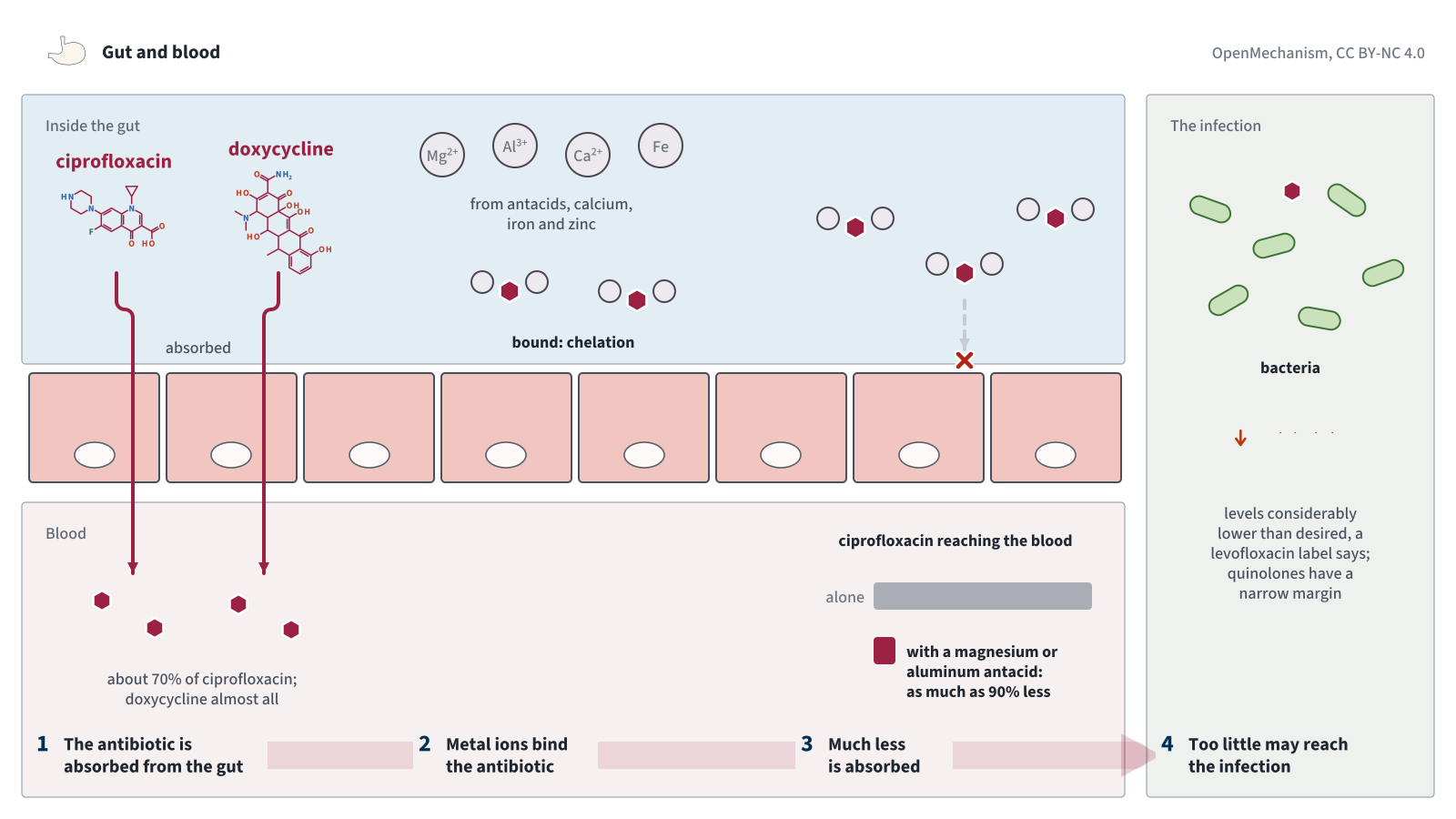
Ciprofloxacin and doxycycline are taken by mouth and absorbed from the gut. Antacids, calcium, iron and zinc bring metal ions that bind these antibiotics (chelation), and much less is absorbed: with magnesium or aluminum antacids, up to 90% less ciprofloxacin. The antibiotic in the blood can then be lower than needed.
- Kind
- Interaction
- Medicines
- Ciprofloxacin, Doxycycline
- Sources
- 6
For teachers: download this drawing.
Step by step
The antibiotic is absorbed from the gut. Taken by mouth, ciprofloxacin and doxycycline are absorbed from the gut into the blood: about 70% of a ciprofloxacin tablet reaches the blood, and doxycycline is almost completely absorbed.1,2
Metal ions bind the antibiotic. Quinolones such as ciprofloxacin and tetracyclines such as doxycycline bind metal ions from antacids and mineral supplements, called chelation. A 1989 review called chelation the most likely mechanism for the quinolones: magnesium and aluminum antacids appear to cut their absorption, and calcium, iron and probably zinc appear to act the same way.3,4
What the source says
“Tetracycline and quinolones undergo chelation interactions with many metal ions found in antacids and mineral supplements.”
Source 3“the absorption of all quinolones appears to be significantly reduced by antacids containing magnesium and/or aluminum”
Source 4“Other cations, such as calcium, iron, and probably zinc, appear to interact in a similar manner. Chelation between the quinolone and cation is the most likely mechanism.”
Source 4Much less is absorbed. Much less of the antibiotic is then absorbed. Antacids with magnesium or aluminum hydroxide may cut the ciprofloxacin reaching the blood by as much as 90%, and antacids with aluminum, calcium or magnesium, and iron products, impair doxycycline's absorption. Magnesium and aluminum antacids, and sucralfate, have the greatest effect on the quinolones, then iron, calcium and zinc.1,2,5
What the source says
“Concurrent administration of antacids containing magnesium hydroxide or aluminum hydroxide may reduce the bioavailability of ciprofloxacin by as much as 90%”
Source 1“Absorption of tetracyclines is impaired by antacids containing aluminum, calcium, or magnesium, and iron-containing preparations.”
Source 2“Concurrent administration of magnesium-aluminum antacids and sucralfate has the greatest effect on the bioavailability of quinolones followed by iron, calcium and zinc.”
Source 5Too little may reach the infection. The antibiotic in the blood can then be considerably lower than desired, as a levofloxacin label puts it. A review adds that quinolones are often used at doses, and against bacteria only modestly sensitive to them, that leave a narrow margin for any fall in absorption.5,6
What the source says
“may interfere with the gastrointestinal absorption of levofloxacin, resulting in systemic levels considerably lower than desired”
Source 6“Fluoroquinolones are often utilised in dosages and against modestly susceptible pathogens which allow a narrow margin for acceptable decreases in bioavailability.”
Source 5
See also
Medicine pages: ciprofloxacin and doxycycline.
Other interactions (infections): isoniazid and phenytoin; linezolid and serotonergic medicines; rifampin and other medicines; and all 40 interactions.
Conditions: urinary tract infections; skin and soft-tissue infections; and acne.
Side effects: why tetracyclines can stain developing teeth and why fluoroquinolones such as ciprofloxacin can damage tendons.
Sources
- 1Cipro (ciprofloxacin): FDA label7 Drug Interactions; 12.3 Pharmacokinetics. Saved copy
- 2Doxycycline hyclate tablets: FDA labelClinical Pharmacology; Precautions: Drug Interactions. Saved copy
- 3Oral antibiotic drug interactions of clinical significance to dermatologistsDel Rosso JQ. Dermatol Clin 2009 (abstract). Saved copy
- 4Drug-drug interactions with ciprofloxacin and other fluoroquinolonesPolk RE. Am J Med 1989 (abstract). Saved copy
- 5Absorption interactions with fluoroquinolones. 1995 updateLomaestro BM, Bailie GR. Drug Saf 1995 (abstract). Saved copy
- 6Levofloxacin tablets (Lupin): FDA label7.1 Chelation Agents. Saved copy
Notes and limits
- The labels' advice on spacing the doses is left out: this page explains the mechanism, not what to do.
- Food and milk matter less for doxycycline: its label says they do not markedly change its absorption, though tetracyclines in general are absorbed less with foods that contain calcium. The ciprofloxacin label says dairy products or calcium-fortified juices alone may lower its absorption, but it can be taken with a meal that contains them.1,2
- The levofloxacin label says levofloxacin's binding of metal ions with a 2+ charge is less marked than other quinolones'.6
Notes that apply to every page are on How to read a page.
Spotted a mistake? Report an error (hello@openmechanism.com). Since launch, every published error we fix is listed on the corrections page.
Cite this page
Tran D. Antibiotics and antacids, calcium or iron [Internet]. OpenMechanism; 2026 [updated 2026 Oct 20; cited 2026 Oct 20]. Available from: https://openmechanism.com/explained/antibiotics-and-antacids-calcium-or-iron