Atropine
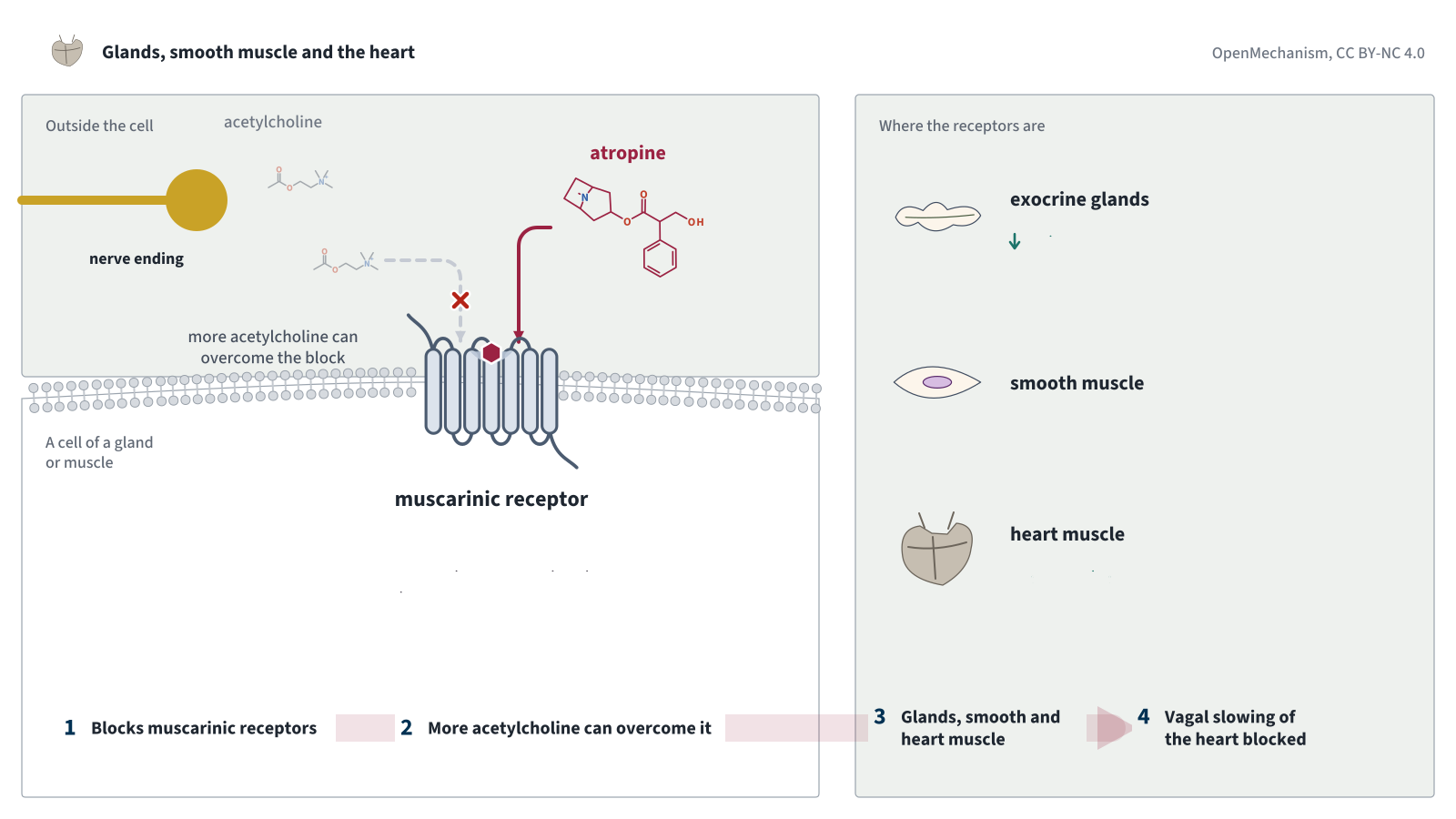
Atropine blocks the muscarine-like actions of acetylcholine at on exocrine glands, smooth muscle and heart muscle. The block is competitive, so more acetylcholine can overcome it. Enough atropine stops the vagus nerve from slowing the heart. It is used for severe or life-threatening muscarinic effects: to reduce saliva, against vagal slowing of the heart, as an antidote for organophosphorus or muscarinic mushroom poisoning, and in cardiac arrest with a very slow or absent heartbeat.
- Acts on
- Muscarinic receptors on glands and smooth and heart muscle
- Where
- Glands, smooth muscle and the heart
- Medicine type
- Small molecule
- Used for
- Antidotes & reversal
- Drug class
- Antimuscarinics (anticholinergics)
Key terms in this drawing
- muscarinic receptors
- Muscarinic receptors (M1 to M5). The receptors that antimuscarinic (anticholinergic) medicines block; they come in five subtypes, M1 to M5.
How it works
Blocks muscarinic receptors. Atropine is an antimuscarinic medicine: it blocks the muscarine-like actions of acetylcholine. It acts on organs supplied by the nerve endings that release acetylcholine (postganglionic cholinergic nerves), and on smooth muscles that respond to acetylcholine without such nerves.1
More acetylcholine can overcome it. Its block is competitive (surmountable): raising the acetylcholine at the receptors can overcome it, for example with anticholinesterase agents, which stop acetylcholine being broken down.1
Glands, smooth and heart muscle. The receptors it blocks are on the structures that muscarine stimulates or inhibits: exocrine glands, smooth muscle and heart muscle. It is used for temporary blockade of severe or life-threatening muscarinic effects: to reduce saliva, against vagal slowing of the heart, as an antidote for organophosphorus or muscarinic mushroom poisoning, and to treat cardiac arrest with a very slow or absent heartbeat (bradyasystolic cardiac arrest).1
Vagal slowing of the heart blocked. Enough atropine abolishes the reflex slowing or stopping of the heart by the vagus nerve. It also prevents or abolishes a slow heartbeat or asystole caused by choline esters, anticholinesterase agents or other parasympathomimetic medicines.1
For teachers: download this drawing.
See also
Condition pages: organophosphate poisoning.
Other antimuscarinics (anticholinergics): oxybutynin and tiotropium.
Related drawings: pralidoxime (given with atropine for organophosphate poisoning: it reactivates cholinesterase) and pilocarpine (stimulates the muscarinic receptors that atropine blocks).
Sources
- 1Atropine sulfate injection (Hospira): FDA label1 Indications and Usage; 12.1 Mechanism of Action; 12.2 Pharmacodynamics
- 2ChEMBL CHEMBL517712Target and action classification: Muscarinic acetylcholine receptor M1 antagonist; Muscarinic acetylcholine receptor M2 antagonist; Muscarinic acetylcholine receptor M3 antagonist
Spotted a mistake? Report an error (hello@openmechanism.com). Since launch, every published error we fix is listed on the corrections page.
Notes and limits
- A schematic teaching drawing: not to scale, not exact structures, binding poses or a complete pathway, and not a guide to dosing, treatment or how a person will respond.
All recorded limits are on the evidence page, and notes that apply to every page are on How to read a page. Version 1.0.0, not yet medically reviewed.
Cite this page
Tran D. Atropine [Internet]. OpenMechanism; 2026 [updated 2026 Oct 16; cited 2026 Oct 16]. Available from: https://openmechanism.com/medicines/atropine