Alendronate
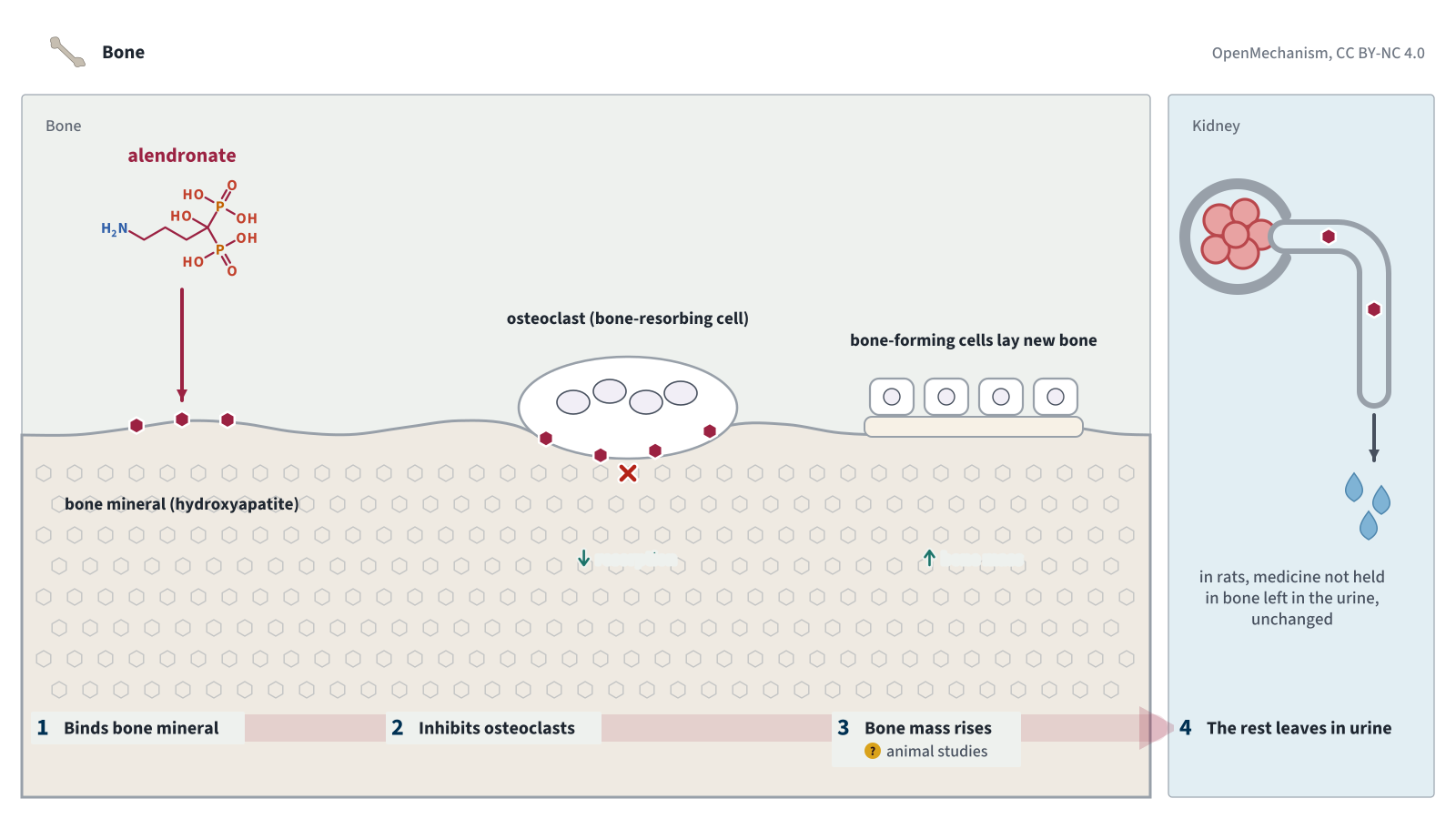
Alendronate, a bisphosphonate, binds to the mineral of bone (hydroxyapatite) and inhibits osteoclasts, the cells that resorb bone, without directly affecting bone formation, though the label says formation is ultimately reduced too, because the two are coupled in bone turnover. In animal studies, bone formation then outpaced resorption and bone mass rose. In studies in rats, medicine not taken up by bone left unchanged in the urine. Its label lists it for treating and preventing osteoporosis in women after menopause, where it increases bone mass and reduces fractures, including those of the hip and spine; for raising bone mass in men with osteoporosis; for osteoporosis caused by glucocorticoid (steroid) medicines in men and women taking the equivalent of 7.5 mg or more of prednisone a day who have low bone mineral density; and for Paget's disease of bone in men and women whose alkaline phosphatase is at least two times the upper limit of normal, who have symptoms, or who are at risk of future complications from it. It says the best length of use has not been determined.
- Acts on
- Bone mineral (hydroxyapatite) and osteoclasts, the bone-resorbing cells
- Where
- Bone
- Medicine type
- Small molecule
- Used for
- Muscles, bones & joints
- Drug class
- Bisphosphonates
Also called Fosamax.
Step 3: animal studies
The Fosamax label says: Animal studies have indicated the following mode of action. … Histomorphometry in baboons and rats showed that alendronate treatment reduces bone turnover (i.e., the number of sites at which bone is remodeled). In addition, bone formation exceeds bone resorption at these remodeling sites, leading to progressive gains in bone mass.
Clinical study: In Liberman and colleagues' 1995 placebo-controlled trial in 994 women with postmenopausal osteoporosis, who took alendronate (5 or 10 mg a day for three years, or 20 mg for two years then 5 mg for one year) or placebo, all with 500 mg of calcium a day; its abstract reports bone mineral density, fractures and height loss, not bone turnover: The women receiving alendronate had significant, progressive increases in bone mineral density at all skeletal sites, whereas those receiving placebo had decreases in bone mineral density.
Liberman UA et al., N Engl J Med 1995 (PMID 7477143)
How it works
Binds bone mineral. Alendronate is a bisphosphonate, a synthetic analog of pyrophosphate that binds to the hydroxyapatite found in bone.1
Inhibits osteoclasts. It specifically inhibits the activity of osteoclasts, the bone-resorbing cells, reducing bone resorption with no direct effect on bone formation, although bone formation is ultimately reduced, because resorption and formation are coupled during bone turnover.1
Bone mass rises. In animal studies, alendronate reduced bone turnover (the number of sites at which bone is remodeled), and bone formation exceeded bone resorption at remodeling sites, leading to progressive gains in bone mass.1
The rest leaves in urine. There is no evidence that alendronate is metabolized in animals or humans; in studies in rats, medicine that was not deposited in bone was rapidly excreted in the urine.1
For teachers: download this drawing.
See also
Condition pages: osteoporosis.
Explained: why alendronate can irritate the esophagus and why steroid medicines can weaken bones.
Related drawings: denosumab (also inhibits osteoclasts, by binding RANKL); and teriparatide (stimulates new bone formation).
Body system: muscles, bones & joints.
Sources
- 1Fosamax (alendronate sodium): FDA label1 Indications and Usage; 11 Description; 12.1 Mechanism of Action; 12.2 Pharmacodynamics; 12.3 Pharmacokinetics
- 2ChEMBL CHEMBL870Target and action classification: Farnesyl diphosphate synthase inhibitor
- 3Effect of oral alendronate on bone mineral density and the incidence of fractures in postmenopausal osteoporosis. The Alendronate Phase III Osteoporosis Treatment Study GroupLiberman UA et al. N Engl J Med 1995 (abstract)
Also used on this page
- 4Prednisone tablets: FDA labelDescription
Spotted a mistake? Report an error (hello@openmechanism.com). Since launch, every published error we fix is listed on the corrections page.
Notes and limits
- A schematic teaching drawing: not to scale, not exact structures, binding poses or a complete pathway, and not a guide to dosing, treatment or how a person will respond.
- The steps are in the order that explains them; one step is said to cause the next only where the source says so.
- The label's mechanism section says the findings in step 3 come from animal studies (histomorphometry in baboons and rats).
All recorded limits are on the evidence page, and notes that apply to every page are on How to read a page. Version 1.0.1, medically reviewed by Daniel Tran, PharmD, on 13 November 2026.
Cite this page
Tran D. Alendronate [Internet]. OpenMechanism; 2026 [updated 2026 Nov 13; cited 2026 Nov 13]. Available from: https://openmechanism.com/medicines/alendronate