OnabotulinumtoxinA
The toxin enters motor nerve endings and cuts , a protein needed to release acetylcholine. With less acetylcholine released, the injected muscle becomes less active. The effect wears off over time, and spread of effects can be serious.
- Acts on
- SNAP25
- Where
- Nerve endings in the injected muscle
- Medicine type
- Unknown
- Used for
- Muscles, bones & joints
Also called Botox.
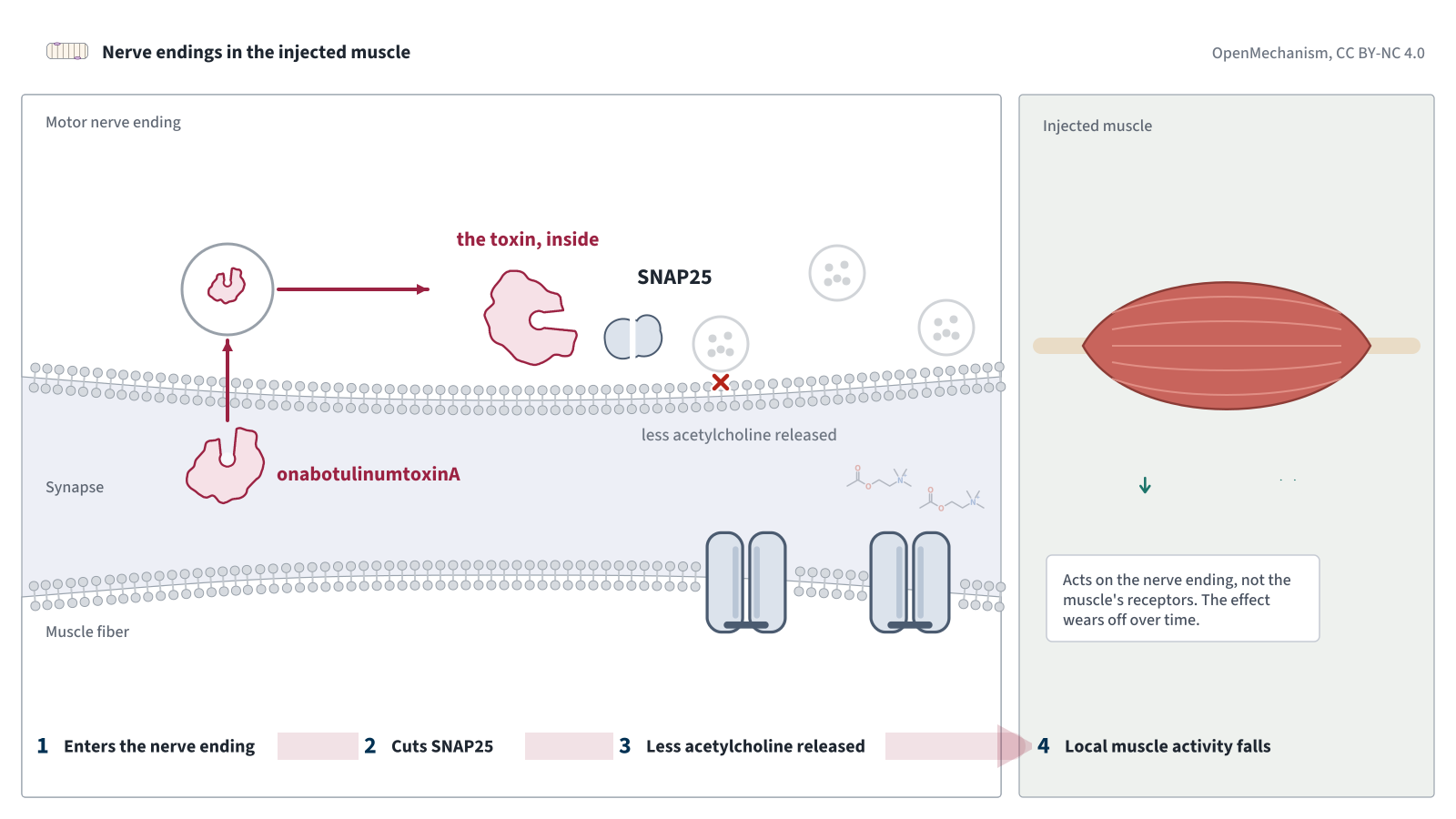
Key terms in this drawing
- SNAP25
- Synaptosomal-associated protein 25. A protein nerve endings need to release acetylcholine.
How it works
Enters the nerve ending. The toxin binds acceptor sites on motor nerve terminals and enters them.1
Cuts SNAP25. Toxin proteolysis cleaves SNAP25, a component needed for vesicle docking and release.1
Less acetylcholine released. Damage to the release apparatus inhibits acetylcholine release.1
Local muscle activity falls. The selected intramuscular route causes partial chemical denervation and a local reduction in muscle activity.1
For teachers: download this drawing or build a slide deck.
More detail
Blocking the nerve signal to the muscle
Binds nerve endings and enters them. OnabotulinumtoxinA binds acceptor sites on motor or autonomic terminals and enters them.2
Cuts SNAP-25 (lab studies). BoNT/A light chain selectively cleaves SNAP-25 as a zinc-dependent protease in experimental assays.3
Less acetylcholine released. SNAP-25 cleavage inhibits acetylcholine release from nerve-ending vesicles.2
Less muscle activity where injected. Intramuscular action produces partial chemical denervation and reduced local muscle activity.2
What the source says
“BOTOX blocks neuromuscular transmission by binding to acceptor sites on motor or autonomic nerve terminals, entering the nerve terminals, and inhibiting the release of acetylcholine.”
Source 1
“These findings demonstrate that BoNT/A acts as a zinc-dependent protease that selectively cleaves SNAP-25.”
Source 3
“When injected intramuscularly at therapeutic doses, BOTOX produces partial chemical denervation of the muscle resulting in a localized reduction in muscle activity.”
Source 1
How the effect wears off
Sweat glands
Antibodies that block it (rare)
27 of 5,876 made blocking antibodies; 5 stopped responding. Across 33 registration studies, 27/5876 evaluable subjects developed neutralizing antibodies; five were classified as secondary nonresponders.4
Effects beyond the injection site
Effects can spread, with possibly fatal swallowing or breathing problems. Effects can extend beyond the injection area, with potentially fatal swallowing or breathing difficulty.2
See also
Condition pages: excessive sweating (hyperhidrosis); migraine; overactive bladder; and spasticity and dystonia.
More medicines for muscles, bones & joints: alendronate, allopurinol, baclofen, burosumab, celecoxib, colchicine, cyclobenzaprine, dantrolene and 16 more.
Body system: muscles, bones & joints.
Sources
- 1Botox (onabotulinumtoxinA): FDA label12.1 Mechanism of Action
- 2Botox (onabotulinumtoxinA): FDA label§12.1–12.3, PDF p28; boxed warning p1 and §5.1; §6.2 immunogenicity; Boxed Warning; 5.1 Spread of Toxin Effect; 12.1 Mechanism of Action
- 3Botulinum neurotoxin A selectively cleaves the synaptic protein SNAP-25Blasi J et al., Nature 1993 (abstract)
- 4Neutralizing Antibody Formation with OnabotulinumtoxinA (BOTOX®) Treatment from Global Registration Studies across Multiple Indications: A Meta-AnalysisJankovic J et al., Toxins (Basel) 2023 (abstract)
- 5ChEMBL CHEMBL1201574Target and action classification: Synaptosomal nerve-associated protein 25 (SNAP-25) inhibitor
Also used on this page
The botulinum toxin A outline is traced from the crystal structure below.
- 6Botulinum toxin A light chain with SNAP-25, the protein it cutsPDB 1XTG; Breidenbach, M.A., Brunger, A.T. Nature 2004; 432:925-929
Spotted a mistake? Report an error (hello@openmechanism.com). Since launch, every published error we fix is listed on the corrections page.
Notes and limits
- A schematic teaching drawing: not to scale, not exact structures, binding poses or a complete pathway, and not a guide to dosing, treatment or how a person will respond.
- Other medicines in the same family may not follow every step or share the same clinical endpoint.
- The steps are in the order that explains them; one step is said to cause the next only where the source says so.
- Intramuscular neuromuscular mechanism is the main path; sweat glands are a separate labeled branch.
- BoNT/A enzyme experiments are not product-dose equivalence or a resolved binding pose.
- No universal vesicle failure, receptor identity, intracellular lifetime, or elimination route is inferred.
- Public manufacturer PDF inspected 2026-10-06 is revised 11/2023; a 2026 repackaged label date is not treated as a manufacturer revision.
- The toxin acts presynaptically rather than competitively blocking the muscle receptor.
- Motor, autonomic and gland routes are distinct; this scene selects the motor/muscle story. It does not show a permanent irreversible clinical state.
All recorded limits are on the evidence page, and notes that apply to every page are on How to read a page. Version 1.1.0, not yet medically reviewed.
Cite this page
Tran D. OnabotulinumtoxinA [Internet]. OpenMechanism; 2026 [updated 2026 Oct 15; cited 2026 Oct 15]. Available from: https://openmechanism.com/medicines/onabotulinumtoxina