Malignant hyperthermia
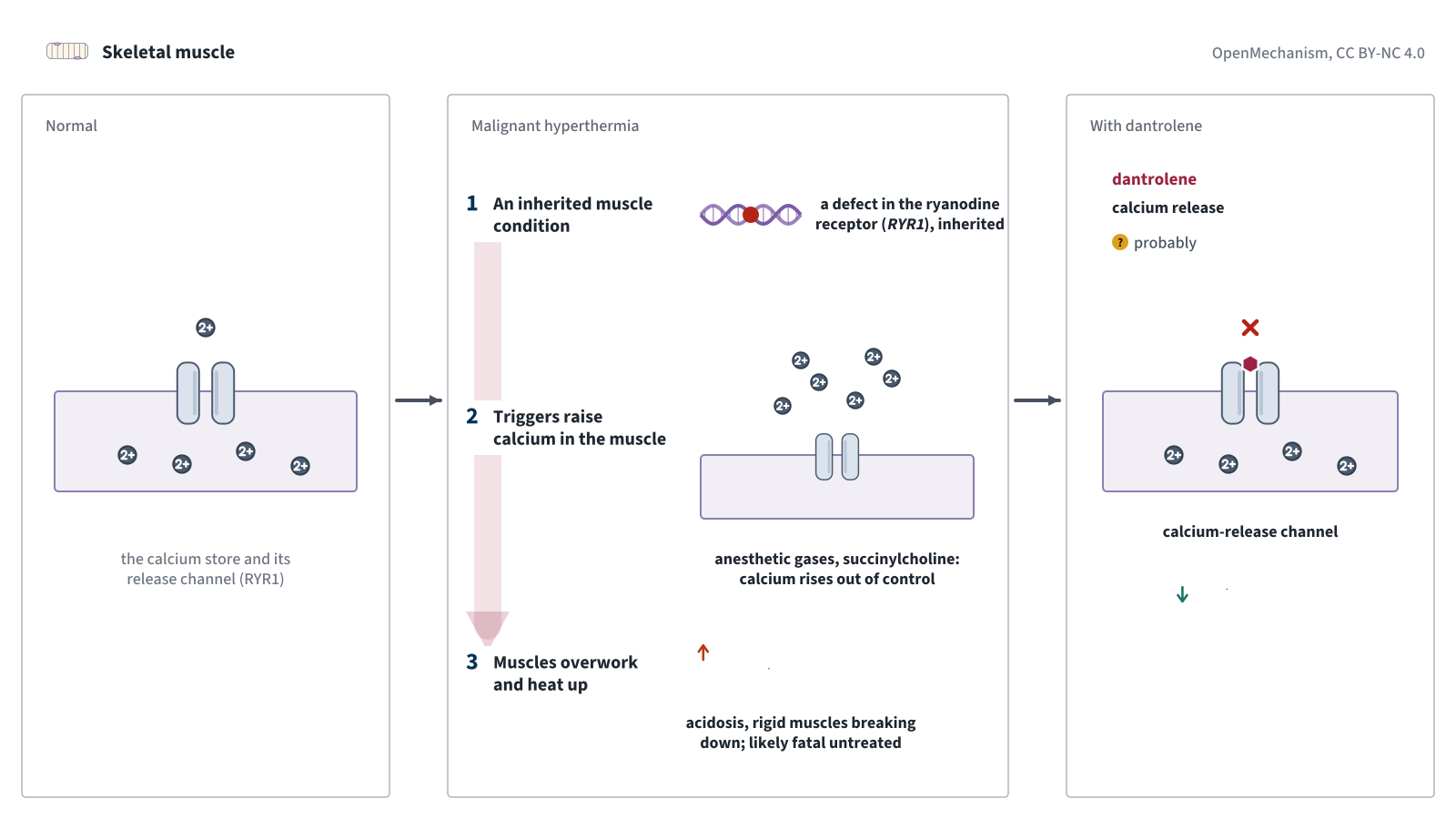
Malignant hyperthermia is an inherited disorder of skeletal muscle, usually from a defect in the ryanodine receptor (RYR1). Volatile anesthetic gases and succinylcholine trigger an uncontrolled rise of calcium inside the muscle cells, and the muscles go into overdrive: high temperature, fast heart rate and breathing, acidosis, rigidity and muscle breakdown. Dantrolene holds back calcium release.
- Where
- Skeletal muscle
- Body system
- Muscles, bones & joints
- Medicines
- 1 medicine
Probably
The Ryanodex (dantrolene) label says: In skeletal muscle, dantrolene dissociates the excitation-contraction coupling, probably by interfering with the release of Ca ++ from the sarcoplasmic reticulum.
Clinical study: In a multicenter study of intravenous dantrolene in 11 people with unequivocal or probable malignant hyperthermia during anesthesia, with no comparison group; the study measured recovery and blood chemistry, not calcium release in muscle: All 11 recovered without sequelae from MH and without adverse drug effects. … A mean dantrolene dose of 2.5 mg/kg in these patients produced significant changes in clinical and biochemical parameters suggestive of decreased cellular metabolism.
Kolb ME et al., Anesthesiology 1982 (PMID 7039419)
This study was picked with a literature search and is not yet checked by our reviewer.
For teachers: download this drawing.
Key terms in this drawing
- RYR1
- Ryanodine receptor 1. The ryanodine receptor of muscle; a defect in it causes most cases of malignant hyperthermia.
What goes wrong
An inherited muscle condition. Malignant hyperthermia is a pharmacogenetic (inherited, medicine-triggered) disorder of skeletal muscle; in most cases it is caused by a defect in the ryanodine receptor, the gene.1
Triggers raise calcium in the muscle. Potent volatile anesthetic gases (such as sevoflurane) and the muscle relaxant succinylcholine set it off; an uncontrolled rise of calcium inside the muscle cells drives the changes that follow.1
What the source says
“presents as a hypermetabolic response to potent volatile anesthetic gases such as halothane, sevoflurane, desflurane, isoflurane and the depolarizing muscle relaxant succinylcholine”
Source 1“Uncontrolled rise of myoplasmic calcium, which activates biochemical processes related to muscle activation leads to the pathophysiologic changes.”
Source 1Muscles overwork and heat up. The result is a hypermetabolic crisis: high temperature, fast heart rate and breathing, more carbon dioxide made, acidosis, high potassium, muscle rigidity and muscle breakdown. It is likely to be fatal if untreated.1
What the source says
“The classic signs of MH include hyperthermia, tachycardia, tachypnea, increased carbon dioxide production, increased oxygen consumption, acidosis, hyperkalaemia, muscle rigidity, and rhabdomyolysis, all related to a hypermetabolic response.”
Source 1“The syndrome is likely to be fatal if untreated.”
Source 1
Where medicines act
- A
Dantrolene: calcium release held back
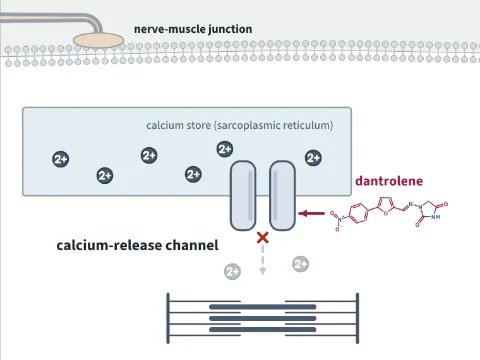
Dantrolene uncouples the muscle's excitation from its contraction, probably by holding back calcium release from the sarcoplasmic reticulum; in a triggered muscle cell it may restore normal calcium, so the crisis may be reversed or lessened.2
What the source says
“In skeletal muscle, dantrolene dissociates the excitation-contraction coupling, probably by interfering with the release of Ca ++ from the sarcoplasmic reticulum.”
Source 2“In this way, physiologic, metabolic, and biochemical changes associated with the malignant hyperthermia crisis may be reversed or attenuated.”
Source 2
See also
Body system: muscles, bones & joints.
Zoom in: inside skeletal muscle.
Can raise or cause it: succinylcholine (“presents as a hypermetabolic response to potent volatile anesthetic gases such as halothane, sevoflurane, desflurane, isoflurane and the depolarizing muscle relaxant succinylcholine”1).
Other conditions: spasticity and dystonia.
The medicine in the body: succinylcholine and the BCHE gene.
Sources
- 1Malignant hyperthermia: a reviewRosenberg H et al. Orphanet J Rare Dis 2015 (abstract). Saved copy
- 2Ryanodex (dantrolene sodium) injectable suspension: FDA label1 Indications and Usage; 12.1 Mechanism of Action. Saved copy
- 3Dantrolene in human malignant hyperthermiaKolb ME et al. Anesthesiology 1982 (abstract). Saved copy
Notes and limits
- The label describes how the triggers act inside the cell as postulated.2
- Reactions are rare (1 in 10,000 to 1 in 250,000 anesthetics), though the genetic changes may be carried by as many as 1 in 400 people.1
Notes that apply to every page are on How to read a page.
Spotted a mistake? Report an error (hello@openmechanism.com). Since launch, every published error we fix is listed on the corrections page.
Cite this page
Tran D. Malignant hyperthermia [Internet]. OpenMechanism; 2026 [updated 2026 Oct 20; cited 2026 Oct 20]. Available from: https://openmechanism.com/conditions/malignant-hyperthermia