Dantrolene
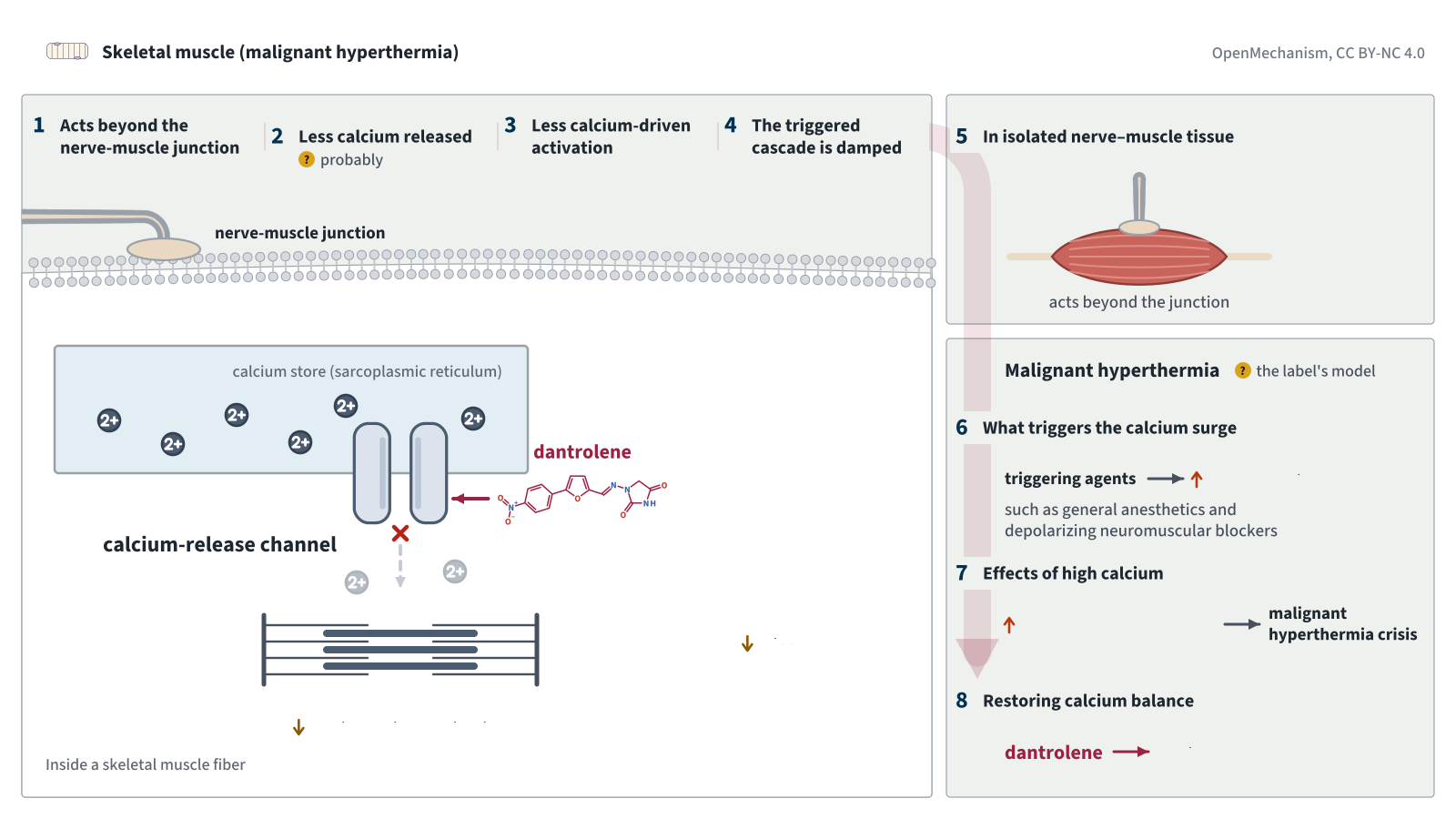
Dantrolene acts inside skeletal muscle, beyond the nerve–muscle junction. The label describes it as probably reducing calcium release from the muscle's internal store, which can damp the calcium surge of malignant hyperthermia.
- Acts on
- Sarcoplasmic-reticulum calcium-release machinery
- Where
- Inside skeletal muscle fibers
- Medicine type
- Small molecule
- Used for
- Muscles, bones & joints
Also called Ryanodex.
The label's model
The Ryanodex label says: In the anesthetic-induced malignant hyperthermia syndrome, evidence points to an intrinsic abnormality of skeletal muscle tissue.
Source 1: Ryanodex (dantrolene sodium): FDA label, 12.1 Mechanism of Action
Clinical study: In a case series from 65 institutions, with no comparison group, in which 11 people with unequivocal or probable malignant hyperthermia during anesthesia were treated with intravenous dantrolene; the study measured recovery and deaths, not the label's model of how the crisis starts: Dantrolene therapy resulted in a statistically significantly lower mortality rate than would be expected in MH patients.
Kolb ME et al., Anesthesiology 1982 (PMID 7039419)
This study was picked with a literature search and is not yet checked by our reviewer.
Step 2: probably
The Ryanodex label says: In skeletal muscle, dantrolene dissociates the excitation-contraction coupling, probably by interfering with the release of Ca ++ from the sarcoplasmic reticulum.
Source 1: Ryanodex (dantrolene sodium): FDA label, 12.1 Mechanism of Action
Clinical study: In a case series from 65 institutions, with no comparison group, in which 11 people with unequivocal or probable malignant hyperthermia during anesthesia were treated with intravenous dantrolene; the study measured recovery and clinical and biochemical changes, not calcium release from the sarcoplasmic reticulum: All 11 recovered without sequelae from MH and without adverse drug effects. … A mean dantrolene dose of 2.5 mg/kg in these patients produced significant changes in clinical and biochemical parameters suggestive of decreased cellular metabolism.
Kolb ME et al., Anesthesiology 1982 (PMID 7039419)
This study was picked with a literature search and is not yet checked by our reviewer.
How it works
Acts beyond the nerve-muscle junction. Dantrolene acts on skeletal-muscle contractile responses at a site beyond the neuromuscular junction.1
Less calcium released. The label describes a probable interference with calcium release from the sarcoplasmic reticulum.1
Less calcium-driven activation. Reduced release opposes the elevated myoplasmic calcium of triggered malignant-hyperthermic muscle.1
The triggered cascade is damped. Restoring calcium equilibrium can attenuate associated metabolic and physiological changes.1
In isolated nerve–muscle tissue. In isolated nerve–muscle preparation, dantrolene affects skeletal-muscle excitation–contraction coupling beyond the myoneural junction.1
What triggers the calcium surge. The label postulates that triggering agents elevate myoplasmic calcium in affected humans.1
Effects of high calcium. Within the label model, elevated myoplasmic calcium activates acute cellular catabolic processes.1
Restoring calcium balance. The label describes dantrolene-mediated inhibition of calcium release as potentially reestablishing myoplasmic calcium equilibrium.1
For teachers: download this drawing or build a slide deck.
See also
Condition pages: malignant hyperthermia; and spasticity and dystonia.
More medicines for muscles, bones & joints: alendronate, allopurinol, baclofen, burosumab, celecoxib, colchicine, cyclobenzaprine, denosumab and 16 more.
Body system: muscles, bones & joints.
Inside the body: inside skeletal muscle.
Sources
- 1Ryanodex (dantrolene sodium): FDA label12.1 Mechanism of Action
- 2ChEMBL CHEMBL1201288Target and action classification: Ryanodine receptor 1 antagonist; Ryanodine receptor 3 antagonist
- 3Dantrolene in human malignant hyperthermiaKolb ME et al. Anesthesiology 1982 (abstract)
Spotted a mistake? Report an error (hello@openmechanism.com). Since launch, every published error we fix is listed on the corrections page.
Notes and limits
- A schematic teaching drawing: not to scale, not exact structures, binding poses or a complete pathway, and not a guide to dosing, treatment or how a person will respond.
- The steps are in the order that explains them; one step is said to cause the next only where the source says so.
- The label qualifies the release mechanism and malignant-hyperthermia sequence as probable/postulated. No direct RYR1 binding pose is established here.
All recorded limits are on the evidence page, and notes that apply to every page are on How to read a page. Version 1.0.1, not yet medically reviewed.
Cite this page
Tran D. Dantrolene [Internet]. OpenMechanism; 2026 [updated 2026 Oct 15; cited 2026 Oct 15]. Available from: https://openmechanism.com/medicines/dantrolene