Pilocarpine
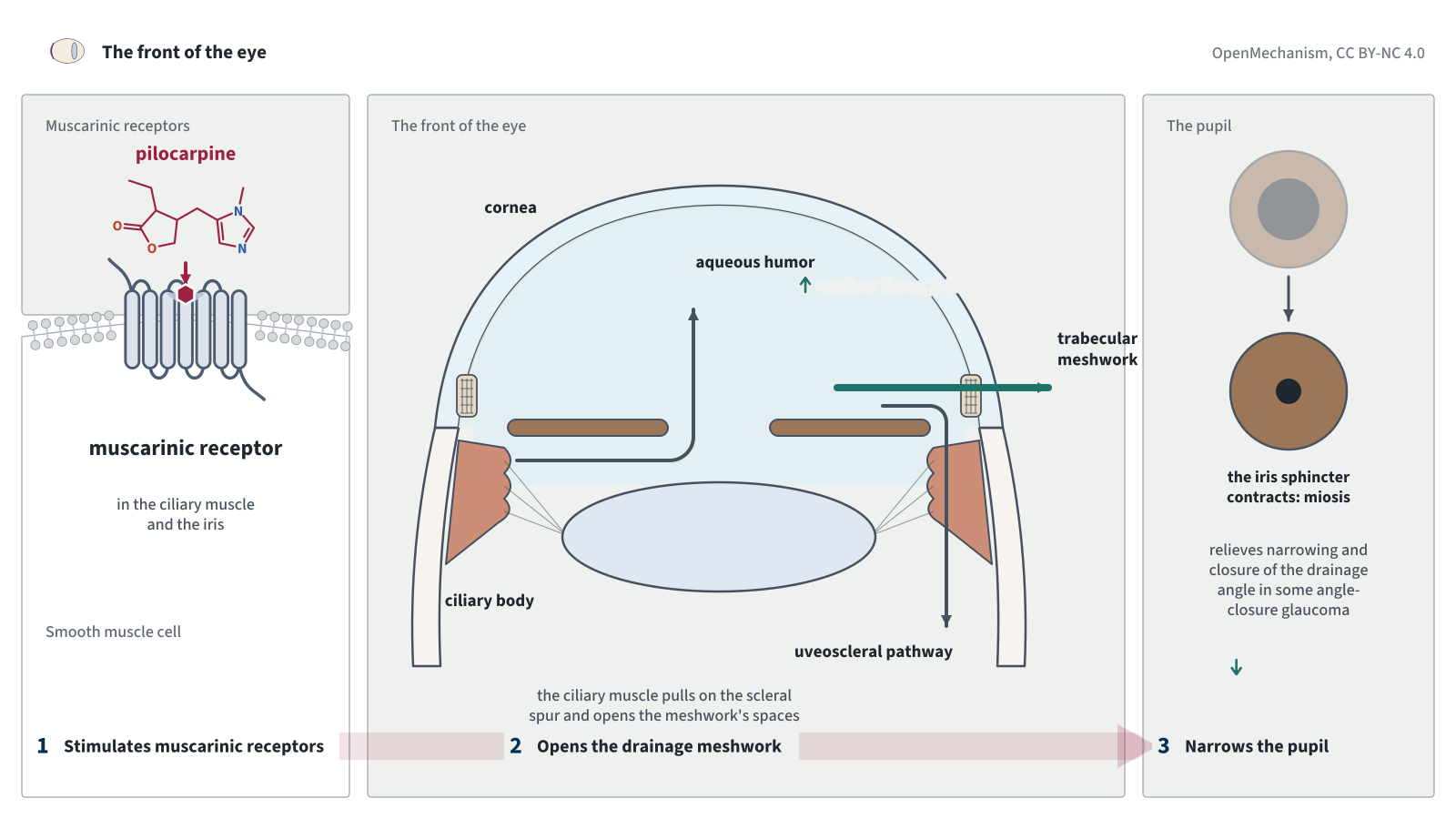
Pilocarpine eye drops directly stimulate . Contracting the ciliary muscle opens the spaces of the trabecular meshwork, so the eye's fluid, the aqueous humor, drains out more easily and eye pressure falls. Contracting the iris sphincter narrows the pupil, which relieves the narrowing and closure of the drainage angle in certain types of angle-closure glaucoma.
- Acts on
- Muscarinic receptors
- Where
- The ciliary muscle and iris of the eye
- Medicine type
- Small molecule
- Used for
- Eyes & ears
Key terms in this drawing
- muscarinic receptors
- Muscarinic receptors (M1 to M5). The receptors that antimuscarinic (anticholinergic) medicines block; they come in five subtypes, M1 to M5.
How it works
Stimulates muscarinic receptors. Pilocarpine, a direct-acting cholinergic agent, directly stimulates muscarinic receptors and smooth muscle such as that of the iris and the secretory glands.1
Opens the drainage meshwork. It contracts the ciliary muscle, which pulls on the scleral spur and opens the spaces of the trabecular meshwork, one of the two main structures that handle the aqueous humor; the fluid drains out more easily and eye pressure falls.1,2
Narrows the pupil. It also narrows the pupil (miosis) by contracting the iris sphincter muscle, which relieves the narrowing and closure of the drainage angle and lowers eye pressure in certain types of angle-closure glaucoma.1
For teachers: download this drawing.
See also
Condition pages: glaucoma.
Related drawings: latanoprost (also lowers eye pressure, by draining fluid mainly through the uveoscleral pathway); timolol (lowers eye pressure, perhaps mainly by making less fluid); and atropine (blocks the muscarinic receptors that pilocarpine stimulates).
Sources
- 1Pilocarpine hydrochloride ophthalmic solution (Sandoz): FDA label1 Indications and Usage; 12.1 Mechanism of Action
- 2Aqueous humor dynamics: a reviewGoel M et al., Open Ophthalmol J 2010 (abstract)
- 3ChEMBL CHEMBL550Target and action classification: Muscarinic acetylcholine receptor M1 agonist; Muscarinic acetylcholine receptor M3 agonist
Spotted a mistake? Report an error (hello@openmechanism.com). Since launch, every published error we fix is listed on the corrections page.
Notes and limits
- A schematic teaching drawing: not to scale, not exact structures, binding poses or a complete pathway, and not a guide to dosing, treatment or how a person will respond.
All recorded limits are on the evidence page, and notes that apply to every page are on How to read a page. Version 1.0.0, not yet medically reviewed.
Cite this page
Tran D. Pilocarpine [Internet]. OpenMechanism; 2026 [updated 2026 Oct 18; cited 2026 Oct 18]. Available from: https://openmechanism.com/medicines/pilocarpine