Cyclobenzaprine
The label for cyclobenzaprine extended-release capsules lists it, alongside rest and physical therapy, for relief of muscle spasm with acute, painful musculoskeletal conditions, and says adequate evidence that it works for longer than 2 or 3 weeks is not available; it has not been found effective for spasticity from brain or spinal cord disease, or in children with cerebral palsy. In animal studies it acts not at the nerve-muscle junction or directly on the muscle but mainly in the brainstem, and the evidence suggests it lowers tonic motor activity. After a single dose of the extended-release capsules, its is about 32 hours (50 hours in people over 65).
- Acts on
- The central nervous system, mainly the brainstem (in animal studies)
- Where
- Brainstem and motor systems
- Medicine type
- Small molecule
- Used for
- Muscles, bones & joints
- Drug class
- Muscle relaxants (centrally acting)
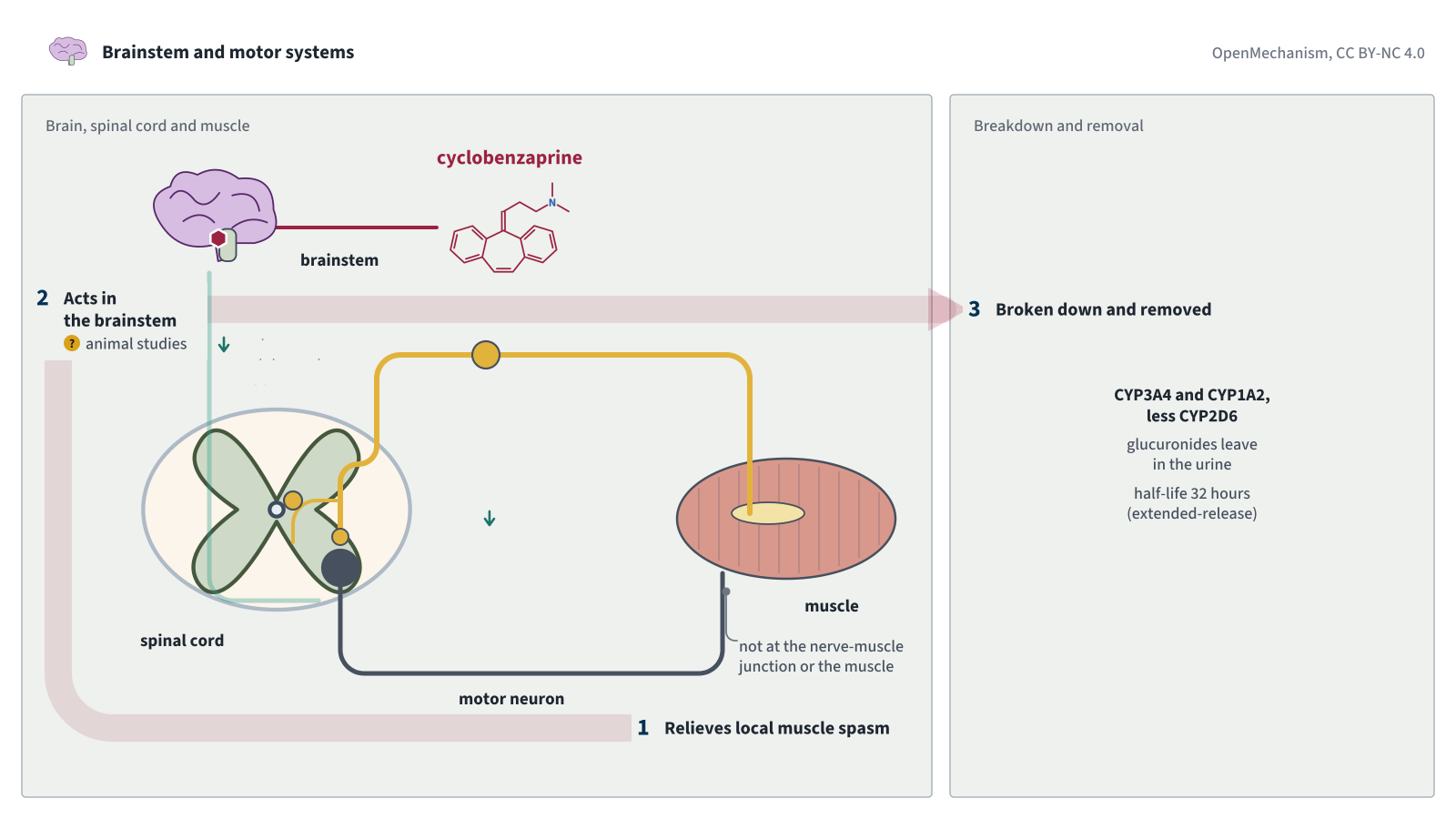
Step 2: animal studies
The cyclobenzaprine label says: Animal studies indicate that cyclobenzaprine does not act at the neuromuscular junction or directly on skeletal muscle. Such studies show that cyclobenzaprine acts primarily within the central nervous system at the brain stem as opposed to the spinal cord level, although an overlapping action on the latter may contribute to its overall skeletal muscle relaxant activity. Evidence suggests that the net effect of cyclobenzaprine is a reduction of tonic somatic motor activity, influencing both gamma (γ) and alpha (α) motor systems.
Clinical study: Browning and colleagues' 2001 meta-analysis of randomized, placebo-controlled trials in adults with back pain, which measured symptom improvement, not where cyclobenzaprine acts, found: Patients treated with cyclobenzaprine were nearly 5 times (odds ratio, 4.7; 95% confidence interval, 2.7-8.1) as likely to report symptom improvement by day 14 as were those treated with placebo. … Cyclobenzaprine is more effective than placebo in the management of back pain; the effect is modest and comes at the price of greater adverse effects.
Browning R et al., Arch Intern Med 2001 (PMID 11434793)
Key terms in this drawing
- CYP1A2
- Cytochrome P450 1A2. One of the cytochrome P450 enzymes that break down medicines; the main one for tizanidine.
- CYP2D6
- Cytochrome P450 2D6. A liver enzyme that breaks down several medicines; for tramadol it makes the active metabolite M1.
- CYP3A4
- Cytochrome P450 3A4. One of the cytochrome P450 enzymes that break down medicines, atorvastatin among them; some antibiotics and antifungals can block it.
- half-life
- Half-life. The time it takes for the amount in the blood to fall by half.
How it works
Relieves local muscle spasm. Cyclobenzaprine relieves skeletal muscle spasm of local origin without interfering with muscle function; it has not been shown to work in spasm due to central nervous system disease.1
Acts in the brainstem. Animal studies indicate that it does not act at the neuromuscular junction or directly on skeletal muscle, but mainly within the central nervous system at the brainstem (an action on the spinal cord may contribute). Evidence suggests its net effect is less tonic somatic motor activity, influencing both gamma and alpha motor systems.1
Broken down and removed. It is extensively metabolized (partly by and , less by ) and excreted mainly as glucuronides in the urine; after a single dose of the extended-release capsules, its elimination half-life is 32 hours (range 8 to 37), and 50 hours in people over 65.1
For teachers: download this drawing.
See also
Condition pages: muscle spasm.
Other muscle relaxants (centrally acting): baclofen, methocarbamol and tizanidine.
Body system: muscles, bones & joints.
Sources
- 1Cyclobenzaprine hydrochloride extended-release capsules: FDA label1 Indications and Usage; 12.1 Mechanism of Action; 12.3 Pharmacokinetics
- 2ChEMBL CHEMBL669Target and action classification: Serotonin 2a (5-HT2a) receptor antagonist; Serotonin 2c (5-HT2c) receptor antagonist
- 3Cyclobenzaprine and back pain: a meta-analysisBrowning R et al. Arch Intern Med 2001 (abstract)
Spotted a mistake? Report an error (hello@openmechanism.com). Since launch, every published error we fix is listed on the corrections page.
Notes and limits
- A schematic teaching drawing: not to scale, not exact structures, binding poses or a complete pathway, and not a guide to dosing, treatment or how a person will respond.
- The steps are in the order that explains them; one step is said to cause the next only where the source says so.
- The label says the findings on where it acts come from animal studies, and that evidence suggests the net effect is a reduction of tonic somatic motor activity.
- The label adds that in animal studies cyclobenzaprine's effects resembled those of the structurally related tricyclic antidepressants, including strong anticholinergic effects and sedation, and that it raised heart rate slightly to moderately in animals.
- Source 2 gives ChEMBL's classification of cyclobenzaprine as a serotonin 2A and 2C receptor antagonist; the label's mechanism section names no receptor.
All recorded limits are on the evidence page, and notes that apply to every page are on How to read a page. Version 1.0.1, medically reviewed by Daniel Tran, PharmD, on 13 November 2026.
Cite this page
Tran D. Cyclobenzaprine [Internet]. OpenMechanism; 2026 [updated 2026 Nov 13; cited 2026 Nov 13]. Available from: https://openmechanism.com/medicines/cyclobenzaprine