Ivabradine
Ivabradine blocks the 'funny' current (If) carried by channels in the heart's natural pacemaker, the . The pacemaker fires more slowly, so heart rate falls.
- Acts on
- HCN channels, cardiac If current
- Where
- The heart's pacemaker (sinoatrial node)
- Medicine type
- Small molecule
- Used for
- Heart & circulation
Also called Corlanor.
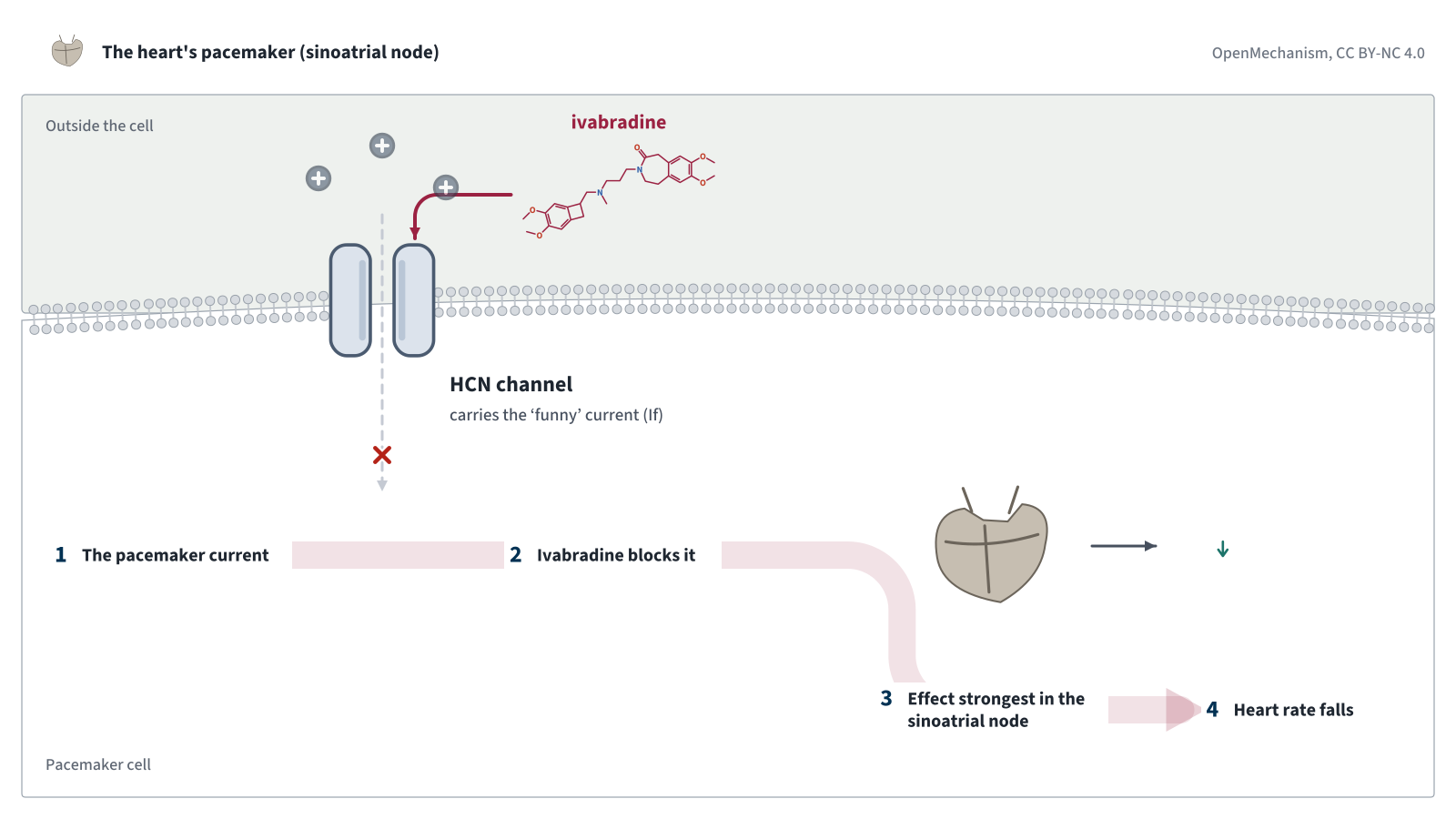
Key terms in this drawing
- HCN
- Hyperpolarization-activated cyclic nucleotide-gated channel. The channel that carries the heart's pacemaker ('funny') current.
- SA node
- Sinoatrial node. The place in the heart where each heartbeat's electrical impulse starts.
How it works
The pacemaker current. HCN channels carry the cardiac If current that regulates heart rate.1
Ivabradine blocks it. Ivabradine inhibits this HCN-channel-dependent current.1
Effect strongest in the sinoatrial node. Electrophysiological effects are most pronounced in the sinoatrial node.1
Heart rate falls. The selected endpoint is reduced cardiac pacing rate.1
For teachers: download this drawing or build a slide deck.
See also
Condition pages: heart failure.
Body system: heart, vessels & cholesterol.
Sources
- 1Corlanor (ivabradine): FDA label12.1 Mechanism of Action
- 2ChEMBL CHEMBL471737Target and action classification: Potassium/sodium hyperpolarization-activated cyclic nucleotide-gated channel 4 blocker
Spotted a mistake? Report an error (hello@openmechanism.com). Since launch, every published error we fix is listed on the corrections page.
Notes and limits
- A schematic teaching drawing: not to scale, not exact structures, binding poses or a complete pathway, and not a guide to dosing, treatment or how a person will respond.
- The steps are in the order that explains them; one step is said to cause the next only where the source says so.
- No HCN isoform, action-potential waveform, beat rate or ventricular contractility change is invented.
All recorded limits are on the evidence page, and notes that apply to every page are on How to read a page. Version 1.0.0, not yet medically reviewed.
Cite this page
Tran D. Ivabradine [Internet]. OpenMechanism; 2026 [updated 2026 Oct 13; cited 2026 Oct 13]. Available from: https://openmechanism.com/medicines/ivabradine