Evolocumab
Evolocumab is an antibody that binds and stops it attaching to . More LDL receptors stay available on liver cells to clear cholesterol from the blood.
- Acts on
- PCSK9
- Where
- Liver cells and PCSK9 in the blood
- Used for
- Heart & circulation
- Drug class
- Antibody medicines
Also called Repatha.
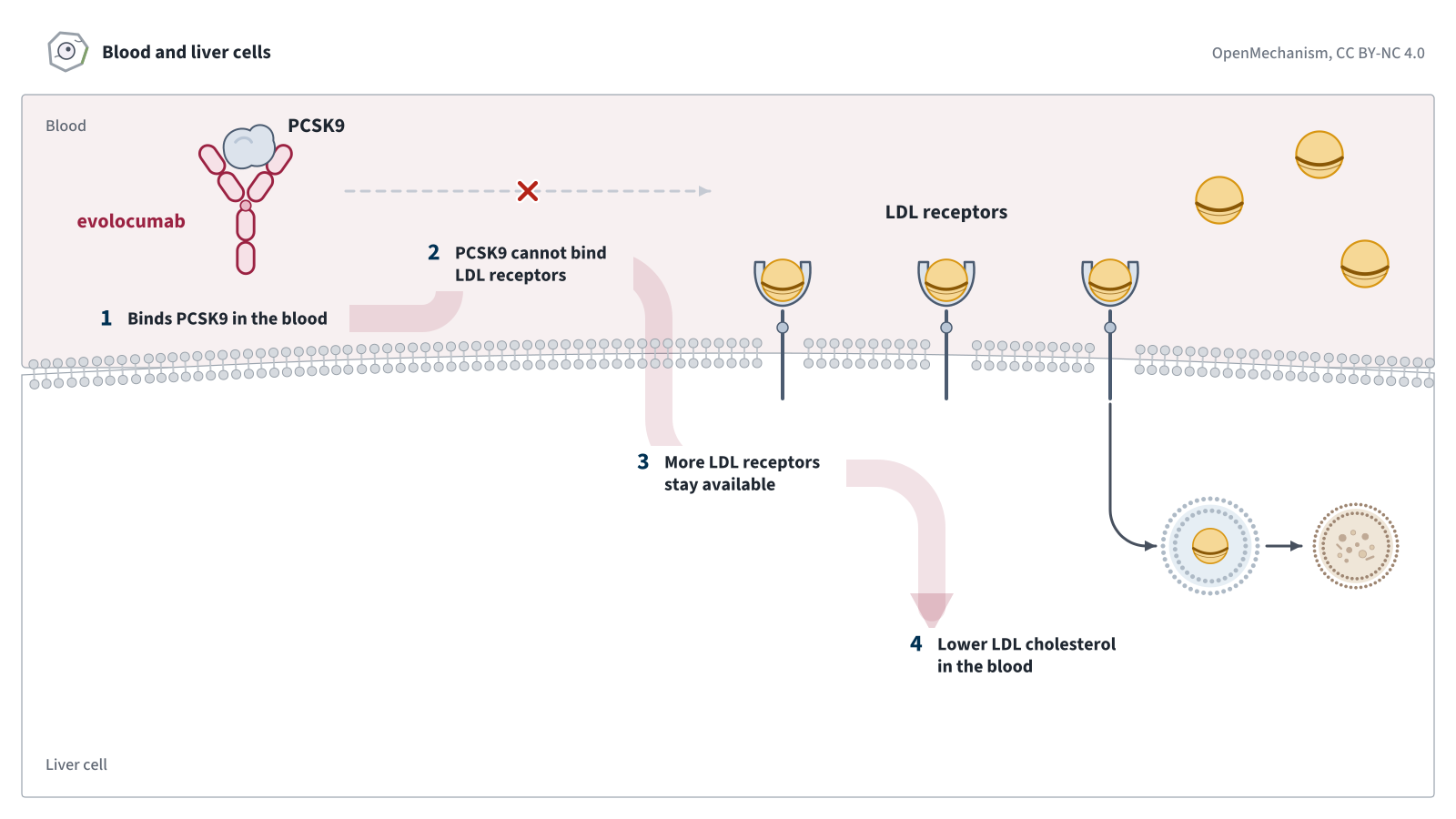
Key terms in this drawing
- LDL
- Low-density lipoprotein. Particles that carry cholesterol in the blood ('LDL cholesterol').
- LDL receptor
- Low-density lipoprotein receptor. A receptor on liver cells that takes LDL particles out of the blood.
- PCSK9
- Proprotein convertase subtilisin/kexin type 9. A protein that binds LDL receptors and sends them to be broken down.
How it works
Binds PCSK9 in the blood. Evolocumab binds PCSK9.1
PCSK9 cannot bind LDL receptors. The antibody prevents PCSK9 from binding LDL receptors.1
More LDL receptors stay available. Inhibited PCSK9 action increases the number of LDL receptors available to clear LDL.1
Lower LDL cholesterol in the blood. Greater receptor-mediated clearance lowers LDL cholesterol.1
For teachers: download this drawing or build a slide deck.
More detail
Blocking PCSK9 to keep LDL receptors
Injected under the skin; reaches the blood. Subcutaneous evolocumab produces systemic serum exposure.1
An antibody against PCSK9. Evolocumab is a human IgG2 monoclonal antibody directed against human PCSK9.1
PCSK9 leads to LDL receptors being broken down. PCSK9–LDLR binding promotes hepatic LDL receptor degradation.1
Stops PCSK9 binding LDL receptors. Evolocumab inhibits PCSK9 binding to LDL receptors.1
More receptors to clear LDL. Binding inhibition increases receptors available to clear LDL.1
Lower LDL cholesterol. Increased LDL clearance lowers LDL-C.1
What the source says
“Evolocumab is a human monoclonal IgG2 directed against human proprotein convertase subtilisin kexin type 9 (PCSK9).”
Source 1
“PCSK9 binds to the low-density lipoprotein receptor (LDLR) on the surface of hepatocytes to promote LDLR degradation within the liver. By inhibiting the binding of PCSK9 to LDLR, evolocumab increases the number of LDLRs available to clear LDL from the blood, thereby lowering LDL-C levels.”
Source 1
How the body clears it
At low levels, cleared by binding PCSK9. At low concentrations, saturable PCSK9 binding predominantly mediates elimination.1
At higher levels, broken down as protein. At higher concentrations, nonsaturable proteolysis largely mediates elimination.1
What the source says
“At low concentrations, the elimination is predominately through saturable binding to target (PCSK9), while at higher concentrations the elimination of REPATHA is largely through a non-saturable proteolytic pathway.”
Source 1
When LDL receptors are missing
No response in people with two LDLR-negative alleles. TESLA patients known to have two LDLR-negative did not respond.1
Allergic reactions
Serious allergic reactions, including angioedema. Serious hypersensitivity, including angioedema, has occurred.1
See also
Condition pages: high LDL cholesterol.
Other antibody medicines: adalimumab, bevacizumab, bezlotoxumab, blinatumomab, burosumab, denosumab, dupilumab, eculizumab and 14 more.
More medicines for heart & circulation: adenosine, aliskiren, ambrisentan, amiloride, amiodarone, amlodipine, atenolol, atorvastatin and 58 more.
Animations: evolocumab blocking PCSK9.
Body system: heart, vessels & cholesterol.
Sources
- 1Repatha (evolocumab): FDA label12.1 Mechanism of Action; 12.2 Pharmacodynamics; 12.3 Pharmacokinetics; 14 Clinical Studies, Study 7 (TESLA); 5.1 Hypersensitivity Reactions; 14 Clinical Studies (TESLA)
- 2ChEMBL CHEMBL2364655Target and action classification: Subtilisin/kexin type 9 inhibitor
Spotted a mistake? Report an error (hello@openmechanism.com). Since launch, every published error we fix is listed on the corrections page.
Notes and limits
- A schematic teaching drawing: not to scale, not exact structures, binding poses or a complete pathway, and not a guide to dosing, treatment or how a person will respond.
- Other medicines in the same family may not follow every step or share the same clinical endpoint.
- The steps are in the order that explains them; one step is said to cause the next only where the source says so.
- The antibody targets protein, unlike inclisiran’s RNA target.
- The TESLA nonresponse observation is specific to known two LDLR-negative alleles; it is not a universal HoFH rule.
- The selected label supports PCSK9-LDLR interaction blockade and greater receptor availability; it does not establish a catalytic-pocket inhibitor or a fully resolved endosomal-routing pose.
All recorded limits are on the evidence page, and notes that apply to every page are on How to read a page. Version 1.1.0, not yet medically reviewed.
Cite this page
Tran D. Evolocumab [Internet]. OpenMechanism; 2026 [updated 2026 Oct 12; cited 2026 Oct 12]. Available from: https://openmechanism.com/medicines/evolocumab