A schematic teaching drawing: not to scale, not exact structures, binding poses or a complete pathway, and not a guide to dosing, treatment or how a person will respond.
Other medicines in the same family may not follow every step or share the same clinical endpoint.
The steps are in the order that explains them; one step is said to cause the next only where the source says so.
Secreted protein target; no RNA interference branch.
Qualitative statement restricted to the linked source context.
The selected label supports PCSK9-LDLR interaction blockade and greater receptor availability; it does not establish a catalytic-pocket inhibitor or a fully resolved endosomal-routing pose.
No epitope coordinates or receptor-binding pose assigned.
No individual response or cardiovascular effect size is inferred.
The antibody targets protein, unlike inclisiran’s RNA target.
The TESLA nonresponse observation is specific to known two LDLR-negative alleles; it is not a universal HoFH rule.
The drawings are schematic and not to scale; each step shows only what its statements say, and the time between steps is not a measured time. They replace the record player's views, which stay available: original record animation.
Every limit as recorded
Player duration and motion are explanatory, not measured biological kinetics.
Secreted protein target; no RNA interference branch.
human-medicine label description; not a resolved molecular pose
Qualitative statement restricted to the linked source context.
Topology, molecular contours and spacing are schematic, not experimentally resolved binding poses or a complete physiological model.
The selected mechanism story does not assert every medicine in its family follows all of these steps or shares its clinical endpoint.
The selected label supports PCSK9-LDLR interaction blockade and greater receptor availability; it does not establish a catalytic-pocket inhibitor or a fully resolved endosomal-routing pose.
No epitope coordinates or receptor-binding pose assigned.
No individual response or cardiovascular effect size is inferred.
Source-backed motion explanation.
Timing, particle counts, paths, spacing and geometry are illustrative; no measured rates, distances, concentrations or clinical response implied.
Original 2D glyphs and class icons are schematic references, not molecular folds, binding poses or to-scale anatomy.
Motion and cue order are an authored explanatory layer. Only declared, separately source-bound relations carry biological meaning.
Manual playback / seek / replay; no autoplay. A still frame alone does not imply the entire process happened at one time.
Qualitative, source-bound teaching figure; no kinetics, response prediction or treatment guidance.
Abstract actors and compartment labels; no inferred binding pose, molecular coordinates or escape efficiency.
The antibody targets protein, unlike inclisiran’s RNA target.
The TESLA nonresponse observation is specific to known two LDLR-negative alleles; it is not a universal HoFH rule.
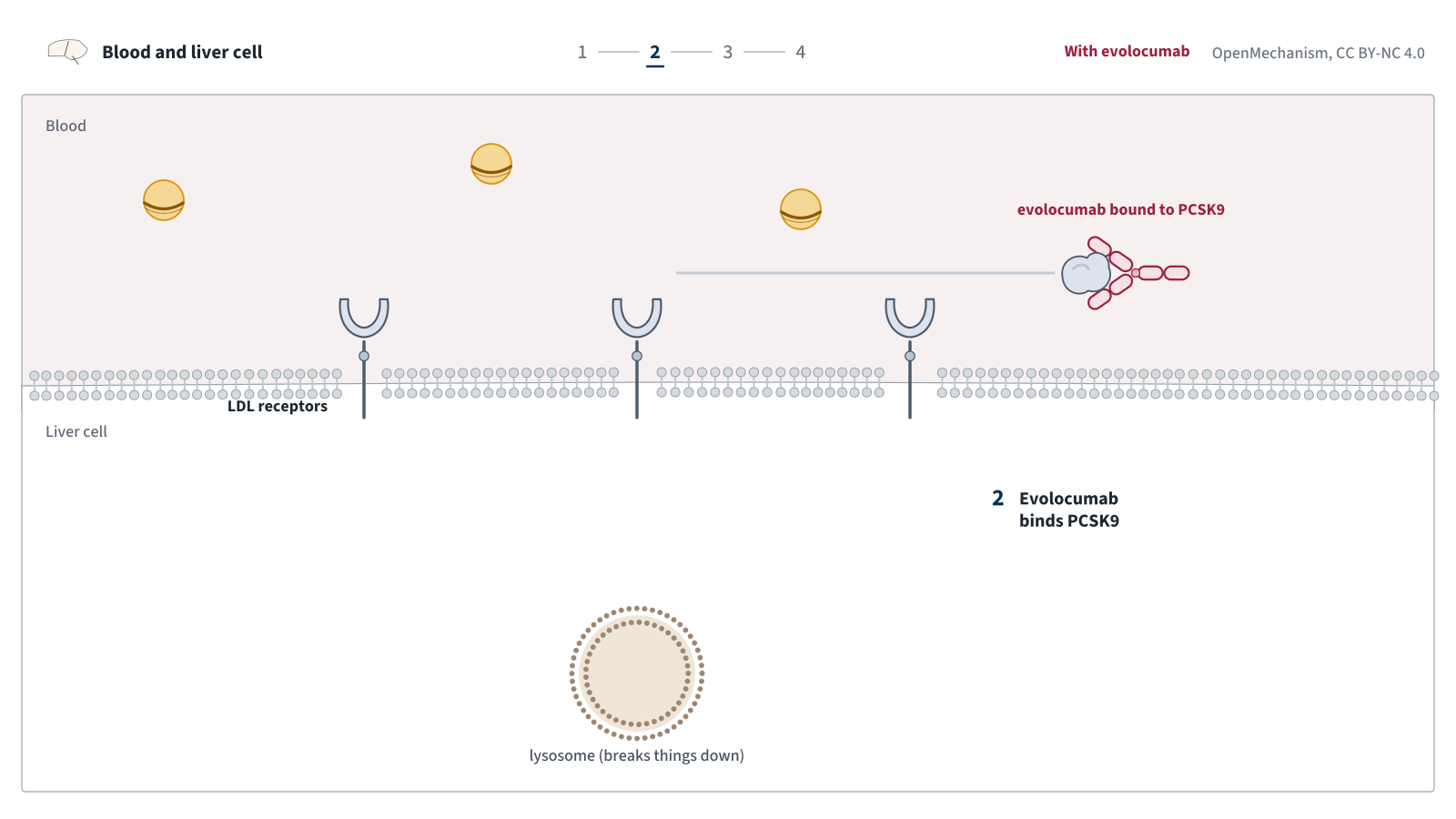
Antibody and PCSK9 remain separate schematic glyphs; an explanatory relation line marks engagement, not resolved antigen/epitope contacts. One receptor/LDL icon does not encode receptor counts or response efficacy.
The record's notes on each step
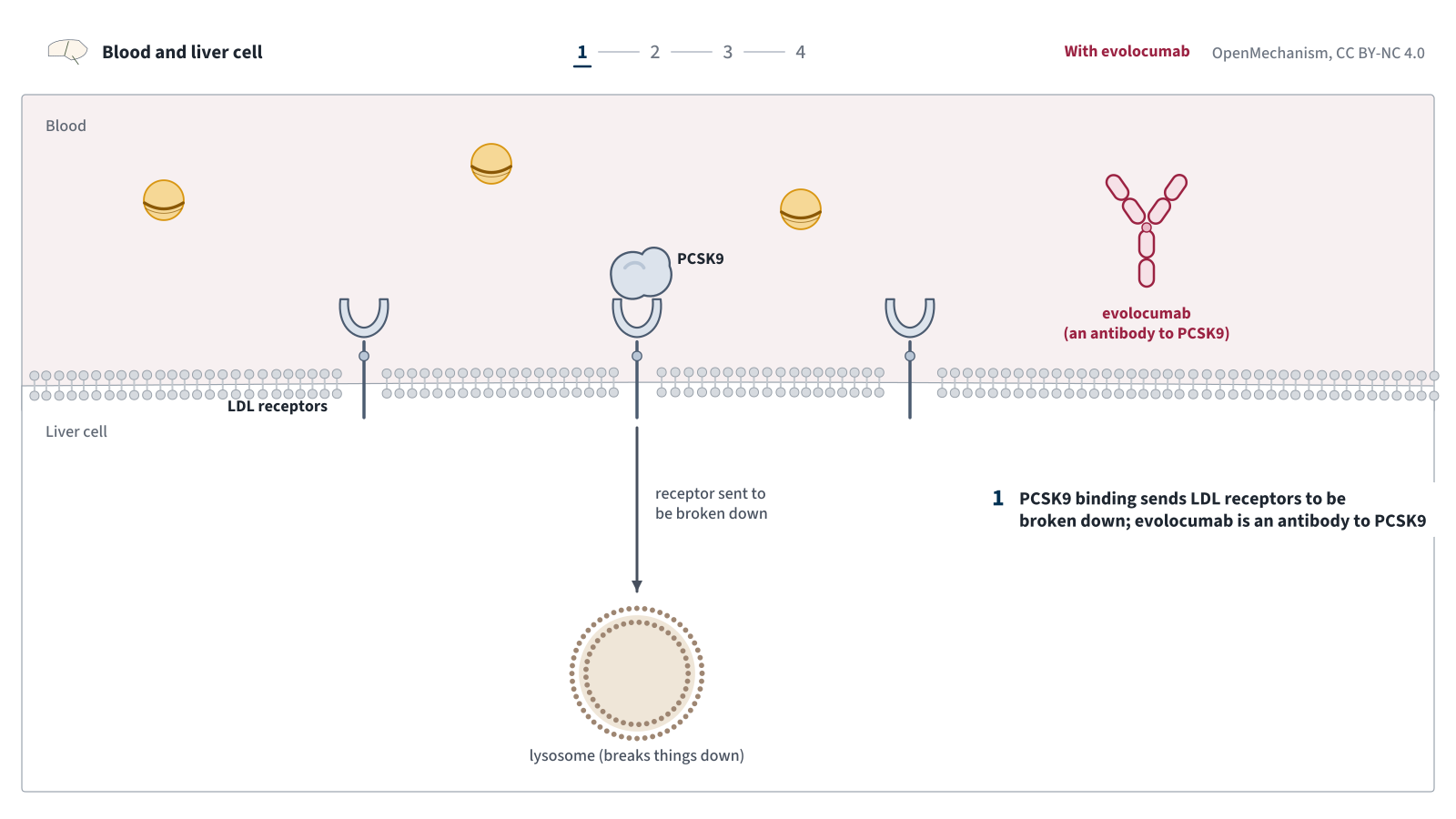
Step 1: Evolocumab is a human IgG2 directed against human PCSK9; PCSK9–LDLR binding promotes receptor degradation.
Step 2: Evolocumab binds PCSK9. Relative glyph positions are explanatory and do not resolve a binding pose.
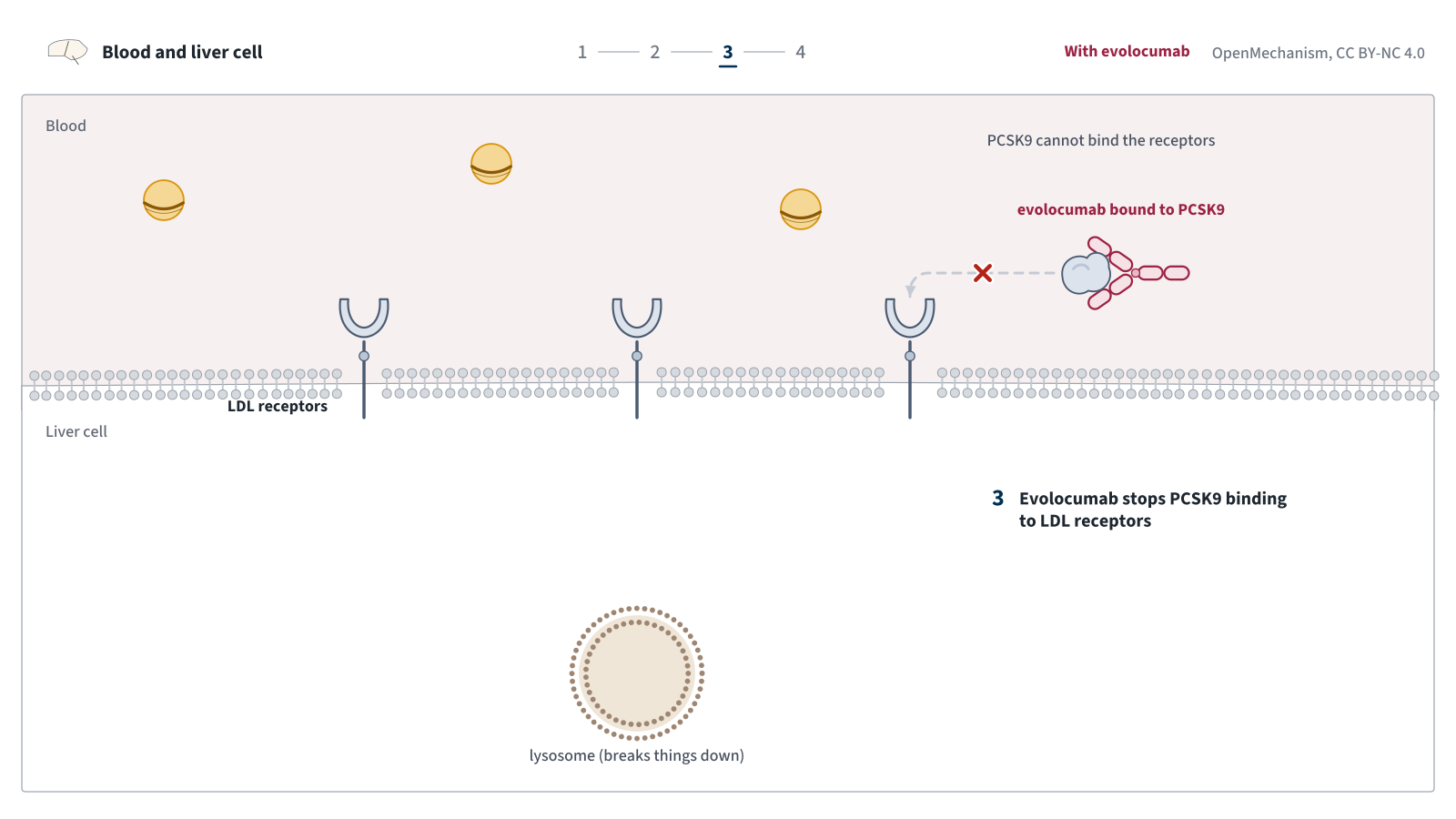
Step 3: Evolocumab inhibits PCSK9 binding to LDL receptors; the receptor illustration stays available.
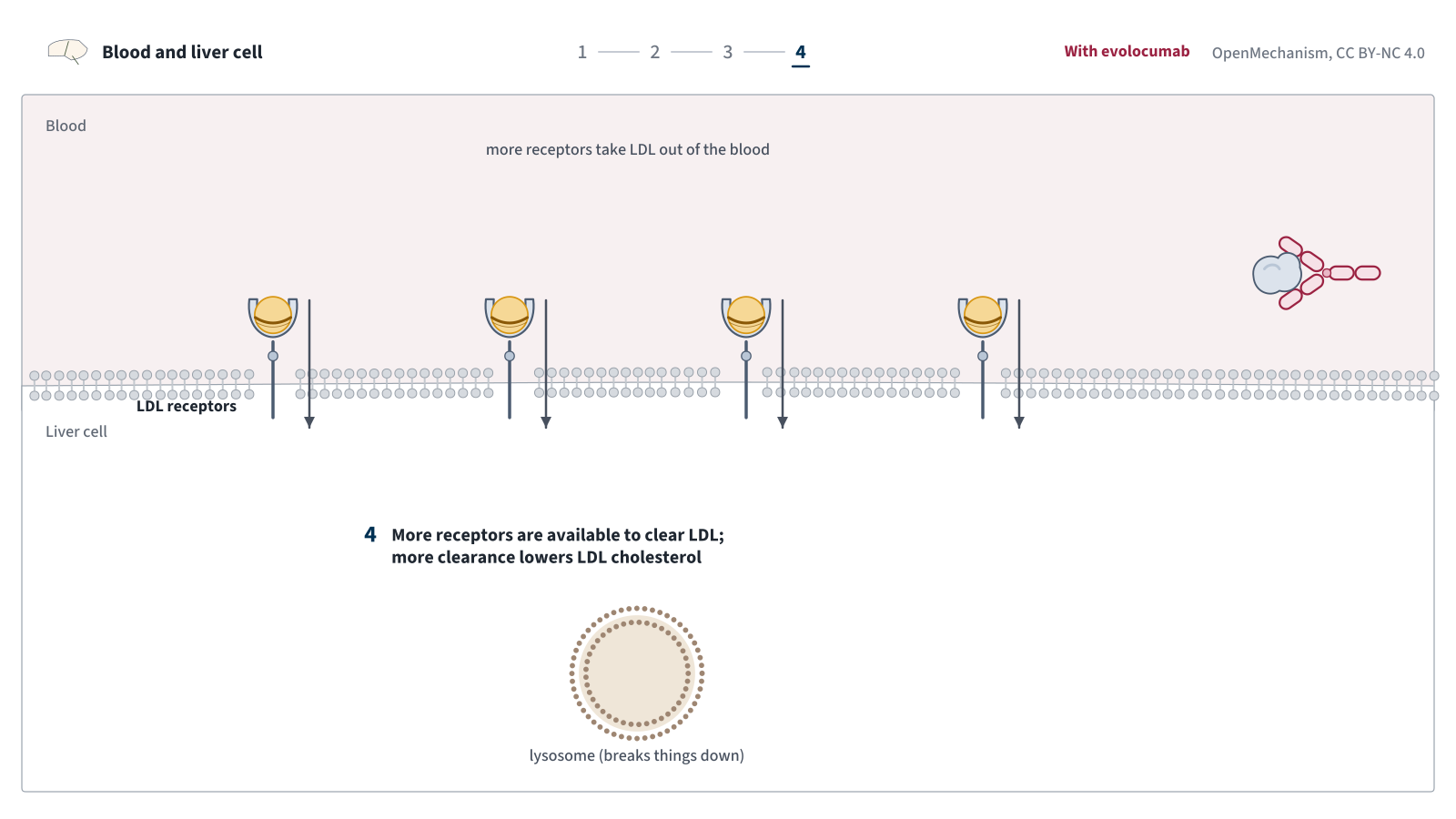
Step 4: More receptors are available to clear LDL; increased clearance lowers LDL-C. No receptor-number or clinical response calculation.
Tran D. How evolocumab stops PCSK9 [Internet]. OpenMechanism; 2026 [updated 2026 Oct 13; cited 2026 Oct 13]. Available from: https://openmechanism.com/animations/evolocumab-engagement