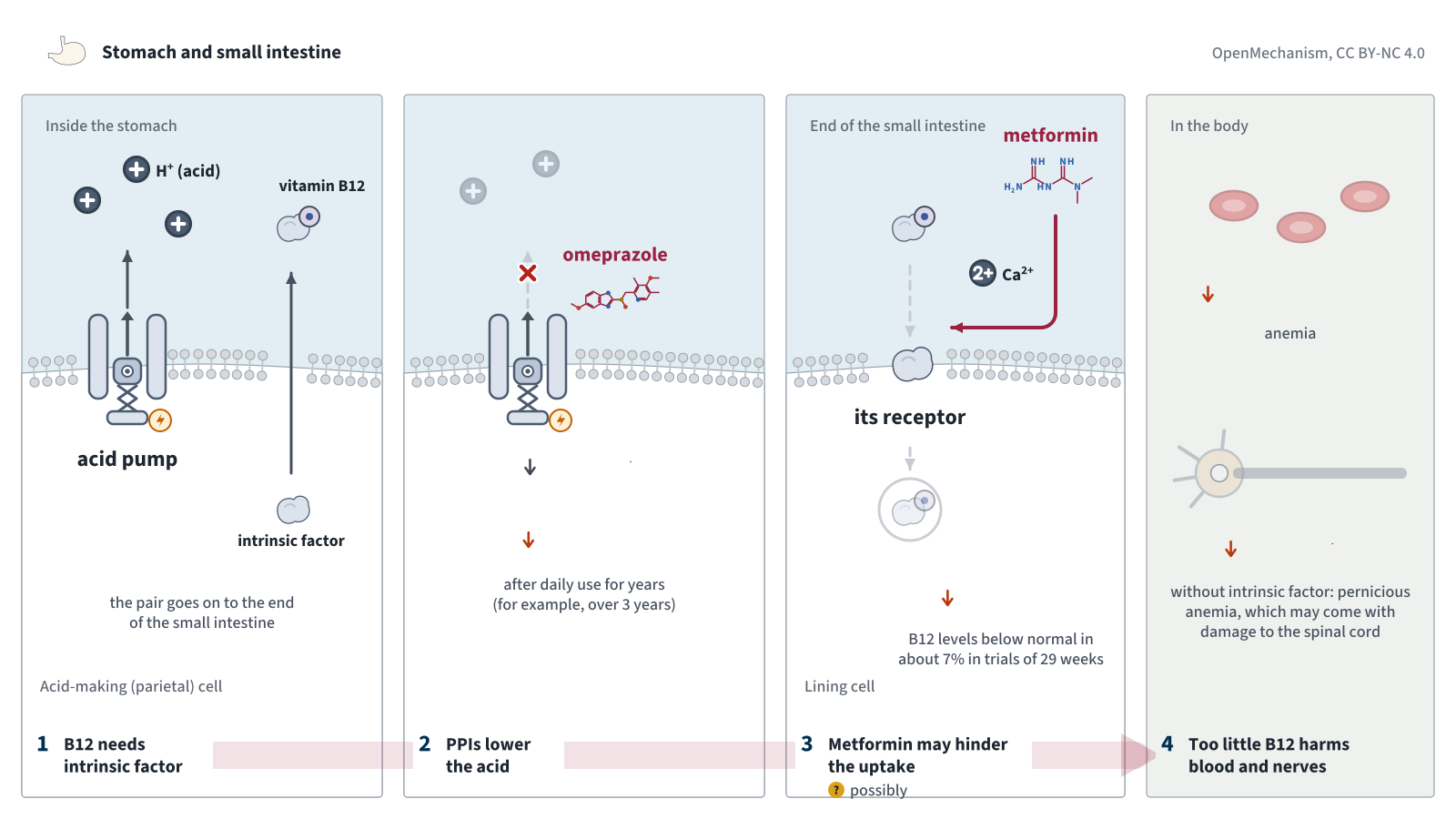
Vitamin B12 is absorbed mainly with intrinsic factor, which the stomach's acid-making cells also make, and the pair is taken up at the end of the small intestine. Taken daily for years, omeprazole and other medicines that suppress stomach acid may lead to poor B12 absorption, from too little acid. The label notes rare reports of B12 deficiency with them. In trials of 29 weeks, B12 levels that had been normal fell below normal in about 7% of people taking metformin, possibly because it gets in the way of the B12-intrinsic factor pair's uptake. B12 is needed for red blood cells and the nerves, so a shortage can cause anemia.
The metformin label says: Such decrease, possibly due to interference with B 12 absorption from the B 12 -intrinsic factor complex, may be associated with anemia but appears to be rapidly reversible with discontinuation of metformin or vitamin B 12 supplementation.
Clinical study: In Bauman and colleagues' small 2000 study of 21 people with type 2 diabetes on a sulfonylurea, 14 were switched to metformin, the other 7 serving as controls, with blood B12 levels measured monthly, and after 3 months on metformin they were given calcium by mouth; the authors conclude: Patients receiving metformin have diminished B12 absorption and low serum total vitamin B12 and TCII-B12 levels because of a calcium-dependent ileal membrane antagonism, an effect reversed with supplemental calcium.Bauman WA et al., Diabetes Care 2000 (PMID 10977010)
B12 needs intrinsic factor. The stomach's parietal cells make both hydrochloric acid and . Intrinsic factor binds and carries it to the end of the small intestine (the terminal ileum), where the pair is taken up. B12 is absorbed mainly this way, and the uptake also needs calcium; a small amount, about 1% of the B12 taken in, is absorbed by simple diffusion, which is enough only with very large doses.1,2,3,4
What the source says
“A large epithelial cell located in the mucous membrane of the stomach that secretes gastric intrinsic factor and hydrochloric acid.”
“A small amount (approximately 1% of the total amount ingested) is absorbed by simple diffusion, but this mechanism is adequate only with very large doses.”
PPIs lower the acid. Omeprazole, a proton pump inhibitor (PPI), lowers stomach acid by blocking the parietal cells' acid pump (). Taken daily for a long time, for example more than 3 years, it and other medicines that suppress acid may lead to poor absorption of vitamin B12, which the label puts down to too little acid. The label adds that there are rare reports in the literature of B12 deficiency with acid-suppressing treatment.5
What the source says
“Omeprazole belongs to a class of antisecretory compounds, the substituted benzimidazoles, that suppress gastric acid secretion by specific inhibition of the H + /K + ATPase enzyme system at the secretory surface of the gastric parietal cell.”
“Daily treatment with any acid-suppressing medications over a long period of time (e.g., longer than 3 years) may lead to malabsorption of cyanocobalamin (vitamin B-12) caused by hypo- or achlorhydria. Rare reports of cyanocobalamin deficiency occurring with acid-suppressing therapy have been reported in the literature.”
Metformin may hinder the uptake. In trials of 29 weeks, B12 levels that had been normal fell below normal in about 7% of people taking metformin, possibly because it gets in the way of the uptake of the B12-intrinsic factor pair. People who take in or absorb too little B12 or calcium appear more prone to it.6
What the source says
“In clinical trials of 29-week duration with metformin hydrochloride tablets, a decrease to subnormal levels of previously normal serum vitamin B 12 levels was observed in approximately 7% of patients.”
“Such decrease, possibly due to interference with B 12 absorption from the B 12 -intrinsic factor complex, may be associated with anemia but appears to be rapidly reversible with discontinuation of metformin or vitamin B 12 supplementation.”
“Certain individuals (those with inadequate vitamin B 12 or calcium intake or absorption) appear to be predisposed to developing subnormal vitamin B 12 levels.”
Too little B12 harms blood and nerves. Vitamin B12 is needed to make mature red blood cells and for normal nerve function, so a shortage can cause anemia and harm the nerves: without intrinsic factor, the result is pernicious anemia, which may come with damage to the spinal cord. With metformin, the label says the fall may go with anemia.4,6,7
What the source says
“Vitamin B12 is an essential water-soluble vitamin required for critical biological processes such as DNA synthesis, erythrocyte maturation, and maintenance of nervous system integrity.”
“Such decrease, possibly due to interference with B 12 absorption from the B 12 -intrinsic factor complex, may be associated with anemia but appears to be rapidly reversible with discontinuation of metformin or vitamin B 12 supplementation.”
The Prilosec and metformin labels both list B12 deficiency among their warnings and precautions; their advice on checking B12 and treating a shortage is left out: this page explains the mechanism, not what to do.5,6
A 2023 review of 25 studies comparing people taking proton pump inhibitors with people not taking them found B12 deficiency slightly more common in those taking them; its authors say the studies differed significantly and the increase was too small to show a link clearly.8
In a 2025 study of health insurance records of adults newly diagnosed with type 2 diabetes who started metformin and took it for at least 4 months, those also taking a PPI had a somewhat higher risk of B12 deficiency, counted from diagnosis codes or B12 prescriptions (adjusted hazard ratio 1.18); a study like this shows an association, not a cause.9
The metformin label says the fall appears to reverse quickly when metformin is stopped or vitamin B12 is given.6
A 1991 paper on intrinsic factor and B12 absorption says B12 in food is bound to animal protein and is freed from it in the stomach by peptic digestion, and that too little or no stomach acid, whether caused by medical treatment or not, may impair B12 uptake. The same paper says omeprazole has no effect on intrinsic factor while substantially reducing acid secretion.2
The 1991 paper also says that in the stomach B12 freed from food protein is bound to R-proteins, and that pancreatic enzymes split that complex in the duodenum, where B12 is bound to intrinsic factor; the cyanocobalamin label says B12 is bound to intrinsic factor during transit through the stomach, as the drawing shows it.2,4
text 192cafe8cd15…; drawings 0bd13660ba14…; notes c00b3b143bbf…
AI source check
Claude Opus 5.5 (AI source check), 13 November 2026: 38 statements compared with their sources, 5 flagged for the reviewer. An automated check, not a medical review.
Next review due
14 May 2028
Cite this page
Tran D. Why PPIs and metformin can lower vitamin B12 [Internet]. OpenMechanism; 2026 [updated 2026 Nov 13; cited 2026 Nov 13]. Available from: https://openmechanism.com/explained/ppis-metformin-and-vitamin-b12