Medically reviewed by Daniel Tran, PharmD, on 13 November 2026.
Levothyroxine and calcium, iron or acid reducers
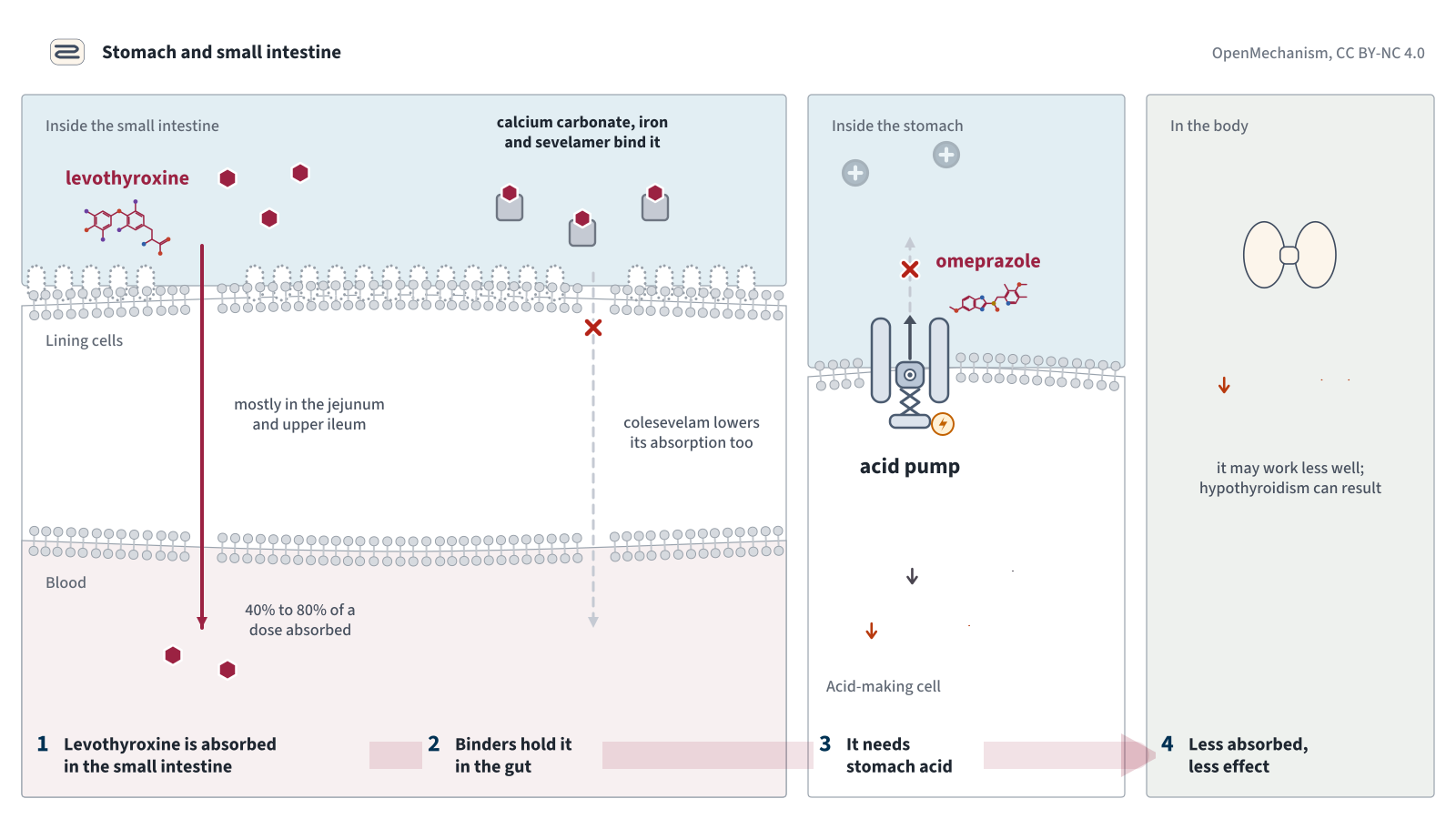
Only part of a levothyroxine dose is absorbed, mostly in the small intestine. Calcium carbonate, iron (ferrous sulfate) and other phosphate binders may bind it in the gut, and bile acid sequestrants such as colesevelam lower its absorption too. It also needs stomach acid to be absorbed well: proton pump inhibitors, antacids and sucralfate may lower the acid and the levothyroxine absorbed. Absorbed less, it may work less well, and hypothyroidism can result.
- Kind
- Interaction
- Medicines
- Levothyroxine, Omeprazole
- Sources
- 2
For teachers: download this drawing.
Step by step
Levothyroxine is absorbed in the small intestine. Between 40% and 80% of a levothyroxine dose taken by mouth is absorbed, most of it from the small intestine (the jejunum and upper ileum).1
Binders hold it in the gut. Phosphate binders, such as calcium carbonate, ferrous sulfate (iron), sevelamer and lanthanum, may bind levothyroxine in the gut, and bile acid sequestrants such as colesevelam lower its absorption too.1
What the source says
“Phosphate Binders (e.g., calcium carbonate, ferrous sulfate, sevelamer, lanthanum) Phosphate binders may bind to levothyroxine.”
Source 1“Bile Acid Sequestrants (e.g., colesevelam, cholestyramine, colestipol) Ion Exchange Resins (e.g., Kayexalate) Bile acid sequestrants and ion exchange resins are known to decrease levothyroxine absorption.”
Source 1It needs stomach acid. Stomach acid is essential for levothyroxine to be absorbed well. Proton pump inhibitors such as omeprazole, antacids and sucralfate may lower the acid and reduce its absorption. Omeprazole, a proton pump inhibitor, lowers acid by blocking the acid pump of the stomach's acid-making (parietal) cells.1,2
What the source says
“Gastric acidity is an essential requirement for adequate absorption of levothyroxine.”
Source 1“Sucralfate, antacids and proton pump inhibitors may cause hypochlorhydria, affect intragastric pH, and reduce levothyroxine absorption.”
Source 1“PRILOSEC is a proton pump inhibitor (PPI)”
Source 2“Omeprazole belongs to a class of antisecretory compounds, the substituted benzimidazoles, that suppress gastric acid secretion by specific inhibition of the H + /K + ATPase enzyme system at the secretory surface of the gastric parietal cell. Because this enzyme system is regarded as the acid (proton) pump within the gastric mucosa, omeprazole has been characterized as a gastric acid-pump inhibitor, in that it blocks the final step of acid production.”
Source 2Less absorbed, less effect. Bound or held back like this, levothyroxine may work less well, and hypothyroidism can result.1
What the source says
“Concurrent use may reduce the efficacy of SYNTHROID by binding and delaying or preventing absorption, potentially resulting in hypothyroidism.”
Source 1
See also
Medicine pages: levothyroxine and omeprazole.
Also part of this interaction: sevelamer (“Phosphate Binders (e.g., calcium carbonate, ferrous sulfate, sevelamer, lanthanum) Phosphate binders may bind to levothyroxine.”1); and colesevelam (“Bile Acid Sequestrants (e.g., colesevelam, cholestyramine, colestipol) Ion Exchange Resins (e.g., Kayexalate) Bile acid sequestrants and ion exchange resins are known to decrease levothyroxine absorption.”1).
Related medicines: esomeprazole and pantoprazole.
Other interactions: all 40 interactions.
Side effects: why PPIs and metformin can lower vitamin B12.
Conditions: hypothyroidism.
Sources
- 1Synthroid (levothyroxine sodium) tablets: FDA label7.1 Drugs Known to Affect Thyroid Hormone Pharmacokinetics (Table 5); 12.3 Pharmacokinetics. Saved copy
- 2Prilosec (omeprazole magnesium) for delayed-release oral suspension: FDA label1 Indications and Usage; 12.1 Mechanism of Action. Saved copy
Notes and limits
- The Synthroid label's advice on spacing the doses and checking thyroid tests is left out: this page explains the mechanism, not what to do.
- Foods change absorption too: fasting raises it, and certain foods, such as soybeans, lower it, as does malabsorption, and it may also decrease with age.1
- Many other medicines can change thyroid hormone in other ways, such as its binding in the blood or its breakdown, not its absorption.1
Notes that apply to every page are on How to read a page.
Spotted a mistake? Report an error (hello@openmechanism.com). Since launch, every published error we fix is listed on the corrections page.
Medical review
Cite this page
Tran D. Levothyroxine and calcium, iron or acid reducers [Internet]. OpenMechanism; 2026 [updated 2026 Nov 13; cited 2026 Nov 13]. Available from: https://openmechanism.com/explained/levothyroxine-and-calcium-iron-or-acid-reducers