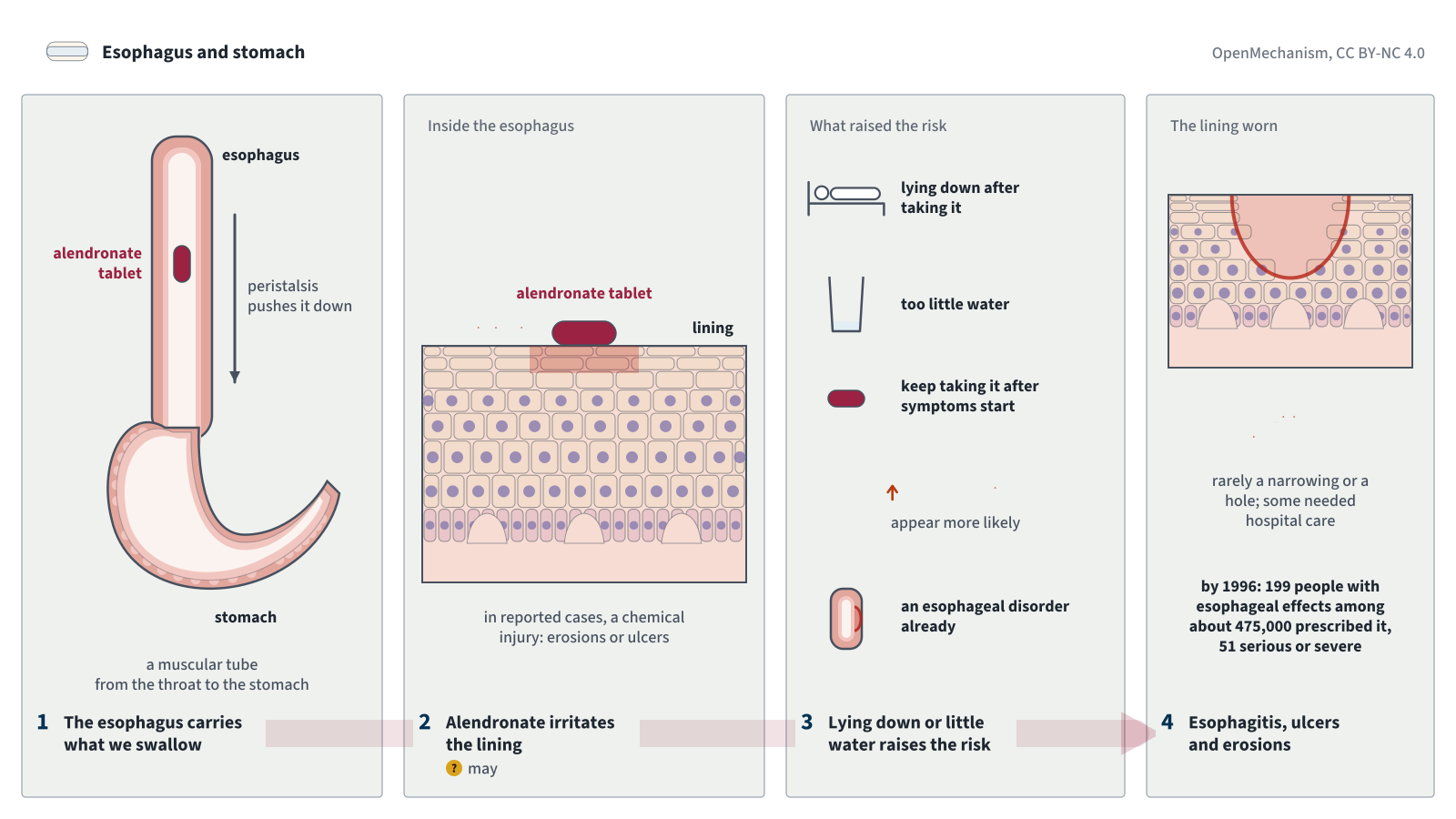
The esophagus carries what we swallow down to the stomach. Alendronate, like other bisphosphonates taken by mouth, may irritate the lining it touches: esophagitis, ulcers and erosions have been reported, some severe. The risk of severe reactions appears greater in people who lie down after taking it or swallow it with too little water.
The Fosamax (alendronate) label says: FOSAMAX, like other bisphosphonates administered orally, may cause local irritation of the upper gastrointestinal mucosa.
Clinical study: From three patients with severe esophagitis and the esophageal reports sent to the maker after alendronate went on sale (199 patients), the authors, de Groen and colleagues, conclude in their 1996 report: Alendronate can cause chemical esophagitis, including severe ulcerations, in some patients.de Groen PC et al., N Engl J Med 1996 (PMID 8793925)
The esophagus carries what we swallow. The esophagus is a muscular tube that connects the throat (pharynx) to the stomach. After we swallow, peristalsis pushes the food down the esophagus into the stomach.1,2
What the source says
“The muscular tube through which food passes from the throat to the stomach.”
Alendronate irritates the lining. Alendronate, like other bisphosphonates taken by mouth, may irritate the lining of the upper digestive tract where it touches it. In reported cases the injury generally looked chemical: erosions or ulcers with inflammation and a thickened wall.3,4
What the source says
“FOSAMAX, like other bisphosphonates administered orally, may cause local irritation of the upper gastrointestinal mucosa.”
“Endoscopic findings generally indicated chemical esophagitis, with erosions or ulcerations and exudative inflammation accompanied by thickening of the esophageal wall.”
Lying down or little water raises the risk. Severe reactions appear more likely in people who lie down after taking it, who swallow it with less than a full glass of water, or who keep taking it after symptoms start; in de Groen and colleagues' 1996 report, where the information was adequate, esophagitis also seemed to be associated with an esophageal disorder the person already had.3,4
What the source says
“The risk of severe esophageal adverse experiences appears to be greater in patients who lie down after taking oral bisphosphonates including FOSAMAX and/or who fail to swallow oral bisphosphonates including FOSAMAX with the recommended full glass (6-8 ounces) of water, and/or who continue to take oral bisphosphonates including FOSAMAX after developing symptoms suggestive of esophageal irritation.”
“In patients for whom adequate information was available, esophagitis seemed to be associated with swallowing alendronate with little or no water, lying down during or after ingestion of the tablet”
Esophagitis, ulcers and erosions. Esophagitis, esophageal ulcers and erosions have been reported, occasionally with bleeding and rarely followed by narrowing (stricture) or a hole (perforation); some were severe enough for hospital care. By March 1996, of an estimated 475,000 people prescribed alendronate, 199 had esophageal effects reported to its maker, 51 of them serious or severe.3,4
What the source says
“Esophageal adverse experiences, such as esophagitis, esophageal ulcers and esophageal erosions, occasionally with bleeding and rarely followed by esophageal stricture or perforation, have been reported in patients receiving treatment with oral bisphosphonates including FOSAMAX.”
“We describe three patients who had severe esophagitis shortly after starting to take alendronate and also analyze adverse esophageal effects reported to Merck, the manufacturer, through postmarketing surveillance.”
“A total of 199 patients had adverse effects related to the esophagus; in 51 of these patients (26 percent), including the 3 we describe in case reports, adverse effects were categorized as serious or severe.”
Stomach and duodenal ulcers, some severe and with complications, have been reported with oral bisphosphonates after marketing, though controlled trials found no increased risk.3
The 1996 figures are reports sent to the maker after the medicine was on the market (postmarketing surveillance).4
The label's instructions for taking it and its advice on stopping are left out: this page explains the mechanism, not what to do.
text a93b253a25af…; drawings c237683f39ef…; notes c7eb350858a5…
AI source check
Claude Opus 5.5 (AI source check), 13 November 2026: 23 statements compared with their sources, 3 flagged for the reviewer. An automated check, not a medical review.
Next review due
14 May 2028
Cite this page
Tran D. Why alendronate can irritate the esophagus [Internet]. OpenMechanism; 2026 [updated 2026 Nov 13; cited 2026 Nov 13]. Available from: https://openmechanism.com/explained/alendronate-and-the-esophagus