Shock
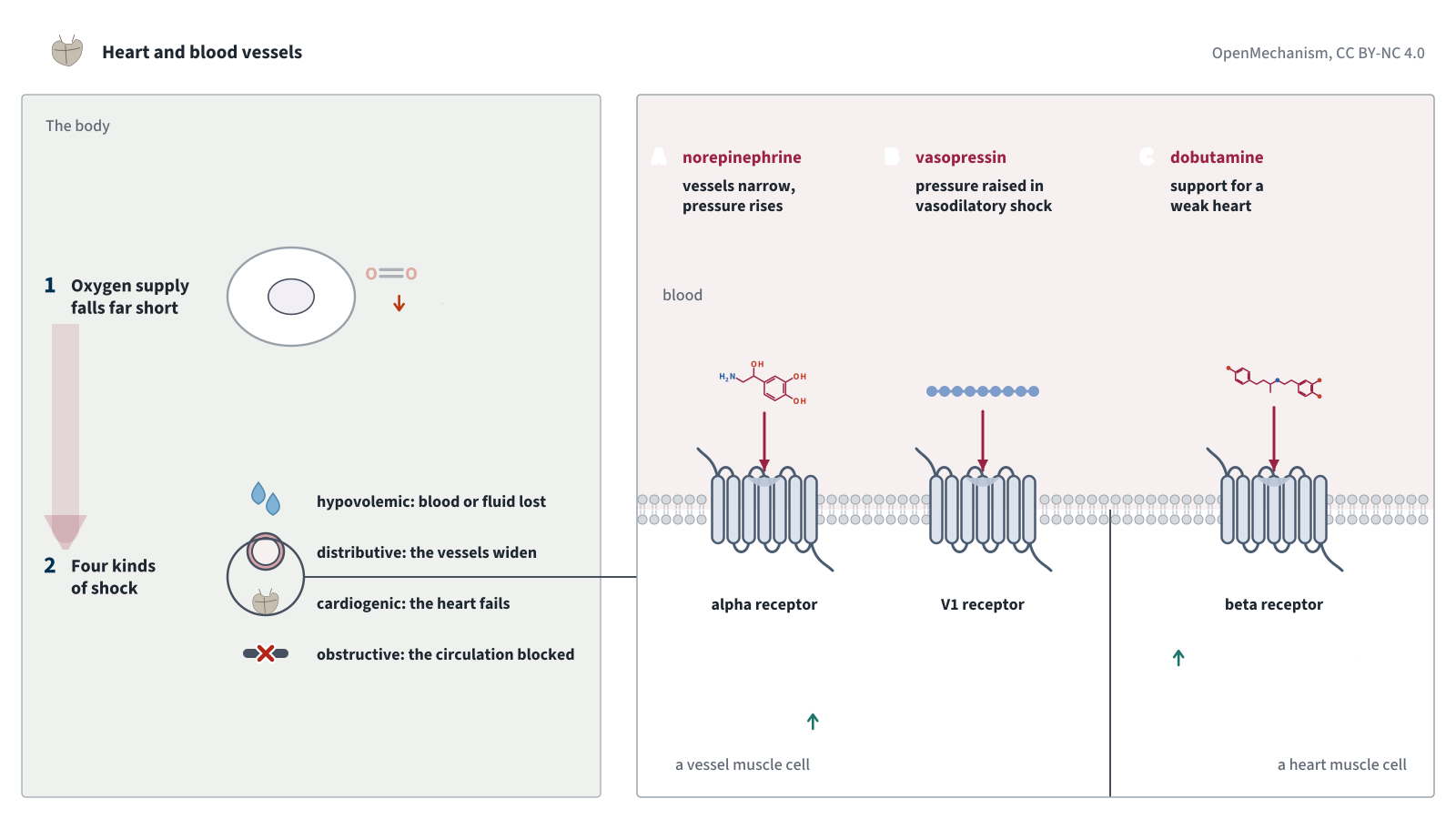
In every kind of shock the body's cells get far too little oxygen for their needs. There are four kinds: hypovolemic (blood or fluid lost), distributive (the vessels widen), cardiogenic (the heart fails) and obstructive (the circulation is blocked). Treatment depends on the kind: norepinephrine narrows vessels, vasopressin raises blood pressure and dobutamine supports a weak heart.
- Where
- Heart and blood vessels
- Body system
- Heart, vessels & cholesterol
- Medicines
- 3 medicines
For teachers: download this drawing.
Key terms in this drawing
- V1 receptor
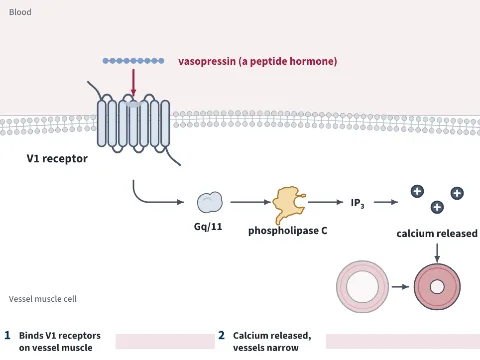
- Vasopressin V1 receptor. The vasopressin receptor on blood-vessel muscle; through it, vasopressin tightens the vessel.
What goes wrong
Oxygen supply falls far short. A severe mismatch between the oxygen the body's cells need and the oxygen they get is common to every kind of shock.1
What the source says
“A severe mismatch between the supply and demand of oxygen is the common feature of all types of shock.”
Source 1Four kinds of shock. Hypovolemic shock comes from the blood and fluids, distributive shock from the blood vessels, cardiogenic shock from the heart, and obstructive shock from a blockage of the circulation.1
What the source says
“Hypovolemic shock relates to the blood and fluids compartment while distributive shock relates to the vascular system; cardiogenic shock arises from primary cardiac dysfunction; and obstructive shock arises from a blockage of the circulation.”
Source 1
Where medicines act
- A
Norepinephrine: vessels narrow, pressure rises
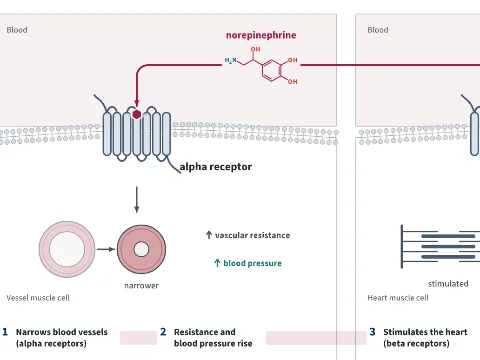
Norepinephrine narrows blood vessels and raises blood pressure in severe, acute low blood pressure.2
- B
Vasopressin: pressure raised in vasodilatory shock
Vasopressin raises blood pressure in vasodilatory shock that persists despite fluids and catecholamines.3
What the source says
“Vasostrict ® is indicated to increase blood pressure in adults with vasodilatory shock who remain hypotensive despite fluids and catecholamines.”
Source 3 - C
Dobutamine: support for a weak heart
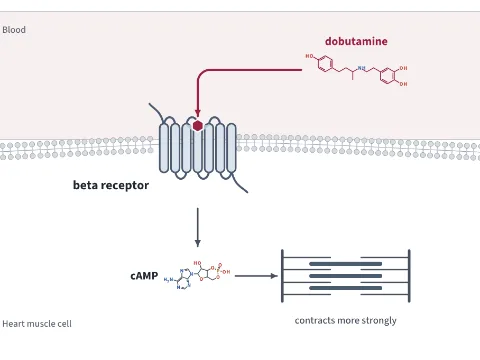
Dobutamine gives short-term support to a heart that is not contracting well.4
What the source says
“indicated when parenteral therapy is necessary for inotropic support in the short-term treatment of patients with cardiac decompensation due to depressed contractility”
Source 4
See also
Body system: heart, vessels & cholesterol.
Also used for it: dexamethasone (“Shock unresponsive to conventional therapy if adrenocortical insufficiency exists or is suspected”5) and epinephrine (“Adrenalin is indicated to increase mean arterial blood pressure in adult patients with hypotension associated with septic shock.”6).
Related medicines: milrinone.
Other conditions: low blood pressure during anesthesia, heart failure, acute lymphoblastic leukemia, adrenal insufficiency, ankylosing spondylitis and asthma.
Sources
- 1The nomenclature, definition and distinction of types of shockStandl T et al. Dtsch Arztebl Int 2018 (abstract). Saved copy
- 2Levophed (norepinephrine): FDA label1 Indications and Usage; 12.1 Mechanism of Action. Saved copy
- 3Vasostrict (vasopressin): FDA label1 Indications and Usage. Saved copy
- 4Dobutamine in 5% Dextrose Injection: FDA labelIndications and Usage. Saved copy
- 5Dexamethasone sodium phosphate injection: FDA labelIndications and Usage. Saved copy
- 6Adrenalin (epinephrine) injection: FDA label1 Indications and Usage. Saved copy
Notes and limits
- Treatment depends on the kind. Distributive shock is treated with vasoconstrictors and fluids; cardiogenic shock, depending on the situation, with medicines, surgery or other procedures. Hypovolemic shock is treated by replacing fluid, and obstructive shock needs an immediate procedure; no medicine on this page treats them directly.1
Notes that apply to every page are on How to read a page.
Spotted a mistake? Report an error (hello@openmechanism.com). Since launch, every published error we fix is listed on the corrections page.
Cite this page
Tran D. Shock [Internet]. OpenMechanism; 2026 [updated 2026 Oct 20; cited 2026 Oct 20]. Available from: https://openmechanism.com/conditions/shock