Latanoprost
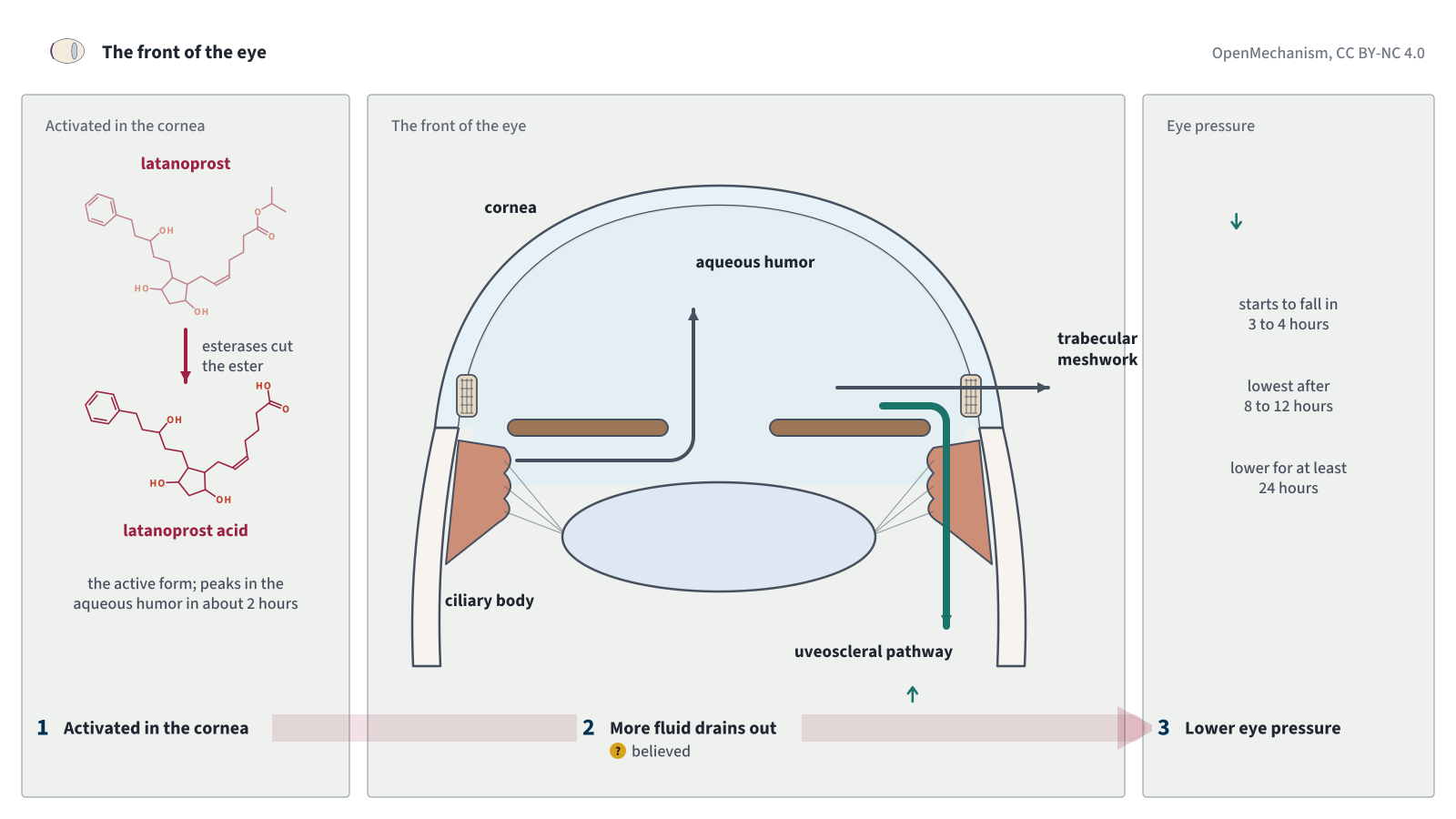
Latanoprost eye drops are absorbed through the cornea, where the medicine is turned into its active acid. It is believed to lower eye pressure by letting more of the eye's fluid, the aqueous humor, drain out, mainly by the uveoscleral pathway. The pressure starts to fall 3 to 4 hours after a drop and stays lower for at least a day.
- Acts on
- Prostaglandin F2α analogue (activated in the cornea)
- Where
- The front of the eye
- Medicine type
- Small molecule
- Used for
- Eyes & ears
Also called Xalatan.
Step 2: believed
The Xalatan (latanoprost) label says: Latanoprost is a prostaglandin F 2α analogue that is believed to reduce the IOP by increasing the outflow of aqueous humor. … Studies in animals and man suggest that the main mechanism of action is increased uveoscleral outflow.
Clinical study: In a randomized, double-masked study in 22 volunteers, one eye was given PhXA41 (the development name of latanoprost) and the other eye the vehicle; fluorophotometry showed: PhXA41 decreases IOP in humans by increasing uveoscleral outflow without significantly affecting other parameters of aqueous humor dynamics.
Toris CB et al., Ophthalmology 1993 (PMID 8371915)
This study was picked with a literature search and is not yet checked by our reviewer.
How it works
Activated in the cornea. Latanoprost, a prostaglandin F2α analogue, is absorbed through the cornea, where esterases cut its isopropyl ester to give the biologically active acid. The acid peaks in the aqueous humor, the fluid inside the front of the eye, about 2 hours after a drop.1
More fluid drains out. The ciliary body and the trabecular meshwork are the two main structures that handle the aqueous humor, which leaves the eye by two pathways: the trabecular meshwork and the uveoscleral pathway. Latanoprost is believed to lower eye pressure by increasing the outflow of aqueous humor; studies in animals and people suggest that the main mechanism is more uveoscleral outflow.1,2
Lower eye pressure. Eye pressure starts to fall about 3 to 4 hours after a drop, falls most after 8 to 12 hours and stays lower for at least 24 hours. Raised eye pressure is a major risk factor for the loss of visual field in glaucoma.1
For teachers: download this drawing.
See also
Condition pages: glaucoma.
Related drawings: pilocarpine (lowers eye pressure by opening the trabecular meshwork).
Inside the body: fluid and pressure in the eye.
Sources
- 1Xalatan (latanoprost ophthalmic solution): FDA label12.1 Mechanism of Action; 12.2 Pharmacodynamics; 12.3 Pharmacokinetics
- 2Aqueous humor dynamics: a reviewGoel M et al., Open Ophthalmol J 2010 (abstract)
- 3ChEMBL CHEMBL1051Target and action classification: Prostanoid FP receptor agonist
- 4Effects of PhXA41, a new prostaglandin F2 alpha analog, on aqueous humor dynamics in human eyesToris CB et al. Ophthalmology 1993 (abstract)
Spotted a mistake? Report an error (hello@openmechanism.com). Since launch, every published error we fix is listed on the corrections page.
Notes and limits
- A schematic teaching drawing: not to scale, not exact structures, binding poses or a complete pathway, and not a guide to dosing, treatment or how a person will respond.
- The label says latanoprost is believed to reduce eye pressure by increasing the outflow of aqueous humor, and that studies in animals and man suggest the main mechanism is increased uveoscleral outflow.
All recorded limits are on the evidence page, and notes that apply to every page are on How to read a page. Version 1.0.0, not yet medically reviewed.
Cite this page
Tran D. Latanoprost [Internet]. OpenMechanism; 2026 [updated 2026 Oct 11; cited 2026 Oct 11]. Available from: https://openmechanism.com/medicines/latanoprost