Brimonidine
Brimonidine eye drops switch on . Studies suggest a dual effect: the eye makes less of its fluid, the aqueous humor, and more of it drains out by the uveoscleral pathway. Eye pressure falls most two hours after a dose.
- Acts on
- Alpha-2 adrenergic receptors (relatively selective)
- Where
- The front of the eye
- Medicine type
- Small molecule
- Used for
- Eyes & ears
Also called Alphagan P.
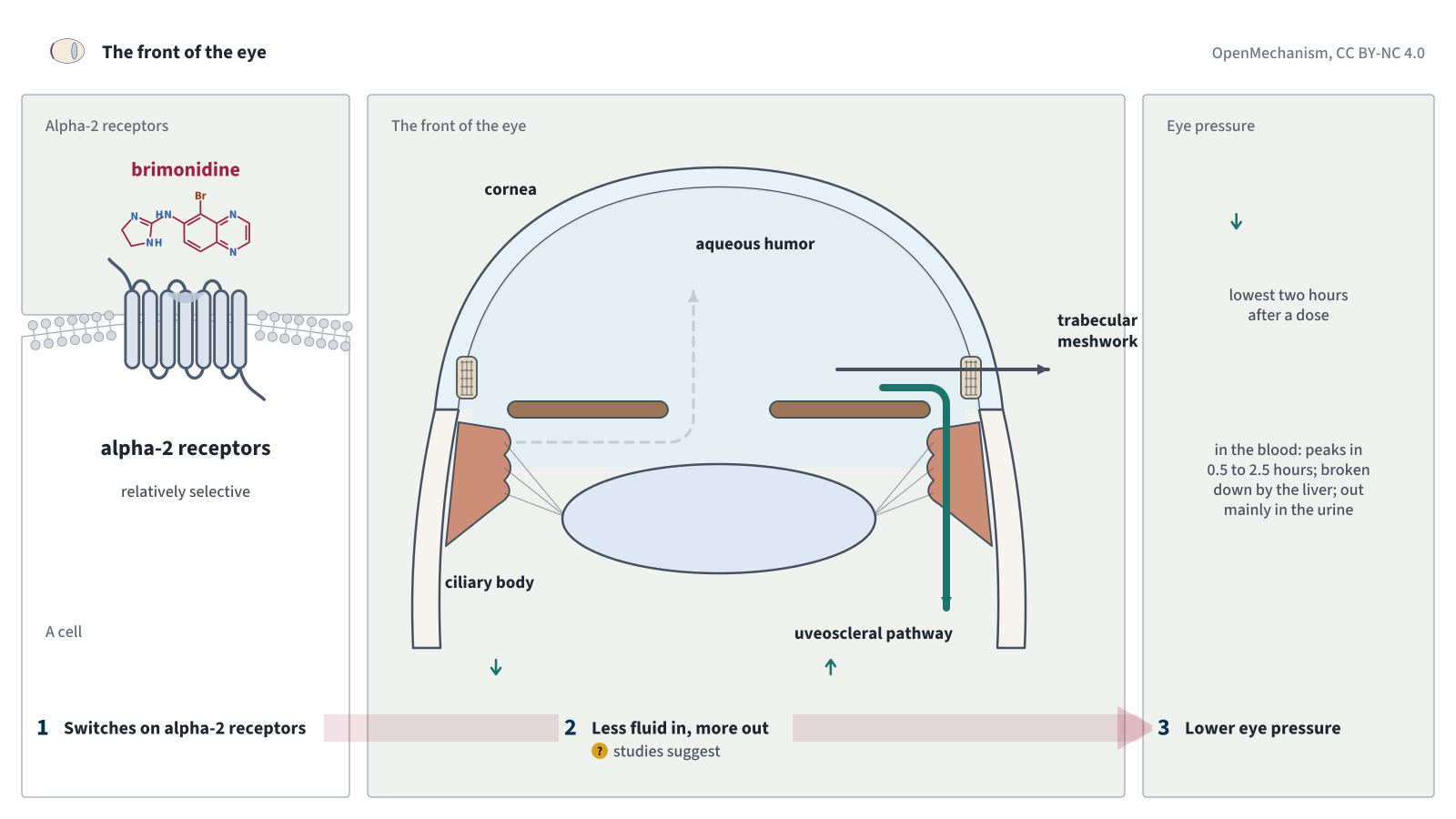
Step 2: studies suggest
The Alphagan P (brimonidine) label says: Fluorophotometric studies in animals and humans suggest that brimonidine tartrate has a dual mechanism of action by reducing aqueous humor production and increasing uveoscleral outflow.
Clinical study: In a randomized, double-masked study in 21 volunteers with raised eye pressure, one eye was given brimonidine and the other eye the vehicle: The brimonidine-induced reduction in IOP in humans is associated with a decrease in aqueous flow and an increase in uveoscleral outflow.
Toris CB et al., Arch Ophthalmol 1995 (PMID 7487618)
This study was picked with a literature search and is not yet checked by our reviewer.
Key terms in this drawing
- alpha-2 receptor
- Alpha-2 adrenergic receptor. An adrenergic receptor. Brimonidine switches it on and lowers the pressure inside the eye.
How it works
Switches on alpha-2 receptors. Brimonidine is a relatively selective alpha-2 adrenergic receptor .1
Less fluid in, more out. The aqueous humor, the fluid inside the front of the eye, leaves by two pathways: the trabecular meshwork and the uveoscleral pathway. Fluorophotometric studies in animals and people suggest brimonidine works in two ways: less aqueous humor is made, and more leaves by the uveoscleral pathway.1,2
Lower eye pressure. Its pressure-lowering effect is greatest two hours after a dose. Some brimonidine reaches the blood, peaking within 0.5 to 2.5 hours; it is broken down extensively by the liver and leaves mainly in the urine.1
For teachers: download this drawing.
See also
Condition pages: glaucoma.
Sources
- 1Alphagan P (brimonidine tartrate ophthalmic solution): FDA label12.1 Mechanism of Action; 12.3 Pharmacokinetics
- 2Aqueous humor dynamics: a reviewGoel M et al., Open Ophthalmol J 2010 (abstract)
- 3ChEMBL CHEMBL844Target and action classification: Adrenergic receptor alpha-2 agonist
- 4Effects of brimonidine on aqueous humor dynamics in human eyesToris CB et al. Arch Ophthalmol 1995 (abstract)
Spotted a mistake? Report an error (hello@openmechanism.com). Since launch, every published error we fix is listed on the corrections page.
Notes and limits
- A schematic teaching drawing: not to scale, not exact structures, binding poses or a complete pathway, and not a guide to dosing, treatment or how a person will respond.
- The label says fluorophotometric studies in animals and humans suggest a dual mechanism of action.
All recorded limits are on the evidence page, and notes that apply to every page are on How to read a page. Version 1.0.0, not yet medically reviewed.
Cite this page
Tran D. Brimonidine [Internet]. OpenMechanism; 2026 [updated 2026 Oct 11; cited 2026 Oct 11]. Available from: https://openmechanism.com/medicines/brimonidine