Bempedoic acid
Bempedoic acid is switched on in the liver by the enzyme . The active form blocks , an enzyme that comes before in cholesterol making. The liver makes less cholesterol, puts out more , and cholesterol in the blood falls.
- Acts on
- Adenosine triphosphate-citrate lyase (ACL)
- Where
- Liver cells
- Medicine type
- Small molecule
- Used for
- Heart & circulation
Also called Nexletol.
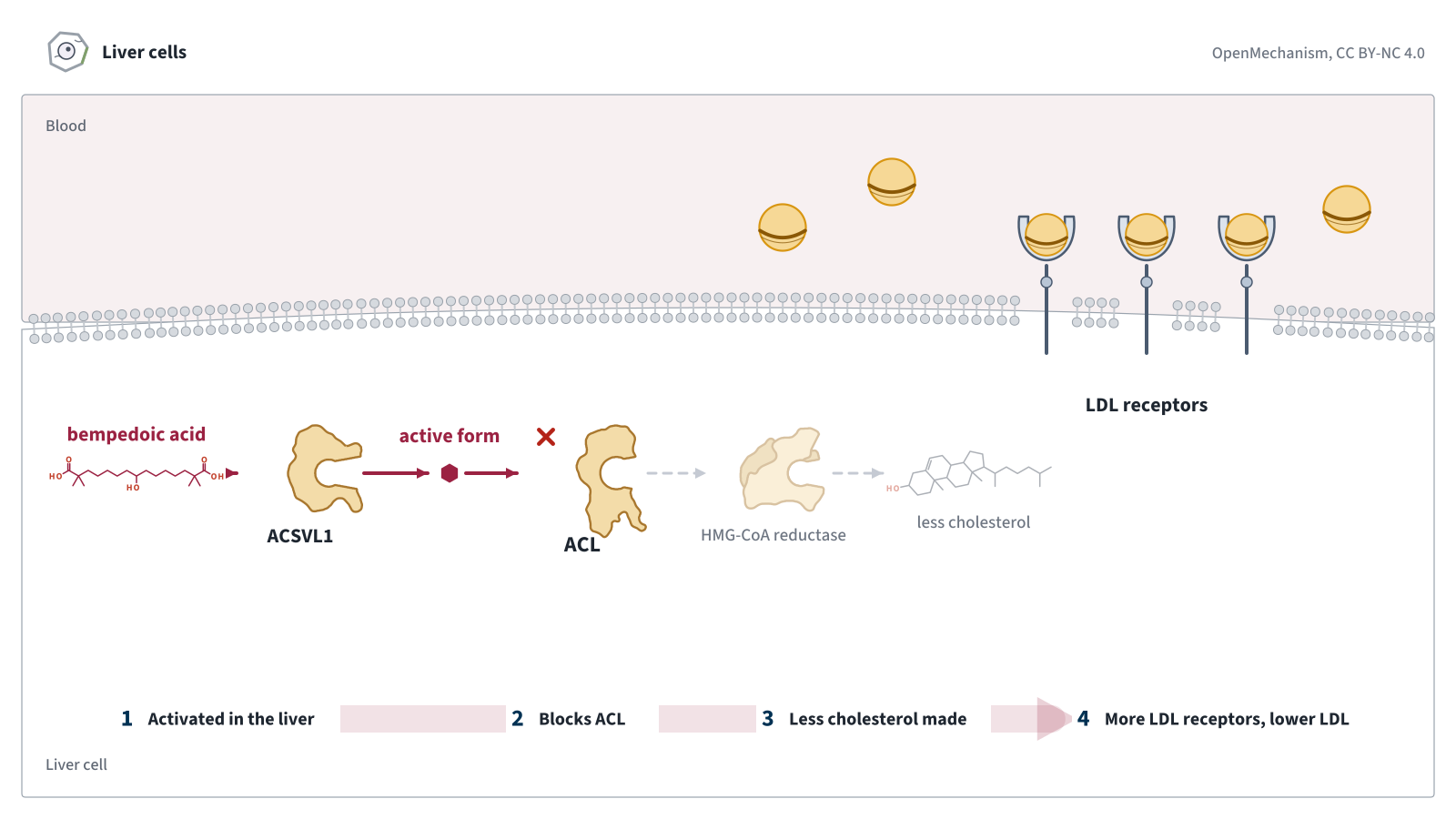
Key terms in this drawing (6)
- ACL
- ATP-citrate lyase. An enzyme in the cholesterol-making pathway, upstream of (earlier than) HMG-CoA reductase; bempedoic acid blocks it.
- ACSVL1
- Very long-chain acyl-CoA synthetase 1. An enzyme, found mainly in the liver, that switches bempedoic acid on by joining it to coenzyme A.
- HMG-CoA
- 3-hydroxy-3-methylglutaryl coenzyme A. A building block the liver turns into mevalonate on the way to making cholesterol.
- HMG-CoA reductase
- 3-hydroxy-3-methylglutaryl-coenzyme A reductase. The enzyme that turns HMG-CoA into mevalonate, an early step in making cholesterol.
- LDL
- Low-density lipoprotein. Particles that carry cholesterol in the blood ('LDL cholesterol').
- LDL receptor
- Low-density lipoprotein receptor. A receptor on liver cells that takes LDL particles out of the blood.
How it works
Activated in the liver. Bempedoic acid needs activation with by very long-chain acyl-CoA synthetase 1 (ACSVL1), which is found mainly in the liver, to become ETC-1002-CoA; its active metabolite is activated the same way.1
Blocks ACL. ETC-1002-CoA inhibits adenosine triphosphate-citrate lyase (ACL), an enzyme upstream of HMG-CoA reductase in the cholesterol-making pathway.1
Less cholesterol made. Blocking ACL decreases cholesterol synthesis in the liver.1
More LDL receptors, lower LDL. LDL cholesterol in the blood falls through upregulation of LDL receptors.1
For teachers: download this drawing.
See also
Condition pages: high LDL cholesterol.
Body system: heart, vessels & cholesterol.
Sources
- 1Nexletol (bempedoic acid) tablets: FDA label12.1 Mechanism of Action
- 2ChEMBL CHEMBL3545313Target and action classification: ATP-citrate synthase inhibitor
Also used for the drawing
The ACSVL1, ACL and HMG-CoA reductase outlines are traced from the electron microscopy and crystal structures below.
- 3Human ACSVL1 (FATP2) with oleic acid and oleoyl-AMPPDB 9VZP; Li, A. et al. Nat Commun 2026; 17
- 4Human ATP-citrate lyase with acetyl-CoA and oxaloacetatePDB 7LJ9; Wei, X., Marmorstein, R. Nat.Struct.Mol.Biol. 2021; 28:639-641
- 5Human HMG-CoA reductase (catalytic portion) with atorvastatinPDB 1HWK; Istvan, E.S., Deisenhofer, J. Science 2001; 292:1160-1164
Spotted a mistake? Report an error (hello@openmechanism.com). Since launch, every published error we fix is listed on the corrections page.
Notes and limits
- A schematic teaching drawing: not to scale, not exact structures, binding poses or a complete pathway, and not a guide to dosing, treatment or how a person will respond.
All recorded limits are on the evidence page, and notes that apply to every page are on How to read a page. Version 1.0.0, not yet medically reviewed.
Cite this page
Tran D. Bempedoic acid [Internet]. OpenMechanism; 2026 [updated 2026 Oct 10; cited 2026 Oct 10]. Available from: https://openmechanism.com/medicines/bempedoic-acid