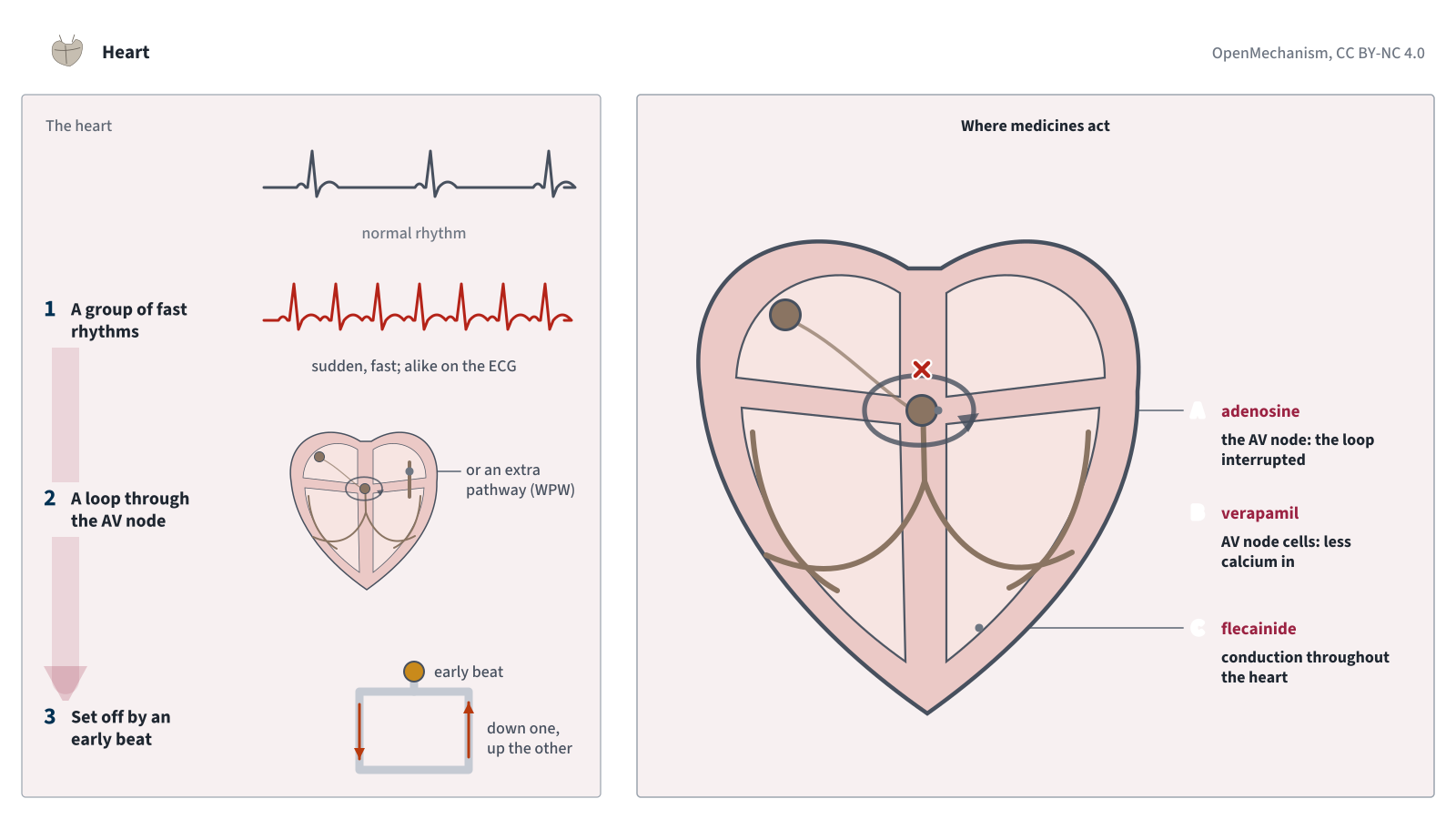
Paroxysmal supraventricular tachycardia (PSVT) is a group of sudden fast heart rhythms. Most are reentry circuits: an early beat starts an electrical loop circling, usually through the AV node. Adenosine and verapamil slow conduction through the AV node: adenosine can break the loop; verapamil makes episodes less frequent. Flecainide slows conduction and is used to prevent PSVT with disabling symptoms in people without structural heart disease.
Atrioventricular node. The part of the heart's wiring that passes each beat's electrical impulse from the upper chambers (atria) to the lower chambers (ventricles).
ECG
Electrocardiogram. A test of the heart's electrical activity.
WPW
Wolff-Parkinson-White syndrome. A condition with an extra pathway that bypasses the AV node; a fast rhythm can circle through it (re-entry).
What goes wrong
A group of fast rhythms. Paroxysmal supraventricular tachycardia is a group of sudden fast rhythms that look alike on the but arise in different ways.1
What the source says
“The phrase paroxysmal supraventricular tachycardia describes a group of arrhythmias with similar electrocardiographic features but different mechanisms”
A loop through the AV node. Most are reentry circuits, usually through the , less often through the sinus node, the atria themselves or an extra pathway between atria and ventricles (Wolff-Parkinson-White syndrome).1
What the source says
“Reentry accounts for most cases and has been localized to the A-V node and less frequently to the sinus node, the atria themselves, and A-V nodal bypass tracts (Wolff-Parkinson-White syndrome).”
Set off by an early beat. An early beat splits conduction between two pathways, so an electrical loop starts circling and drives the atria and ventricles.1
What the source says
“These forms of supraventricular tachycardia are initiated by premature beats that dissociate conduction between two pathways and permit the establishment of circulating electrical activity that spreads to atrial and ventricular myocardium.”
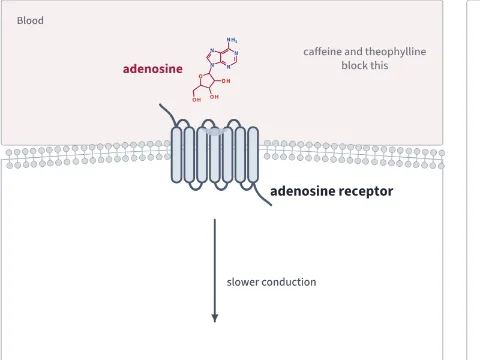
Given into a vein, adenosine slows conduction through the AV node and can interrupt the reentry loop there, restoring normal rhythm.2
What the source says
“Adenosine Injection slows conduction time through the A-V node, can interrupt the reentry pathways through the A-V node, and can restore normal sinus rhythm in patients with paroxysmal supraventricular tachycardia (PSVT), including PSVT associated with Wolff-Parkinson-White Syndrome.”
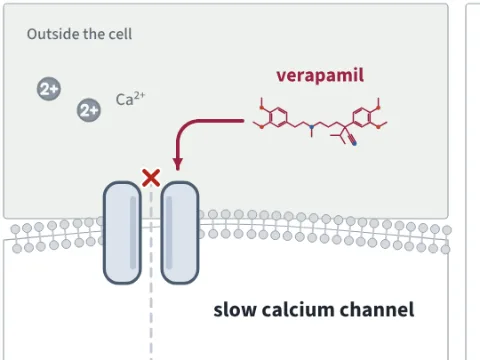
By letting less calcium in, verapamil lengthens the AV node's recovery time (refractory period) and slows AV conduction; it makes PSVT episodes less frequent.3
What the source says
“By decreasing the influx of calcium, verapamil hydrochloride prolongs the effective refractory period within the AV node and slows AV conduction in a rate-related manner.”
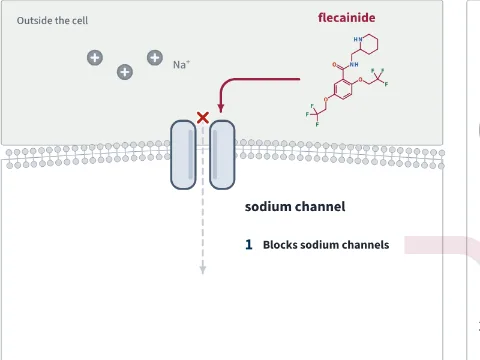
Flecainide, a class IC antiarrhythmic, slows conduction throughout the heart, most in the His-Purkinje system and less in the AV node and atria; in people without structural heart disease it is used to prevent PSVT with disabling symptoms.4
What the source says
“it has electrophysiologic effects characteristic of the IC class of antiarrhythmics.”
“In patients without structural heart disease, Flecainide Acetate Tablets, USP are indicated for the prevention of: paroxysmal supraventricular tachycardias (PSVT), including atrioventricular nodal reentrant tachycardia, atrioventricular reentrant tachycardia and other supraventricular tachycardias of unspecified mechanism associated with disabling symptoms”
“In man, flecainide acetate produces a dose-related decrease in intracardiac conduction in all parts of the heart with the greatest effect on the His-Purkinje system (H-V conduction). Effects upon atrioventricular (AV) nodal conduction time and intra-atrial conduction times, although present, are less pronounced than those on ventricular conduction velocity.”
Also used for it: esmolol (for short-term treatment: “Control of ventricular rate in supraventricular tachycardia including atrial fibrillation and atrial flutter and control of heart rate in noncompensatory sinus tachycardia”6).
Adenosine does not convert atrial flutter, atrial fibrillation or ventricular tachycardia, and the fast rhythm may come back within minutes in a minority.2,5
The flecainide label warns that flecainide has proarrhythmic effects (it can bring on arrhythmias).4
Claude Opus 5.5 (AI source check), 29 October 2026: 30 statements compared with their sources, 7 flagged for the reviewer. An automated check, not a medical review.
Key terms
Definitions reworded since this review: ECG. Definitions are shared across pages, so a later rewording does not take the review line off (what a review covers).
Next review due
29 April 2028
Cite this page
Tran D. Supraventricular tachycardia (SVT) [Internet]. OpenMechanism; 2026 [updated 2026 Oct 29; cited 2026 Oct 29]. Available from: https://openmechanism.com/conditions/supraventricular-tachycardia