Flumazenil
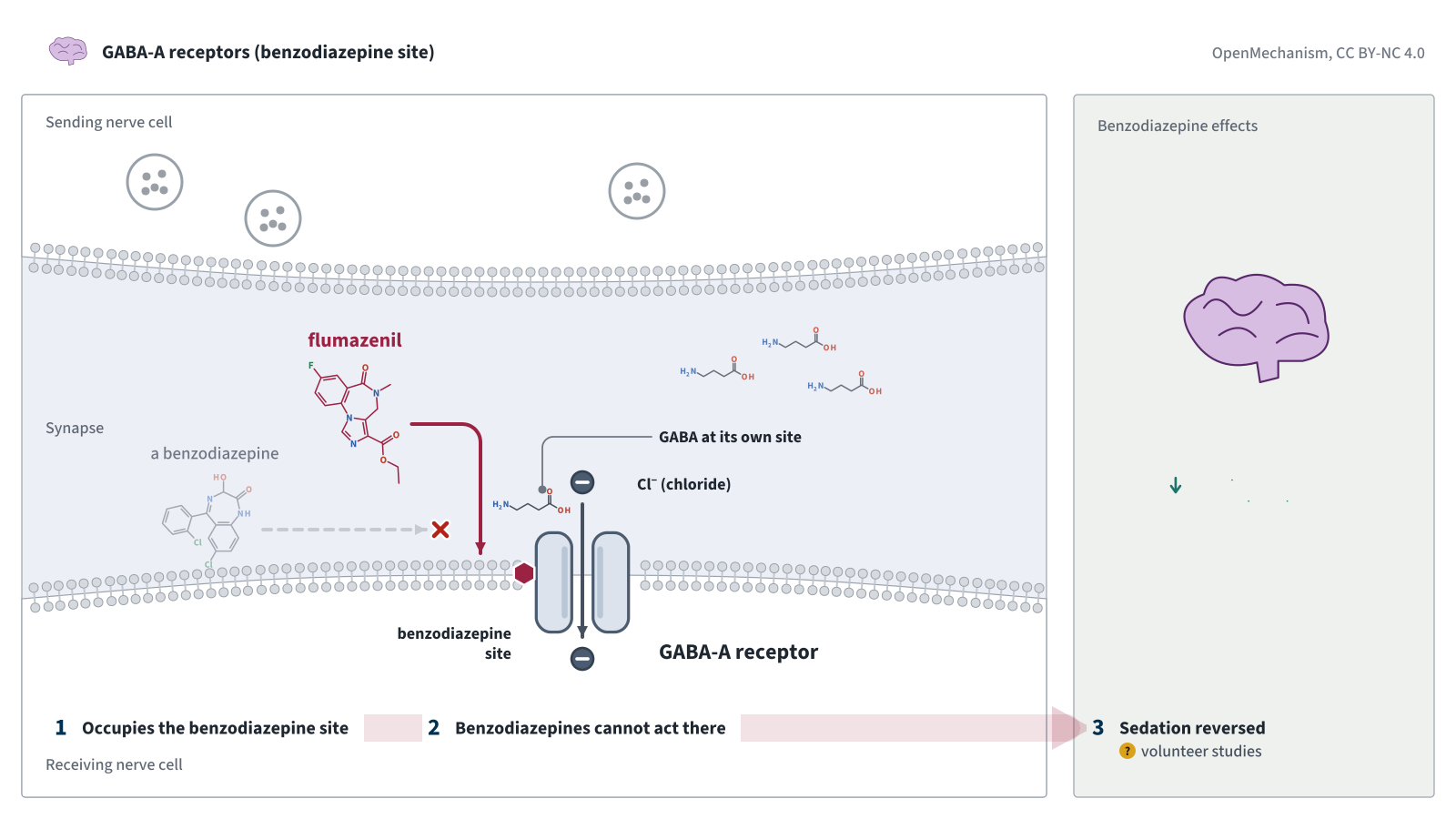
Flumazenil competes for the benzodiazepine site on and blocks benzodiazepines from acting there. In healthy volunteers it reversed benzodiazepine sedation.
- Acts on
- Benzodiazepine recognition site on GABAA receptor complex
- Where
- GABA-A receptors (benzodiazepine site)
- Medicine type
- Small molecule
- Used for
- Antidotes & reversal
Step 3: volunteer studies
The flumazenil label says: Intravenous flumazenil has been shown to antagonize sedation, impairment of recall, psychomotor impairment and ventilatory depression produced by benzodiazepines in healthy human volunteers.
Source 1: Flumazenil: FDA label, Clinical Pharmacology introductory mechanism and Pharmacodynamics
Clinical study: In a randomized, double-blind crossover study in 72 healthy volunteers, each given midazolam (at one of two doses, or none) and then flumazenil (1 or 3 mg, or none) in three sessions; a volunteer study like those the label describes, it tested the step itself, through sedation and memory: Flumazenil reversed both the sedative and the memory effects of the benzodiazepine.
Ghoneim MM et al., Anesthesiology 1993 (PMID 8267193)
This study was picked with a literature search and is not yet checked by our reviewer.
Key terms in this drawing
- GABA
- Gamma-aminobutyric acid. The main inhibitory messenger in the central nervous system.
- GABA-A receptor
- Gamma-aminobutyric acid type A receptor. A receptor channel on nerve cells that GABA switches on; benzodiazepines also bind it.
How it works
Occupies the benzodiazepine site. Flumazenil competes at the benzodiazepine recognition site of the receptor complex.1
Benzodiazepines cannot act there. Competition inhibits benzodiazepine-mediated effects.1
Sedation reversed. Healthy-volunteer studies showed antagonism of benzodiazepine-produced sedation and related impairment.1
For teachers: download this drawing or build a slide deck.
See also
Condition pages: benzodiazepine overdose.
Sources
- 1Flumazenil: FDA labelClinical Pharmacology introductory mechanism and Pharmacodynamics
- 2ChEMBL CHEMBL407Target and action classification: GABA-A receptor; anion channel allosteric antagonist
- 3The interactions of midazolam and flumazenil on human memory and cognitionGhoneim MM et al. Anesthesiology 1993 (abstract)
Also used for the drawing
The drawing shares its GABA-A synapse with the other medicines that act there: the receptor is a chloride channel, and chloride usually flows into the receiving nerve cell when GABA opens it. The label does not mention chloride; these two papers back it.
- 4GABA-A receptor signalling mechanisms revealed by structural pharmacologyMasiulis S et al., Nature 2019 (abstract)
- 5Anion transport and GABA signalingHübner CA, Holthoff K, Front Cell Neurosci 2013 (abstract)
Spotted a mistake? Report an error (hello@openmechanism.com). Since launch, every published error we fix is listed on the corrections page.
Notes and limits
- A schematic teaching drawing: not to scale, not exact structures, binding poses or a complete pathway, and not a guide to dosing, treatment or how a person will respond.
- Other medicines in the same family may not follow every step or share the same clinical endpoint.
- The steps are in the order that explains them; one step is said to cause the next only where the source says so.
- The site is modulatory and distinct from GABA binding; competitive occupation is not direct channel-pore blockade.
- The label notes weak partial agonism in some animal models but little or no agonist activity in humans. It does not reverse every sedative or opioid.
All recorded limits are on the evidence page, and notes that apply to every page are on How to read a page. Version 1.0.0, not yet medically reviewed.
Cite this page
Tran D. Flumazenil [Internet]. OpenMechanism; 2026 [updated 2026 Oct 15; cited 2026 Oct 15]. Available from: https://openmechanism.com/medicines/flumazenil