Hydroxocobalamin
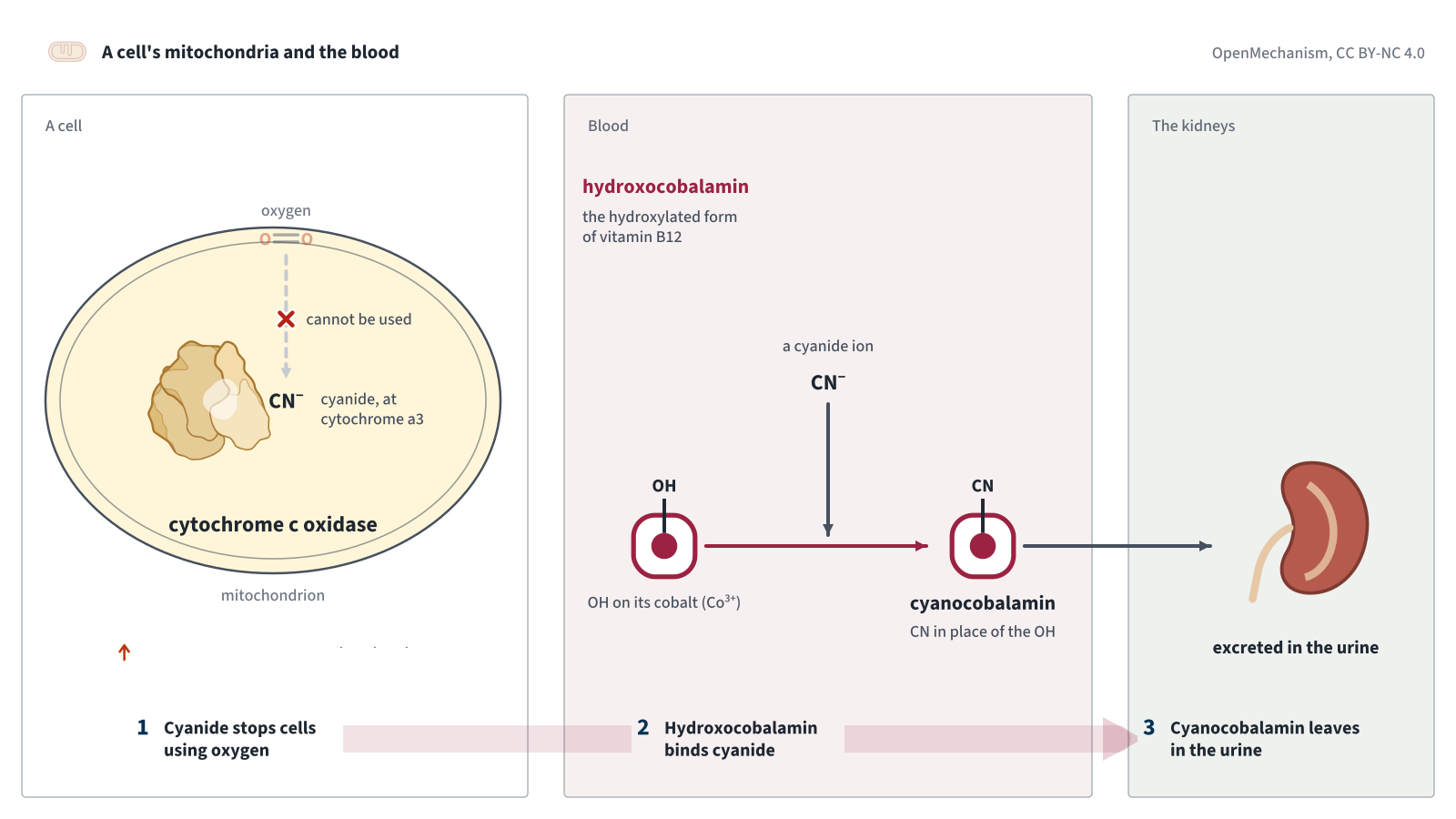
Cyanide binds cytochrome a3 in mitochondria, so cells cannot use oxygen; they switch to anaerobic metabolism, and lactate and metabolic acidosis follow. Hydroxocobalamin, the hydroxylated active form of , binds one cyanide ion per molecule in place of its , forming cyanocobalamin, which is excreted in the urine.
- Acts on
- Cyanide ions
- Where
- The blood, in cyanide poisoning
- Medicine type
- Small molecule
- Used for
- Antidotes & reversal
Key terms in this drawing
- vitamin B12
- Vitamin B12 (cobalamin). A vitamin the body needs for growth, cell division, making blood cells and making myelin.
How it works
Cyanide stops cells using oxygen. Cyanide binds cytochrome a3, part of the cytochrome c oxidase complex in mitochondria. With cytochrome a3 blocked, cells cannot use oxygen and switch to anaerobic metabolism, which leads to lactate production, cellular hypoxia and metabolic acidosis.1
Hydroxocobalamin binds cyanide. Hydroxocobalamin, the hydroxylated active form of vitamin B12, holds a trivalent cobalt ion in its corrin ring. Each molecule binds one cyanide ion in place of its hydroxo ligand, forming cyanocobalamin.1
Cyanocobalamin leaves in the urine. The cyanocobalamin formed is then excreted in the urine.1
For teachers: download this drawing.
See also
Condition pages: cyanide poisoning.
Related drawings: cyanocobalamin (vitamin B12) (vitamin B12 for deficiency: the molecule hydroxocobalamin becomes when it binds cyanide).
Sources
- 1Cyanokit (hydroxocobalamin for injection): FDA label11 Description; 12.1 Mechanism of Action
- 2ChEMBL CHEMBL2103737Target and action classification: Cyanide sequestering agent
Also used for the drawing
The cytochrome c oxidase outline is traced from the crystal structure below.
- 3Bovine heart cytochrome c oxidase, fully oxidized (the catalytic core, subunits I to III, drawn; the site of cytochrome a3 and CuB marked)PDB 5B1A; Yano, N. et al. J.Biol.Chem. 2016; 291:23882-23894
Spotted a mistake? Report an error (hello@openmechanism.com). Since launch, every published error we fix is listed on the corrections page.
Notes and limits
- A schematic teaching drawing: not to scale, not exact structures, binding poses or a complete pathway, and not a guide to dosing, treatment or how a person will respond.
- Given into a vein, hydroxocobalamin also binds plasma proteins and small molecules of the body in place of its hydroxo ligand (the label, 12.3).
- In massive acute cyanide poisoning, other enzyme systems may be involved as well (the label).
All recorded limits are on the evidence page, and notes that apply to every page are on How to read a page. Version 1.0.0, not yet medically reviewed.
Cite this page
Tran D. Hydroxocobalamin [Internet]. OpenMechanism; 2026 [updated 2026 Oct 18; cited 2026 Oct 18]. Available from: https://openmechanism.com/medicines/hydroxocobalamin