Dimercaprol
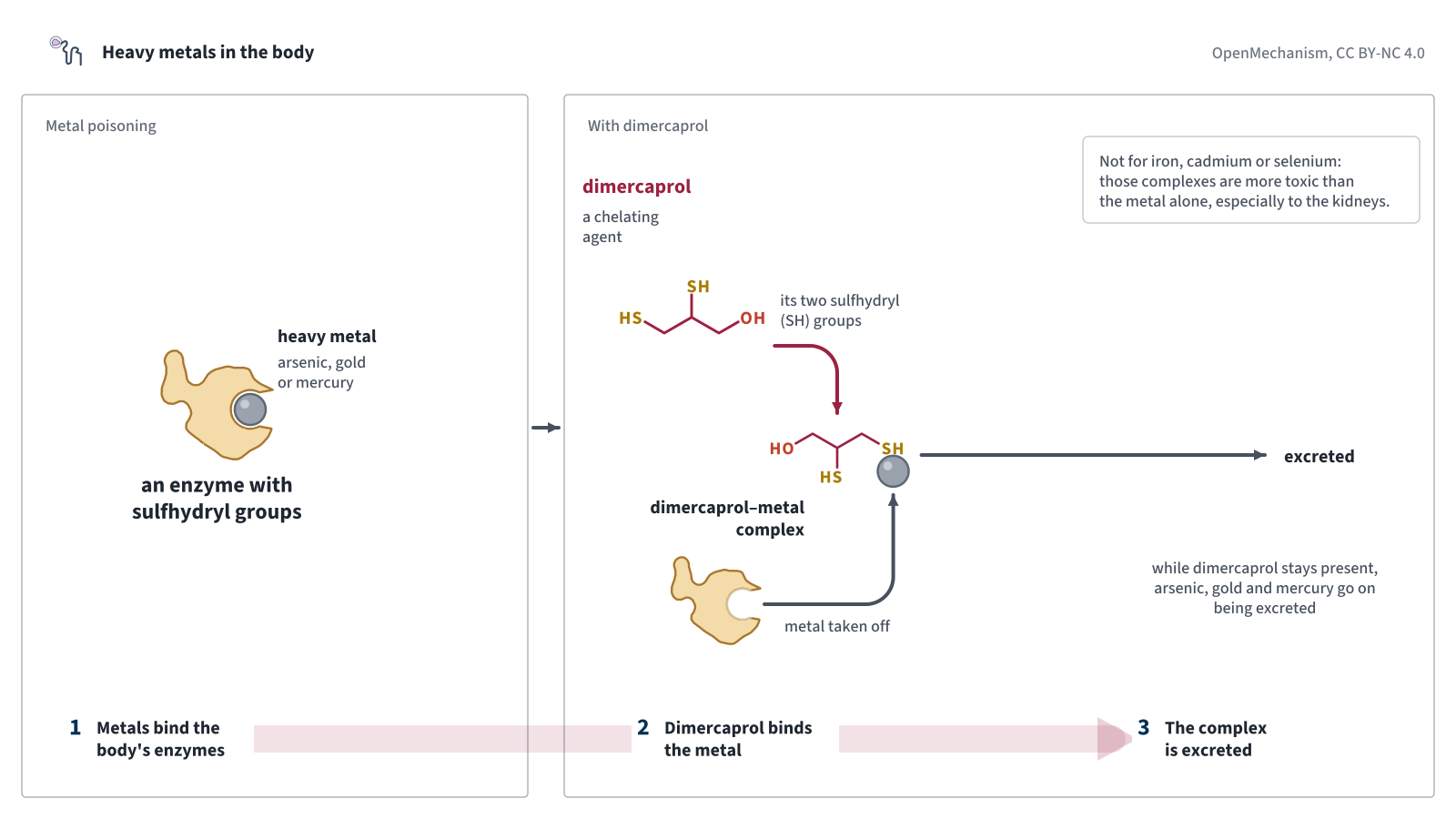
Heavy metals such as arsenic, gold and mercury bind to enzymes that contain sulfhydryl groups. Dimercaprol's own sulfhydryl groups form complexes with these metals, preventing or reversing their binding to the enzymes. The complex is excreted, and while dimercaprol stays present the metals go on being excreted.
- Acts on
- Heavy metals: arsenic, gold and mercury
- Where
- Enzymes with sulfhydryl groups
- Medicine type
- Small molecule
- Used for
- Antidotes & reversal
Also called BAL in Oil.
How it works
Metals bind the body's enzymes. Heavy metals such as arsenic, gold and mercury bind to enzymes that contain sulfhydryl groups.1
Dimercaprol binds the metal. Dimercaprol, a chelating agent, forms complexes with these metals through its sulfhydryl groups, preventing or reversing the metals' binding to the enzymes.1
The complex is excreted. The dimercaprol-metal complex is excreted; while dimercaprol stays present, the body goes on excreting arsenic, gold and mercury.1
For teachers: download this drawing.
See also
Condition pages: heavy metal poisoning.
Sources
- 1BAL in Oil (dimercaprol injection): FDA labelIndications; Description; Clinical Pharmacology
- 2ChEMBL CHEMBL1597Target and action classification: Heavy metals chelating agent
Also used for the drawing
The sulfhydryl enzyme outline is traced from the crystal structure below.
- 3Human 5-aminolevulinic acid dehydratase (ALAD) from red cells, with zinc and porphobilinogenPDB 1E51; Mills-Davies, N.L. et al. To be Published
Spotted a mistake? Report an error (hello@openmechanism.com). Since launch, every published error we fix is listed on the corrections page.
Notes and limits
- A schematic teaching drawing: not to scale, not exact structures, binding poses or a complete pathway, and not a guide to dosing, treatment or how a person will respond.
- Not for iron, cadmium or selenium poisoning: those dimercaprol-metal complexes are more toxic than the metal alone, especially to the kidneys (the label).
- For lead poisoning it is used together with edetate calcium disodium (the label).
All recorded limits are on the evidence page, and notes that apply to every page are on How to read a page. Version 1.0.0, not yet medically reviewed.
Cite this page
Tran D. Dimercaprol [Internet]. OpenMechanism; 2026 [updated 2026 Oct 18; cited 2026 Oct 18]. Available from: https://openmechanism.com/medicines/dimercaprol