Fenofibrate
Fenofibrate's active form activates , a mechanism explained from transgenic mice and cultured human liver cells. Lipoprotein lipase becomes more active and , which holds it back, falls, so triglyceride-rich particles are broken down and cleared. and its proteins and rise, and triglycerides, cholesterol and total cholesterol in the blood fall.
- Acts on
- Peroxisome proliferator-activated receptor alpha (PPARα)
- Where
- Liver cells and the blood
- Medicine type
- Small molecule
- Used for
- Heart & circulation
Also called Tricor.
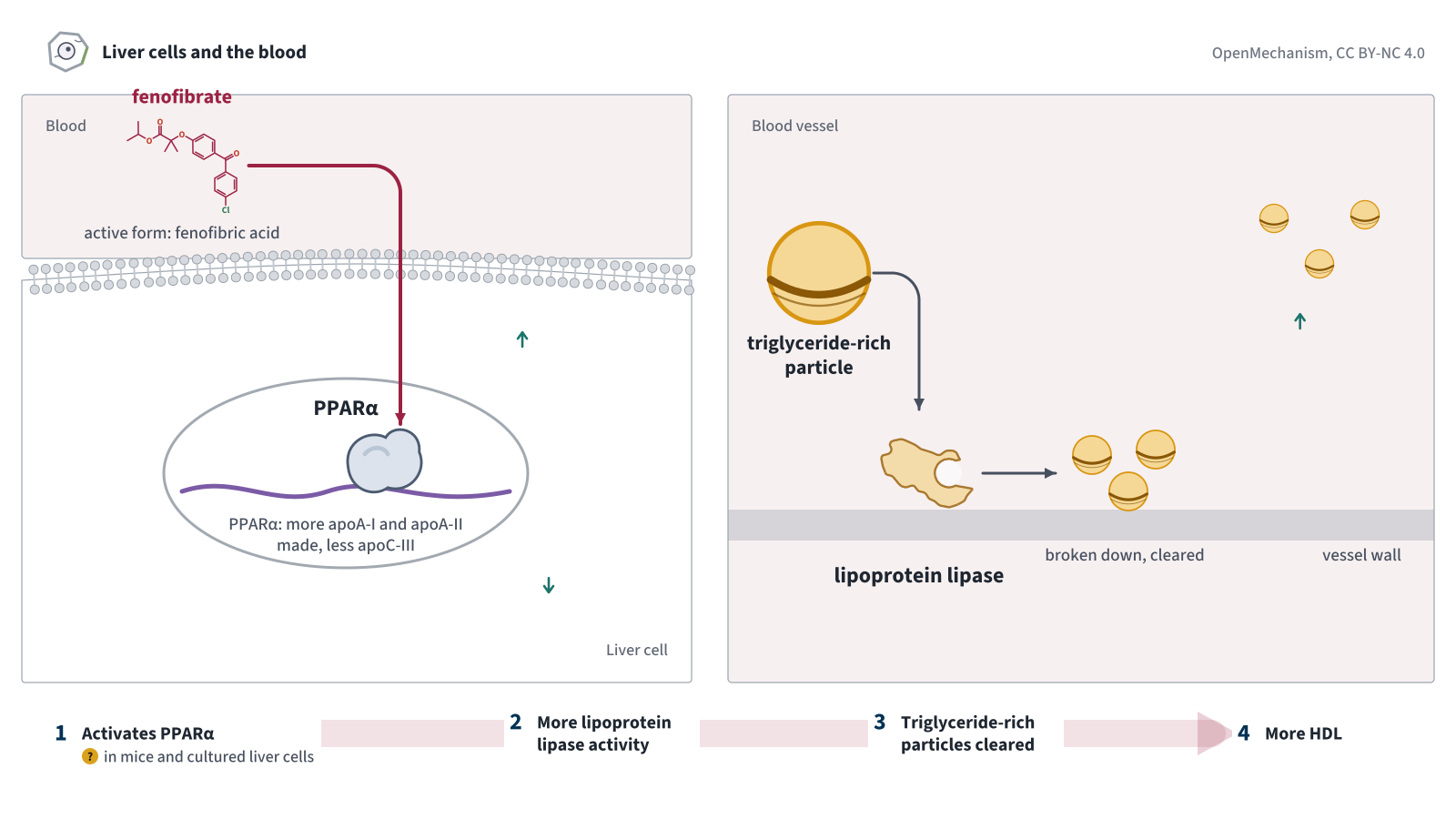
Step 1: in mice and cultured liver cells
The fenofibrate (Tricor) label says: The lipid-modifying effects of fenofibric acid seen in clinical practice have been explained in vivo in transgenic mice and in vitro in human hepatocyte cultures by the activation of peroxisome proliferator activated receptor α (PPARα).
Clinical study: In a 2003 controlled crossover trial that compared micronized fenofibrate (200 mg a day) with atorvastatin (40 mg a day) and placebo in 11 men with the metabolic syndrome and abnormal blood lipids, fenofibrate sped the clearance of triglyceride-rich particles and raised the making of apoA-I, a protein of HDL: Fenofibrate significantly increased (P < 0.01) the FCR of VLDL, IDL, and LDL apoB but did not affect the production of VLDL apoB. Relative to placebo and atorvastatin, fenofibrate significantly increased the production (P < 0.001) and FCR (P = 0.016) of apoAI.
Watts GF et al., Diabetes 2003 (PMID 12606523)
Key terms in this drawing (5)
- apoA-I
- Apolipoprotein A-I. A protein of HDL; with apoA-II it forms the transport complex of HDL cholesterol.
- apoA-II
- Apolipoprotein A-II. A protein of HDL; with apoA-I it forms the transport complex of HDL cholesterol.
- apoC-III
- Apolipoprotein C-III. A protein that holds back lipoprotein lipase, the enzyme that clears triglyceride-rich particles from the blood; fenofibrate lowers it.
- HDL
- High-density lipoprotein. A lipoprotein; low levels of HDL cholesterol, and of its carrier proteins apoA-I and apoA-II, are linked to hardening of the arteries (atherosclerosis).
- PPARα
- Peroxisome proliferator-activated receptor alpha. A receptor that fenofibrate switches on; studies in mice and in cultured human liver cells explain how this clears triglyceride-rich particles from the blood faster.
How it works
Activates PPARα. The active form, fenofibric acid, activates peroxisome proliferator-activated receptor α (PPARα); the lipid effects seen in clinical practice have been explained by this activation in transgenic mice and in cultured human liver cells.1
More lipoprotein lipase activity. Through PPARα, fenofibrate activates lipoprotein lipase and reduces production of apoprotein C-III, an inhibitor of lipoprotein lipase.1
Triglyceride-rich particles cleared. Breakdown and elimination of triglyceride-rich particles from the plasma increase. With less triglyceride, LDL shifts from small, dense particles (thought to be atherogenic) to large, buoyant ones that are cleared faster.1
More HDL. PPARα activation also increases the synthesis of apolipoproteins A-I and A-II and of HDL cholesterol.1
For teachers: download this drawing.
See also
Condition pages: high LDL cholesterol and severe high triglycerides.
Body system: heart, vessels & cholesterol.
Sources
- 1Tricor (fenofibrate) tablets: FDA label1 Indications and Usage; 12.1 Mechanism of Action; 12.2 Pharmacodynamics
- 2ChEMBL CHEMBL672Target and action classification: Peroxisome proliferator-activated receptor alpha agonist
- 3Differential regulation of lipoprotein kinetics by atorvastatin and fenofibrate in subjects with the metabolic syndromeWatts GF et al. Diabetes 2003 (abstract)
Also used for the drawing
The lipoprotein lipase outline is traced from the crystal structure below.
- 4Lipoprotein lipase (crystallized with GPIHBP1)PDB 6E7K; Birrane, G. et al. Proc. Natl. Acad. Sci. U.S.A. 2019; 116:1723-1732
Spotted a mistake? Report an error (hello@openmechanism.com). Since launch, every published error we fix is listed on the corrections page.
Notes and limits
- A schematic teaching drawing: not to scale, not exact structures, binding poses or a complete pathway, and not a guide to dosing, treatment or how a person will respond.
- The steps are in the order that explains them; one step is said to cause the next only where the source says so.
- The label explains the mechanism from transgenic mice and cultured human liver cells. It also says it has not been determined whether raising HDL cholesterol or lowering triglycerides, on their own, changes the risk of heart and blood vessel disease or death, and that fenofibrate was not shown to reduce illness or death from coronary heart disease in people with type 2 diabetes.
All recorded limits are on the evidence page, and notes that apply to every page are on How to read a page. Version 1.0.1, medically reviewed by Daniel Tran, PharmD, on 29 October 2026.
Cite this page
Tran D. Fenofibrate [Internet]. OpenMechanism; 2026 [updated 2026 Oct 29; cited 2026 Oct 29]. Available from: https://openmechanism.com/medicines/fenofibrate