We’re looking for volunteer reviewers in pharmacy, medicine and pharmacology. How to volunteerWe’re looking for volunteer reviewers.

Inside skeletal muscle

From a whole muscle down to the filaments that pull: normal, in malignant hyperthermia (the label's model), and with dantrolene.

Zoom
Compare

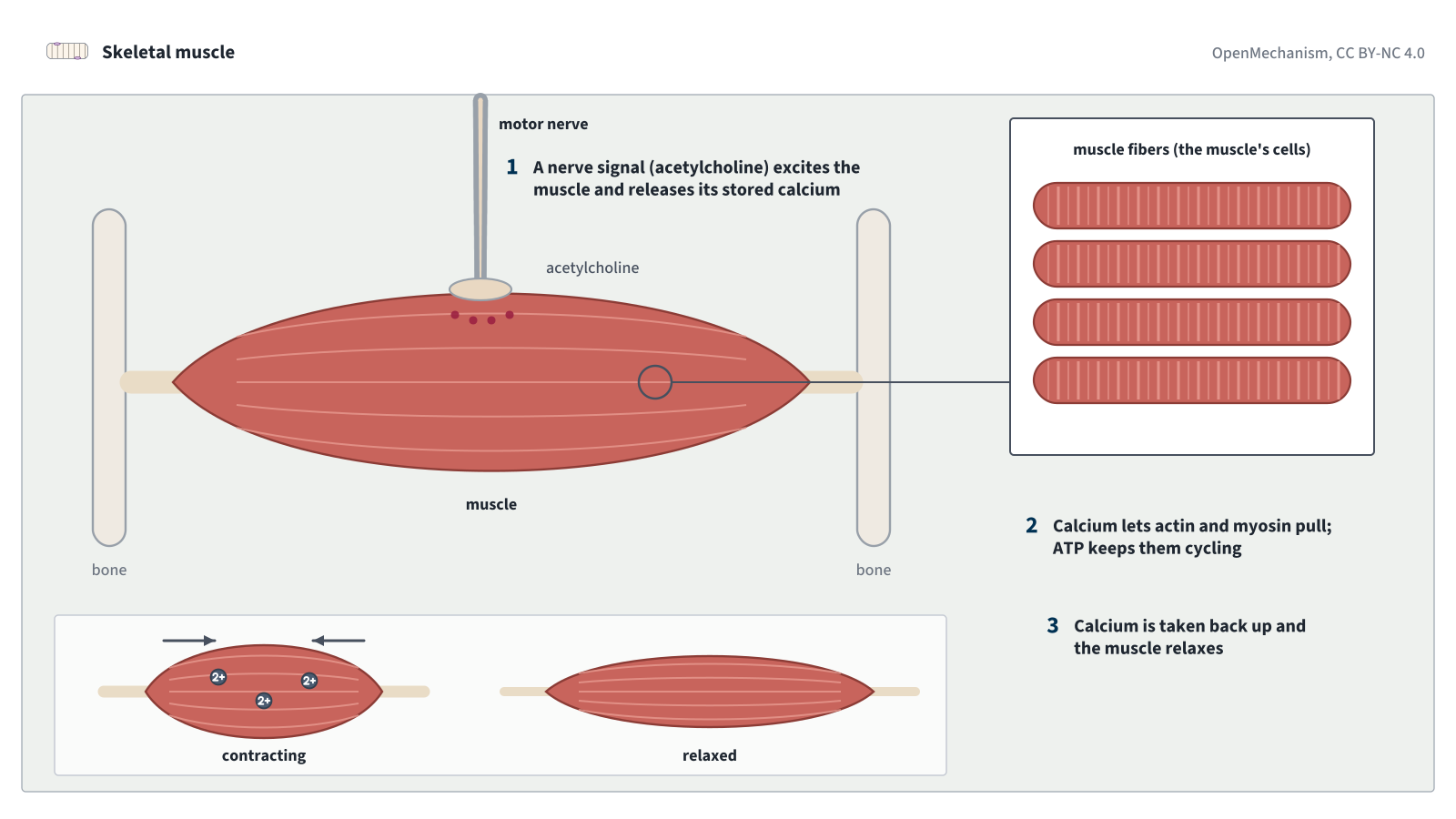
A whole muscle, normal biology

Drawing: A whole muscle, normal biology. 1: A nerve signal (acetylcholine) excites the muscle and releases its stored calcium. 2: Calcium lets actin and myosin pull; ATP keeps them cycling. 3: Calcium is taken back up and the muscle relaxes.
Schematic, not to scale. License CC BY-NC 4.0.

For teachers: download this drawing.

  1. A nerve signal (acetylcholine) excites the muscle and releases its stored calcium. A motor-neuron acetylcholine signal initiates muscle-membrane excitation and calcium release from the sarcoplasmic reticulum.1

  2. Calcium lets actin and myosin pull; ATP keeps them cycling. Calcium binding to troponin permits actin–myosin cross-bridge formation; supports repeated cycling.1

  3. Calcium is taken back up and the muscle relaxes. Calcium after excitation ends reduces exposed binding sites and allows relaxation.1

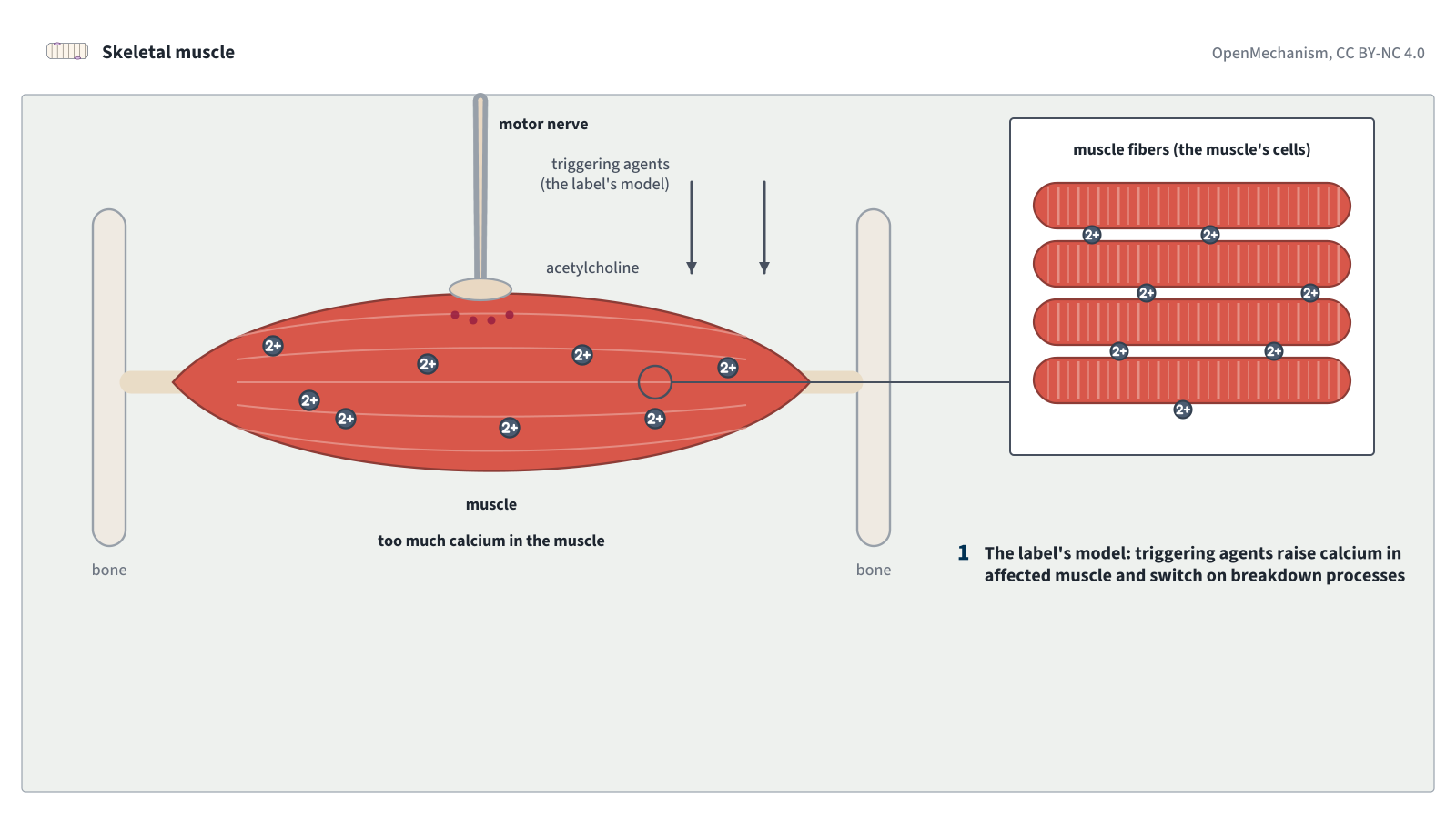
A whole muscle, malignant hyperthermia (label's model)

Drawing: A whole muscle, malignant hyperthermia (label's model). 1: The label's model: triggering agents raise calcium in affected muscle and switch on breakdown processes.
Schematic, not to scale. License CC BY-NC 4.0.

For teachers: download this drawing.

  1. The label's model: triggering agents raise calcium in affected muscle and switch on breakdown processes. The label postulates that triggering agents elevate myoplasmic calcium in affected muscle, activating catabolic processes associated with a malignant-hyperthermia crisis.2

More on the condition: malignant hyperthermia.

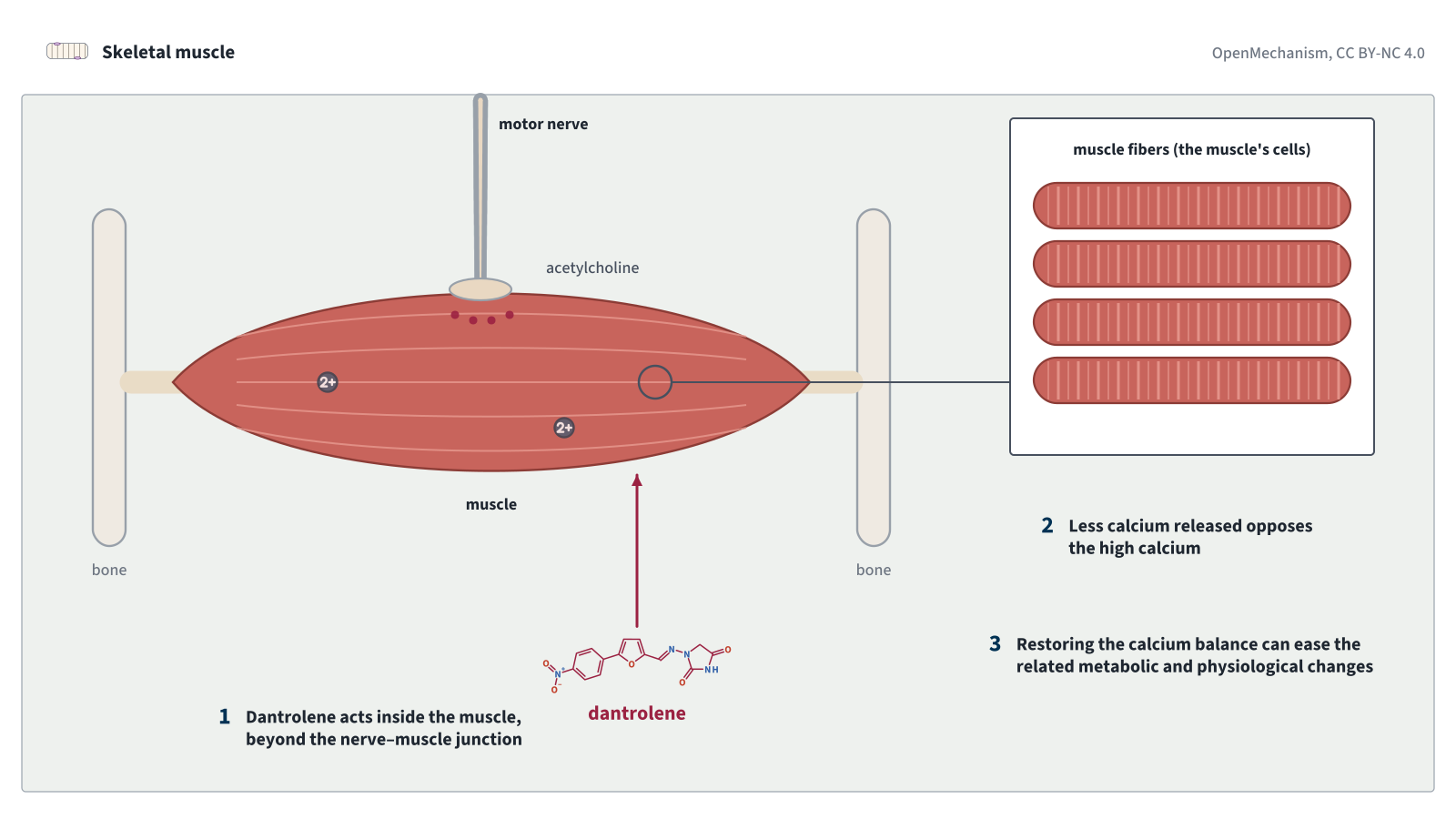
A whole muscle, with dantrolene

Drawing: A whole muscle, with dantrolene. 1: Dantrolene acts inside the muscle, beyond the nerve–muscle junction. 2: Less calcium released opposes the high calcium. 3: Restoring the calcium balance can ease the related metabolic and physiological changes.
Schematic, not to scale. License CC BY-NC 4.0.

For teachers: download this drawing.

  1. Dantrolene acts inside the muscle, beyond the nerve–muscle junction. Dantrolene acts on skeletal-muscle contractile responses at a site beyond the neuromuscular junction.2

  2. Less calcium released opposes the high calcium. Reduced release opposes the elevated myoplasmic calcium of triggered malignant-hyperthermic muscle.2

  3. Restoring the calcium balance can ease the related metabolic and physiological changes. Restoring calcium equilibrium can attenuate associated metabolic and physiological changes.2

More on the medicine: dantrolene.

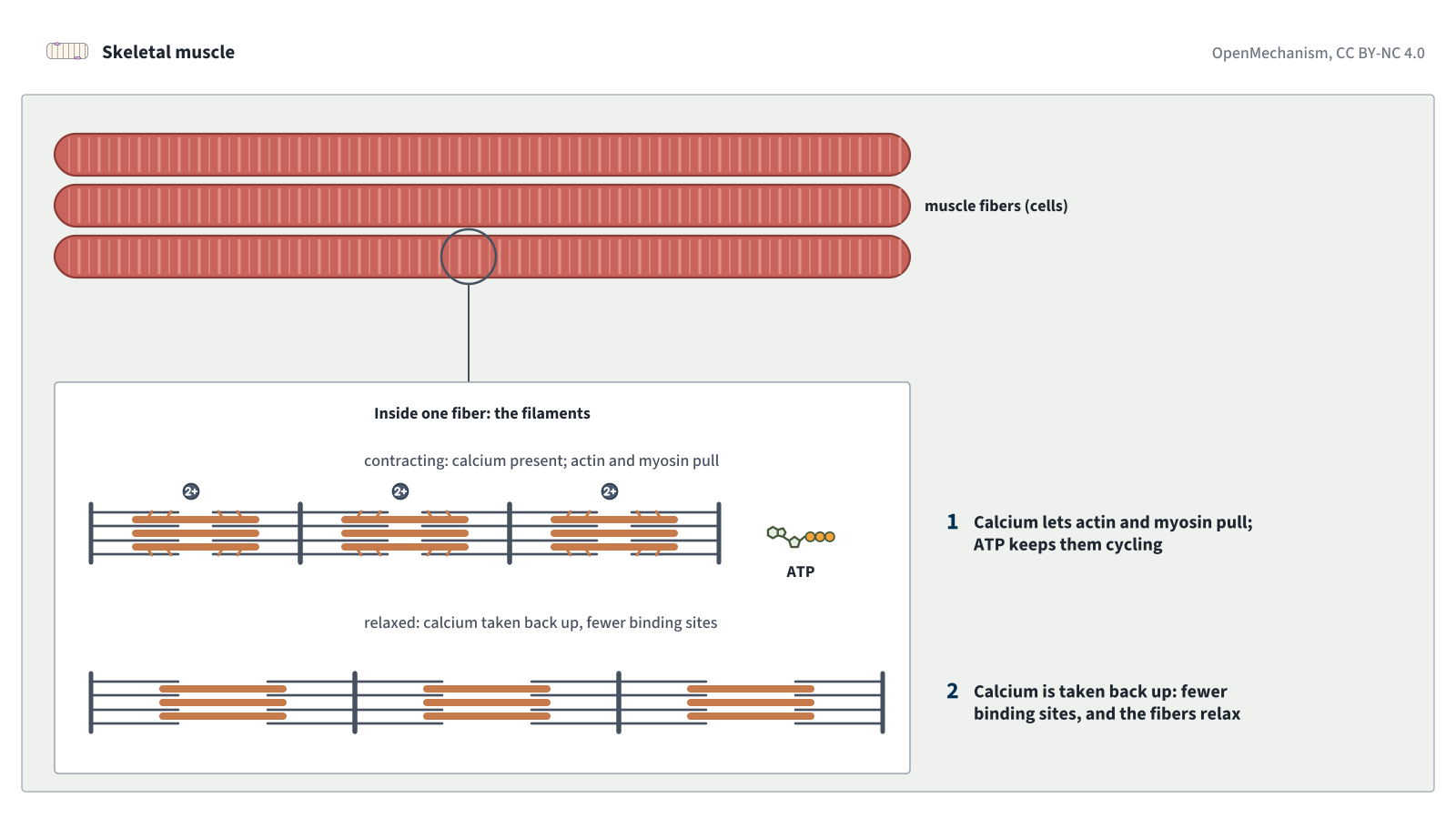
Muscle fibers, normal biology

Drawing: Muscle fibers, normal biology. 1: Calcium lets actin and myosin pull; ATP keeps them cycling. 2: Calcium is taken back up: fewer binding sites, and the fibers relax.
Schematic, not to scale. License CC BY-NC 4.0.

For teachers: download this drawing.

  1. Calcium lets actin and myosin pull; ATP keeps them cycling. Calcium binding to troponin permits actin–myosin cross-bridge formation; ATP supports repeated cycling.1

  2. Calcium is taken back up: fewer binding sites, and the fibers relax. Calcium reuptake after excitation ends reduces exposed binding sites and allows relaxation.1

Muscle fibers, malignant hyperthermia (label's model)

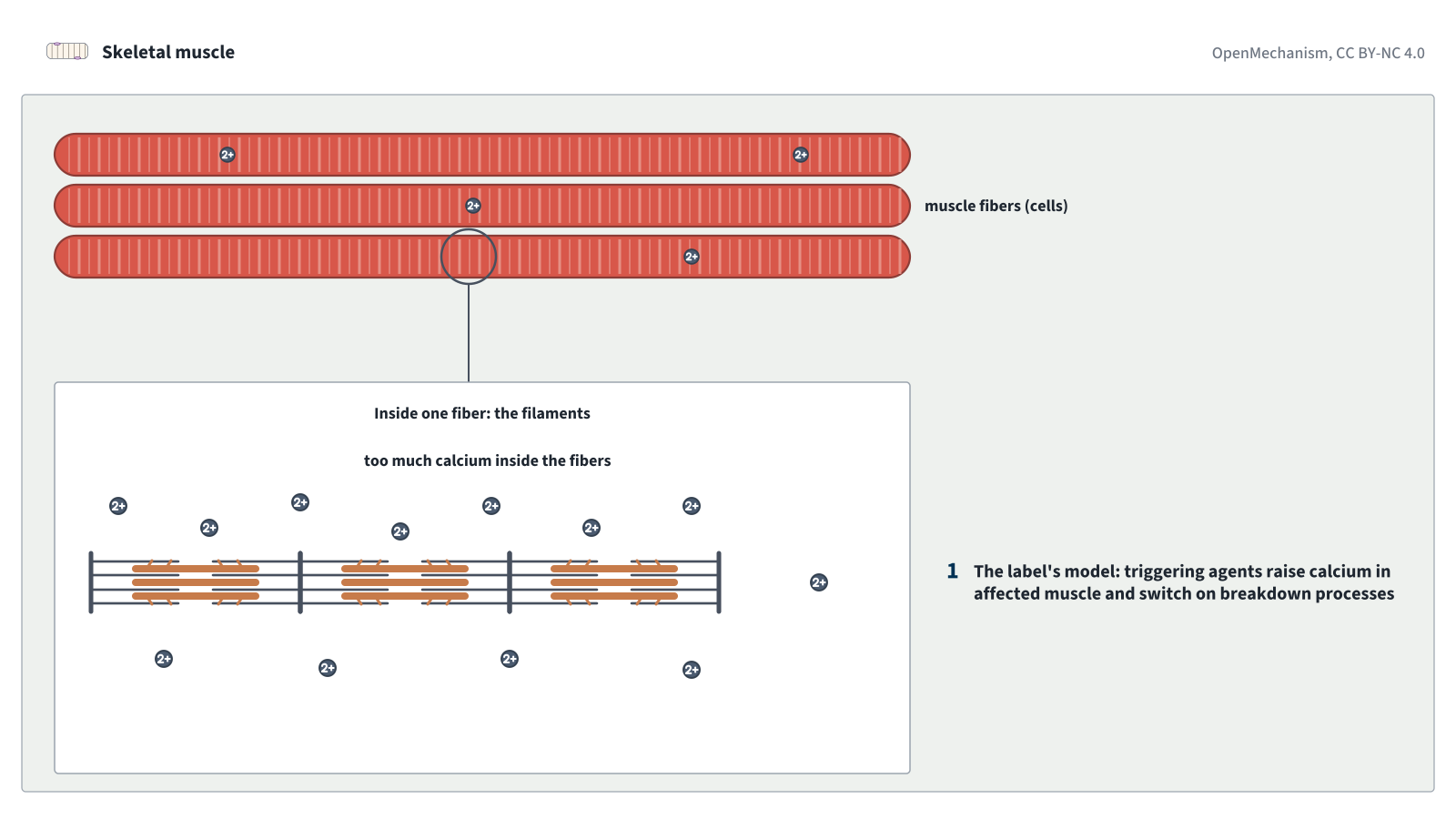
Drawing: Muscle fibers, malignant hyperthermia (label's model). 1: The label's model: triggering agents raise calcium in affected muscle and switch on breakdown processes.
Schematic, not to scale. License CC BY-NC 4.0.

For teachers: download this drawing.

  1. The label's model: triggering agents raise calcium in affected muscle and switch on breakdown processes. The label postulates that triggering agents elevate myoplasmic calcium in affected muscle, activating catabolic processes associated with a malignant-hyperthermia crisis.2

More on the condition: malignant hyperthermia.

Muscle fibers, with dantrolene

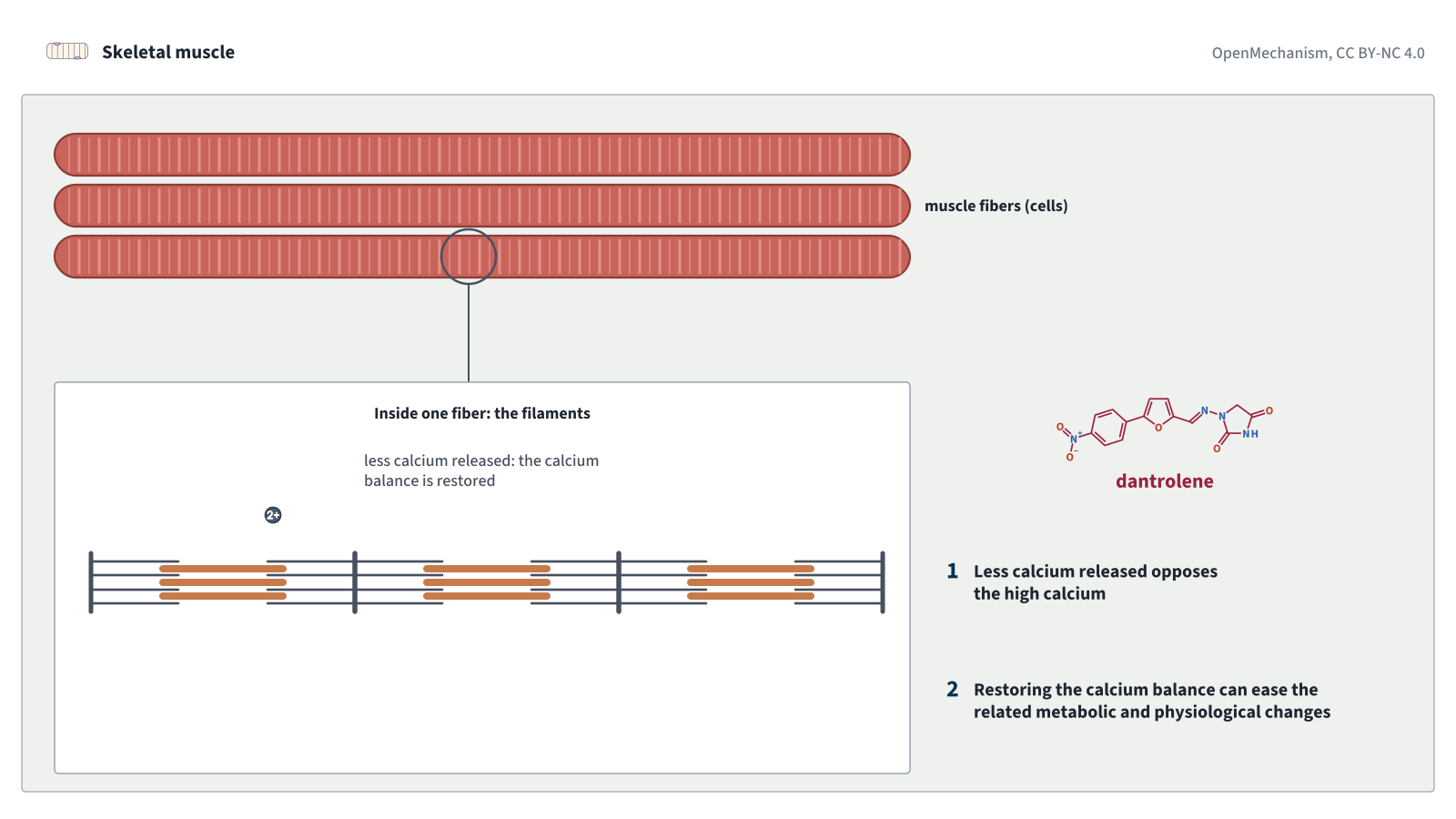
Drawing: Muscle fibers, with dantrolene. 1: Less calcium released opposes the high calcium. 2: Restoring the calcium balance can ease the related metabolic and physiological changes.
Schematic, not to scale. License CC BY-NC 4.0.

For teachers: download this drawing.

  1. Less calcium released opposes the high calcium. Reduced release opposes the elevated myoplasmic calcium of triggered malignant-hyperthermic muscle.2

  2. Restoring the calcium balance can ease the related metabolic and physiological changes. Restoring calcium equilibrium can attenuate associated metabolic and physiological changes.2

More on the medicine: dantrolene.

One muscle fiber, normal biology

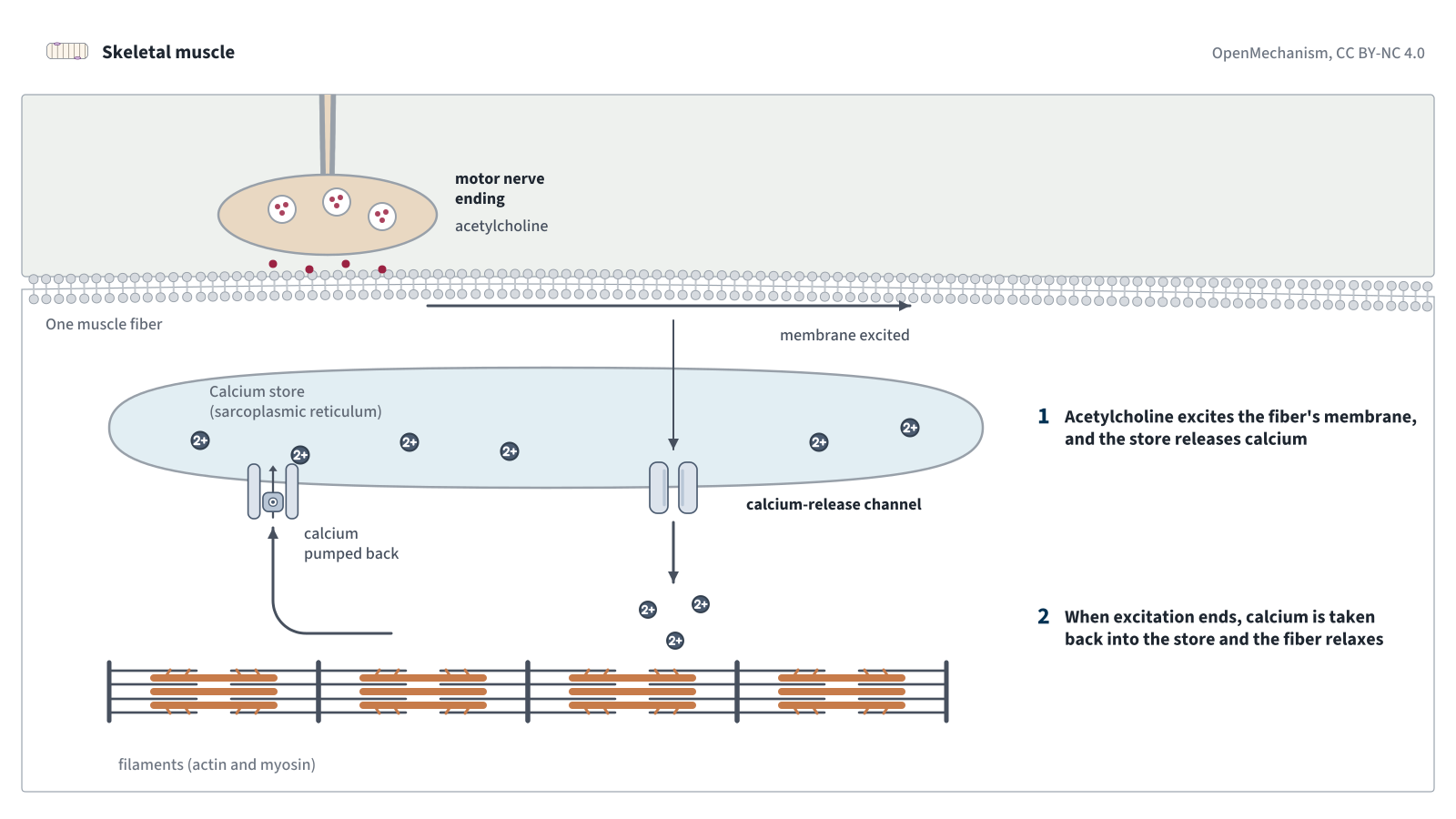
Drawing: One muscle fiber, normal biology. 1: Acetylcholine excites the fiber's membrane, and the store releases calcium. 2: When excitation ends, calcium is taken back into the store and the fiber relaxes.
Schematic, not to scale. License CC BY-NC 4.0.

For teachers: download this drawing.

  1. Acetylcholine excites the fiber's membrane, and the store releases calcium. A motor-neuron acetylcholine signal initiates muscle-membrane excitation and calcium release from the sarcoplasmic reticulum.1

  2. When excitation ends, calcium is taken back into the store and the fiber relaxes. Calcium reuptake after excitation ends reduces exposed binding sites and allows relaxation.1

One muscle fiber, malignant hyperthermia (label's model)

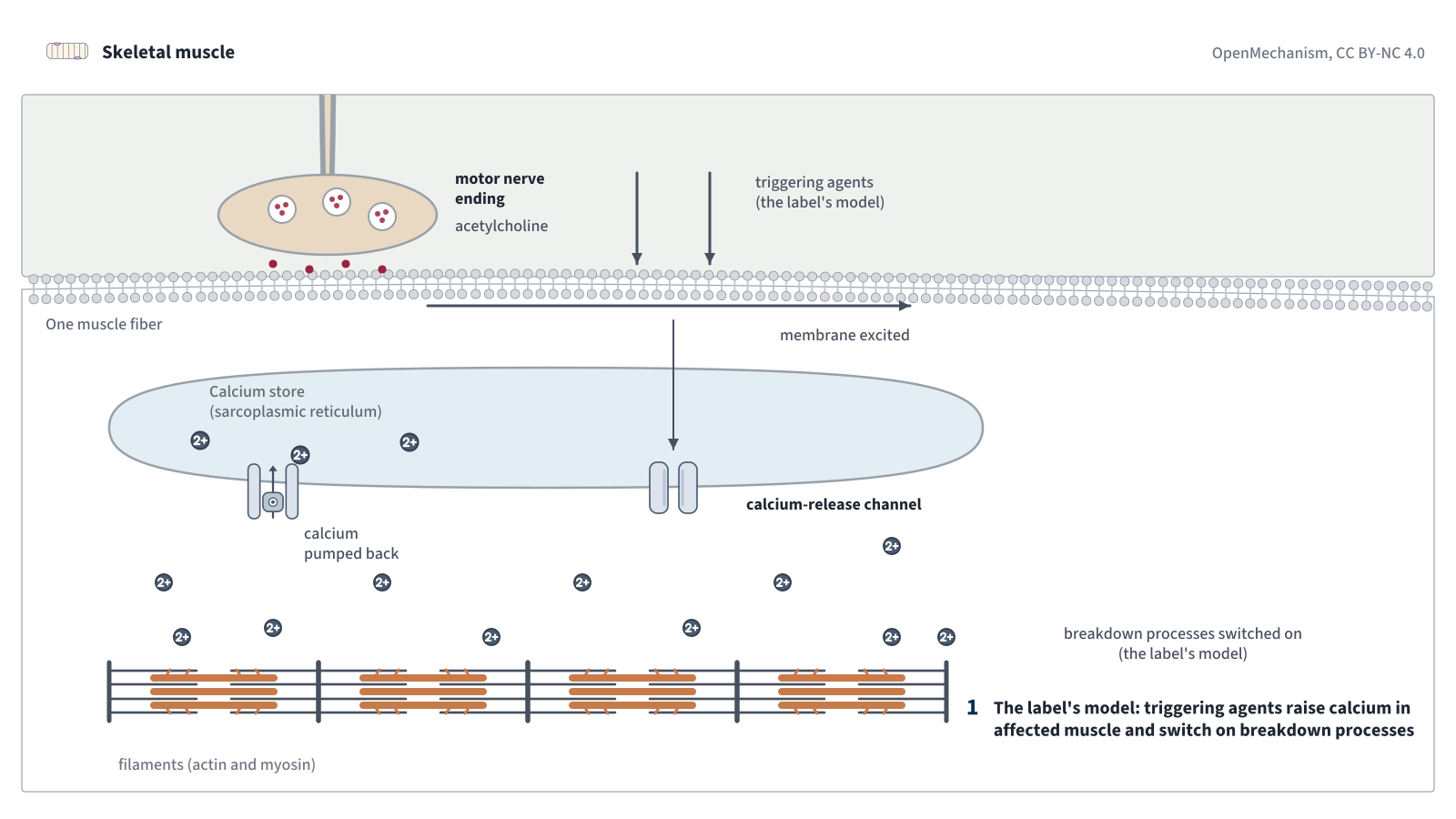
Drawing: One muscle fiber, malignant hyperthermia (label's model). 1: The label's model: triggering agents raise calcium in affected muscle and switch on breakdown processes.
Schematic, not to scale. License CC BY-NC 4.0.

For teachers: download this drawing.

  1. The label's model: triggering agents raise calcium in affected muscle and switch on breakdown processes. The label postulates that triggering agents elevate myoplasmic calcium in affected muscle, activating catabolic processes associated with a malignant-hyperthermia crisis.2

More on the condition: malignant hyperthermia.

One muscle fiber, with dantrolene

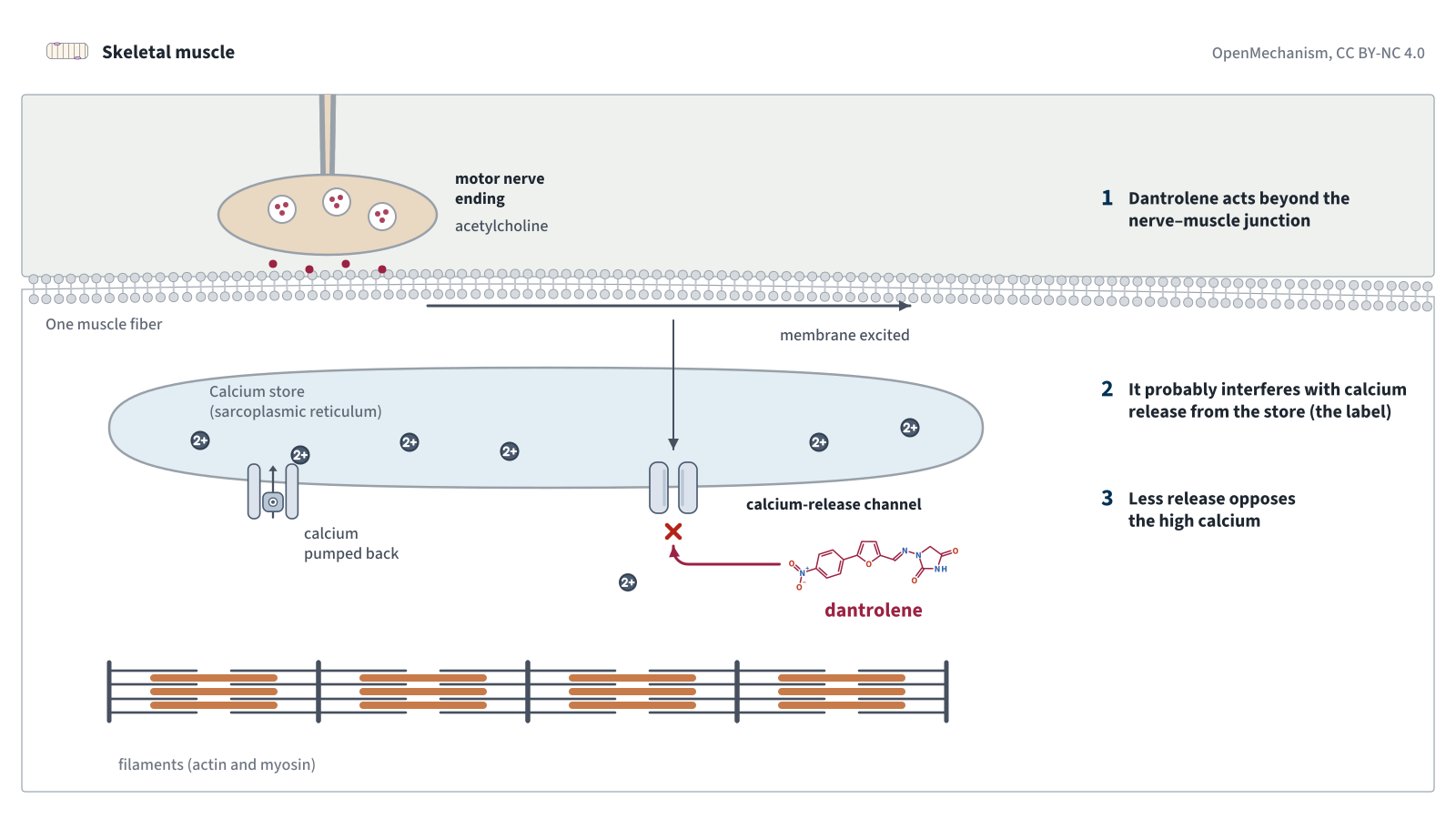
Drawing: One muscle fiber, with dantrolene. 1: Dantrolene acts beyond the nerve–muscle junction. 2: It probably interferes with calcium release from the store (the label). 3: Less release opposes the high calcium.
Schematic, not to scale. License CC BY-NC 4.0.

For teachers: download this drawing.

  1. Dantrolene acts beyond the nerve–muscle junction. Dantrolene acts on skeletal-muscle contractile responses at a site beyond the neuromuscular junction.2

  2. It probably interferes with calcium release from the store (the label). The label describes a probable interference with calcium release from the sarcoplasmic reticulum.2

  3. Less release opposes the high calcium. Reduced release opposes the elevated myoplasmic calcium of triggered malignant-hyperthermic muscle.2

More on the medicine: dantrolene.

Calcium, actin and myosin, normal biology

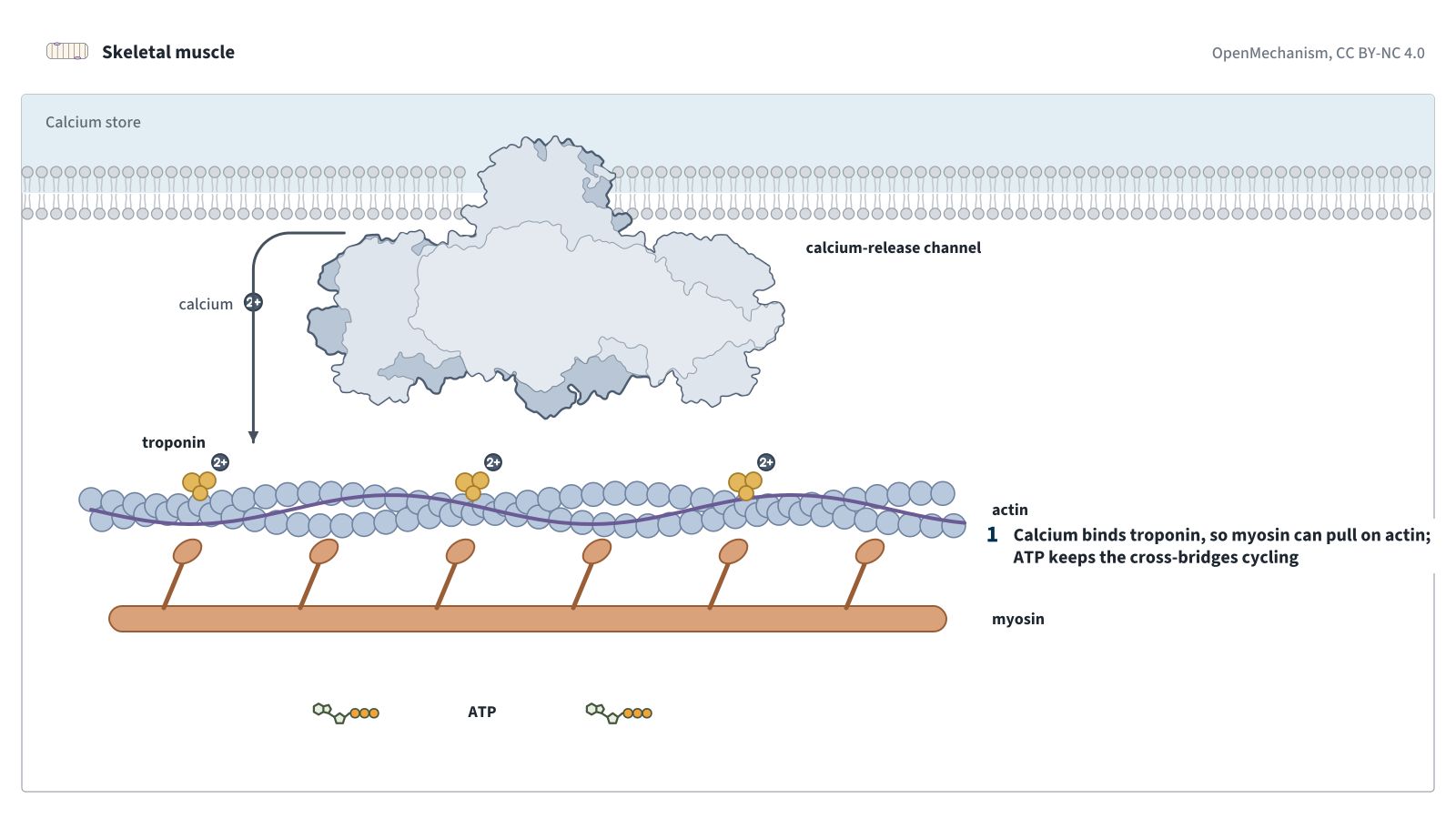
Drawing: Calcium, actin and myosin, normal biology. 1: Calcium binds troponin, so myosin can pull on actin; ATP keeps the cross-bridges cycling.
Schematic, not to scale. Calcium-release channel outline from the rabbit channel. License CC BY-NC 4.0.

For teachers: download this drawing.

  1. Calcium binds troponin, so myosin can pull on actin; ATP keeps the cross-bridges cycling. Calcium binding to troponin permits actin–myosin cross-bridge formation; ATP supports repeated cycling.1

Calcium, actin and myosin, malignant hyperthermia (label's model)

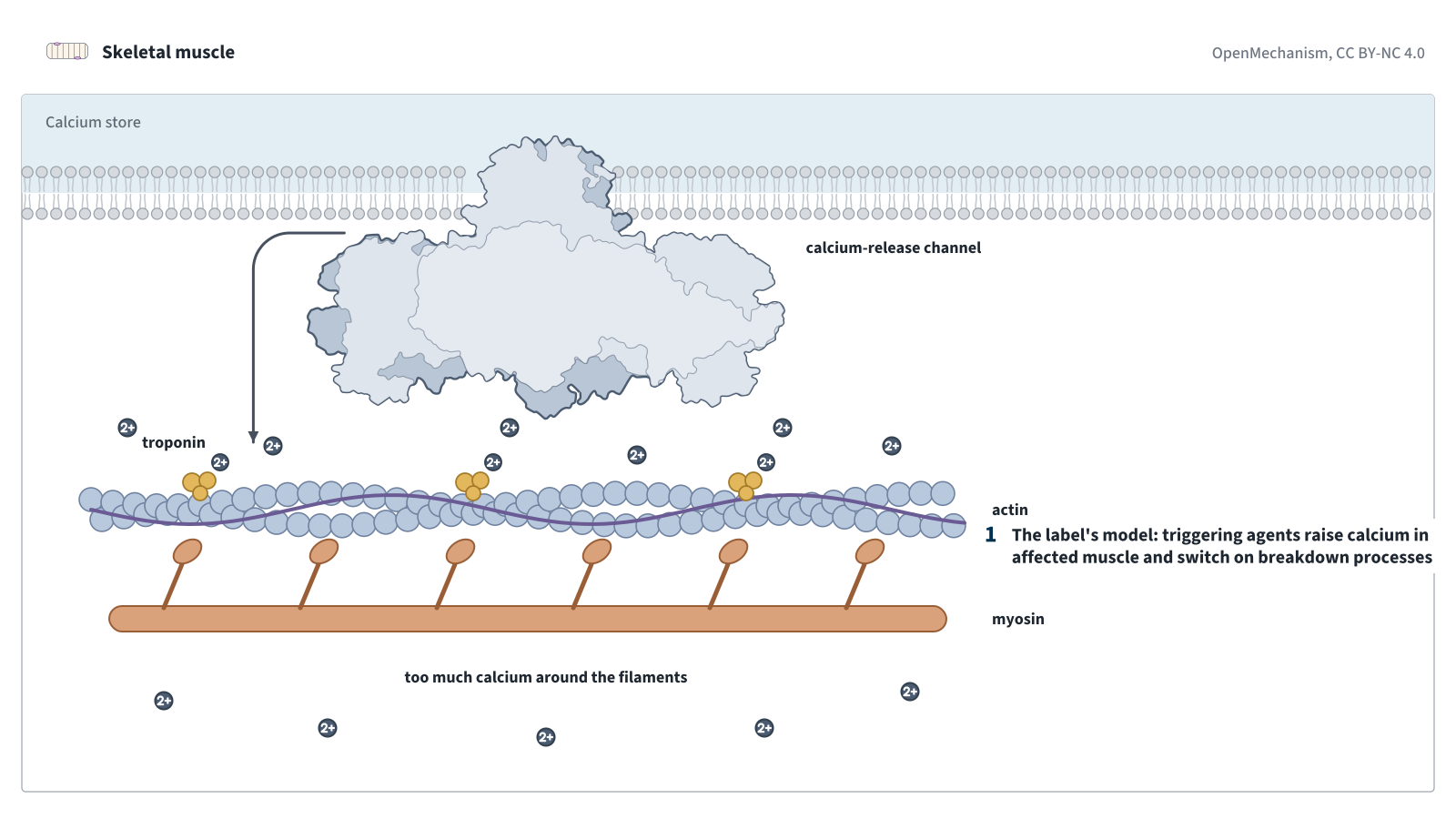
Drawing: Calcium, actin and myosin, malignant hyperthermia (label's model). 1: The label's model: triggering agents raise calcium in affected muscle and switch on breakdown processes.
Schematic, not to scale. Calcium-release channel outline from the rabbit channel. License CC BY-NC 4.0.

For teachers: download this drawing.

  1. The label's model: triggering agents raise calcium in affected muscle and switch on breakdown processes. The label postulates that triggering agents elevate myoplasmic calcium in affected muscle, activating catabolic processes associated with a malignant-hyperthermia crisis.2

More on the condition: malignant hyperthermia.

Calcium, actin and myosin, with dantrolene

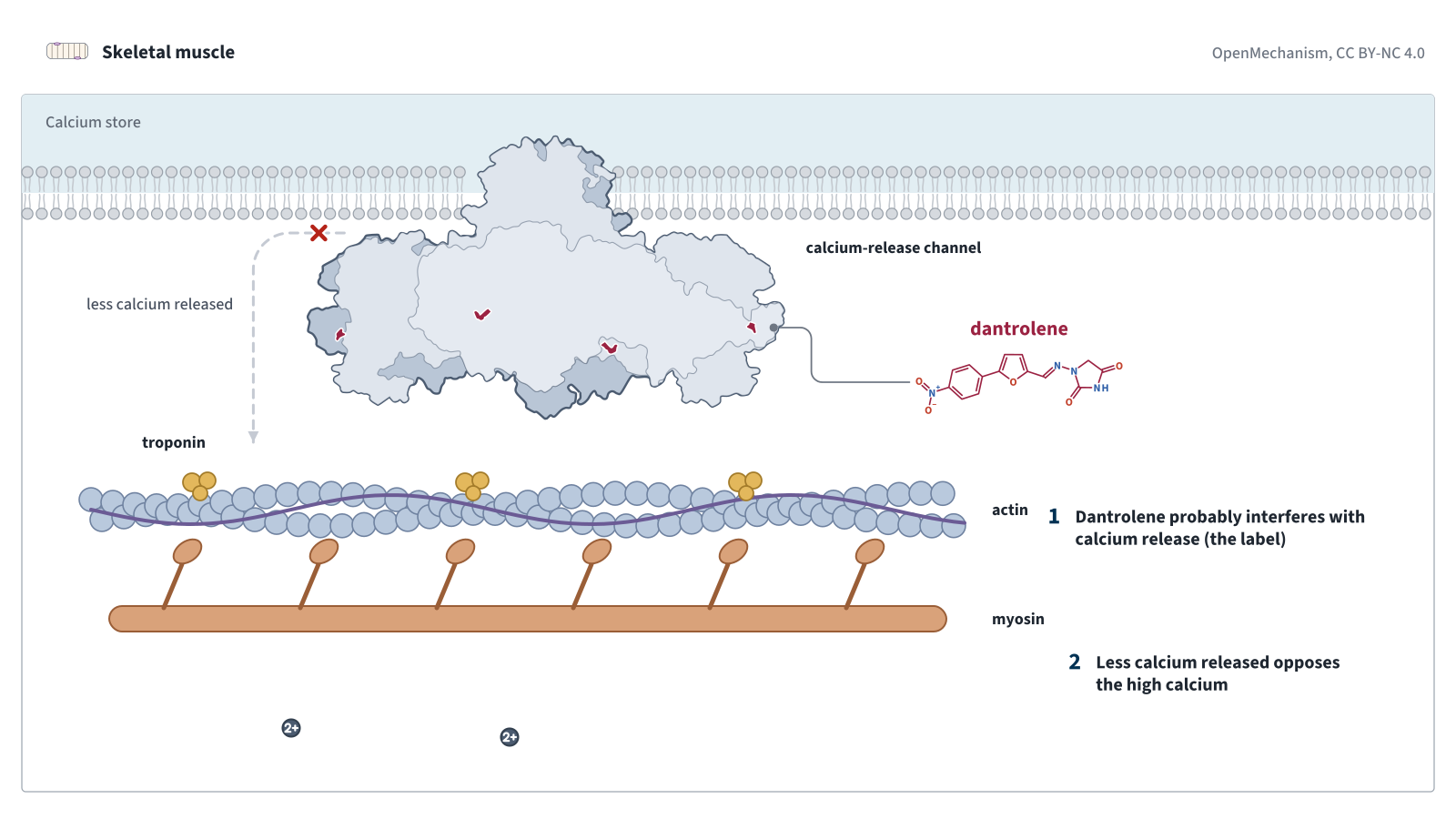
Drawing: Calcium, actin and myosin, with dantrolene. 1: Dantrolene probably interferes with calcium release (the label). 2: Less calcium released opposes the high calcium.
Schematic, not to scale. Calcium-release channel outline from the rabbit channel. License CC BY-NC 4.0.

For teachers: download this drawing.

  1. Dantrolene probably interferes with calcium release (the label). The label describes a probable interference with calcium release from the sarcoplasmic reticulum.2

  2. Less calcium released opposes the high calcium. Reduced release opposes the elevated myoplasmic calcium of triggered malignant-hyperthermic muscle.2

More on the medicine: dantrolene.

Key terms in these drawings

ATP
Adenosine triphosphate. The molecule cells use to carry energy.

See also

Body system: muscles, bones & joints.

Condition: malignant hyperthermia.

Medicine: dantrolene.

Animations: calcium in muscle.

Sources

  1. 1
    OpenStax · Muscle Fiber Contraction and Relaxation10.3: opening sequence; sliding filament model; relaxation. Our notes on this source
  2. 2
    Ryanodex (dantrolene sodium): FDA label12.1 Mechanism of Action. Saved copy
  3. 3
    Rabbit calcium-release channel (RyR1) with a malignant hyperthermia mutation, bound to dantrolenePDB 9CGP; Iyer, K.A. et al. Structure 2025;33:338-348.e4. The calcium-release channel outline in the drawings is traced from this structure. Saved copy
Notes and limits
  • Selected qualitative comparison, schematic and not to scale; not a complete physiological or treatment model.
  • The selected dantrolene label qualifies the calcium-release mechanism as probable and the pathological sequence as postulated. No exact RYR1 binding pose or measured calcium trajectory is asserted.
  • Selected human physiology / official human drug label; qualitative comparison only.
  • Source-backed teaching figure.
  • Schematic; not to scale. Four scales are explanatory contexts, not continuous measured zoom or complete anatomy.
  • Source art is unchanged reference context. Separate actor cards carry state observations; art shape does not depict measured disease changes.
  • Solid arrows mean only the qualified selected source relation; dashed lines mean association. Row order and cross-scale navigation do not create a causal chain.
  • No dosing, diagnosis, treatment selection, response prediction, molecular pose or quantitative clinical model.
  • The drawings are schematic and not to scale; each shows only what the statements under it say.

Spotted a mistake? Report an error (hello@openmechanism.com). Since launch, every published error we fix is listed on the corrections page.

Cite this page

Tran D. Inside skeletal muscle [Internet]. OpenMechanism; 2026 [updated 2026 Oct 16; cited 2026 Oct 16]. Available from: https://openmechanism.com/body/scales/muscle