Colesevelam
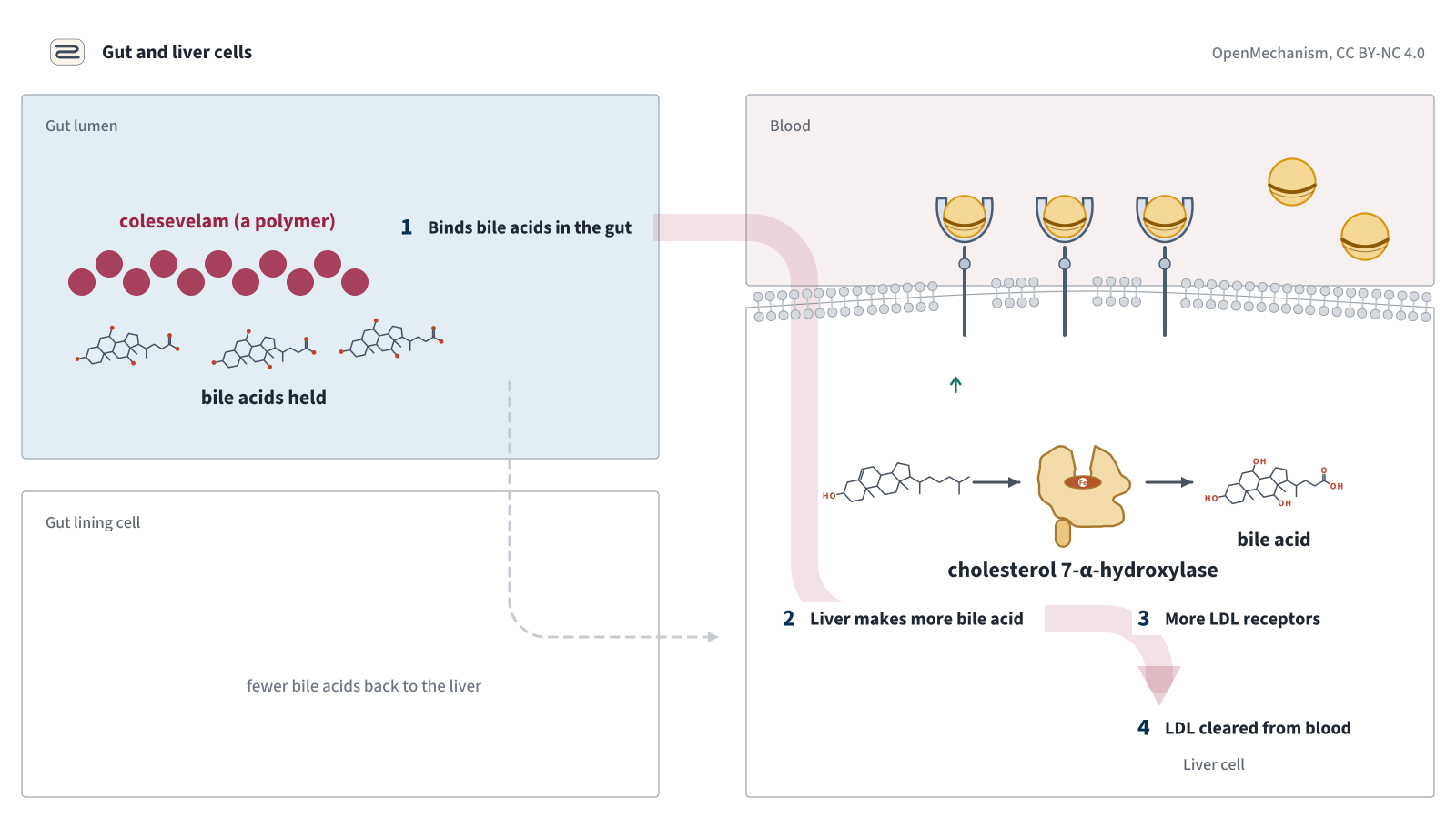
Colesevelam stays in the gut and binds bile acids so they are not reabsorbed. The liver turns more cholesterol into bile acids to replace them, makes more cholesterol and more , and takes more cholesterol out of the blood.
- Acts on
- Bile acids in the intestine
- Where
- Gut and liver cells
- Medicine type
- Unknown
- Used for
- Heart & circulation
Key terms in this drawing
- HMG-CoA
- 3-hydroxy-3-methylglutaryl coenzyme A. A building block the liver turns into mevalonate on the way to making cholesterol.
- HMG-CoA reductase
- 3-hydroxy-3-methylglutaryl-coenzyme A reductase. The enzyme that turns HMG-CoA into mevalonate, an early step in making cholesterol.
- LDL
- Low-density lipoprotein. Particles that carry cholesterol in the blood ('LDL cholesterol').
- LDL receptor
- Low-density lipoprotein receptor. A receptor on liver cells that takes LDL particles out of the blood.
How it works
Binds bile acids in the gut. Colesevelam is a non-absorbed, lipid-lowering polymer that binds bile acids in the intestine, so they are not reabsorbed.1
Liver makes more bile acid. As the bile acid pool shrinks, the liver enzyme cholesterol 7-α-hydroxylase is upregulated, converting more cholesterol into bile acids.1
More LDL receptors. Liver cells then need more cholesterol: transcription and activity of increase, and so does the number of liver LDL receptors.1
LDL cleared from blood. These compensating effects increase clearance of LDL cholesterol from the blood, so serum LDL cholesterol falls; serum triglycerides may rise or stay unchanged.1
For teachers: download this drawing.
See also
Condition pages: high LDL cholesterol and type 2 diabetes.
More medicines for heart & circulation: adenosine, aliskiren, ambrisentan, amiloride, amiodarone, amlodipine, atenolol, atorvastatin and 59 more.
Explained: levothyroxine and calcium, iron or acid reducers.
Body system: heart, vessels & cholesterol.
Sources
- 1Colesevelam hydrochloride tablets: FDA label12.1 Mechanism of Action
- 2ChEMBL CHEMBL6068331Target and action classification: Bile acids sequestering agent
Also used for the drawing
The cholesterol 7-alpha-hydroxylase outline is traced from the crystal structure below.
- 3Human cholesterol 7-alpha-hydroxylase (CYP7A1) with 7-ketocholesterolPDB 3V8D; Strushkevich, N. et al. To be Published
Spotted a mistake? Report an error (hello@openmechanism.com). Since launch, every published error we fix is listed on the corrections page.
Notes and limits
- A schematic teaching drawing: not to scale, not exact structures, binding poses or a complete pathway, and not a guide to dosing, treatment or how a person will respond.
- The label says the mechanism by which colesevelam improves glycemic control in type 2 diabetes is unknown.
All recorded limits are on the evidence page, and notes that apply to every page are on How to read a page. Version 1.0.0, not yet medically reviewed.
Cite this page
Tran D. Colesevelam [Internet]. OpenMechanism; 2026 [updated 2026 Oct 10; cited 2026 Oct 10]. Available from: https://openmechanism.com/medicines/colesevelam