Low blood pressure during anesthesia
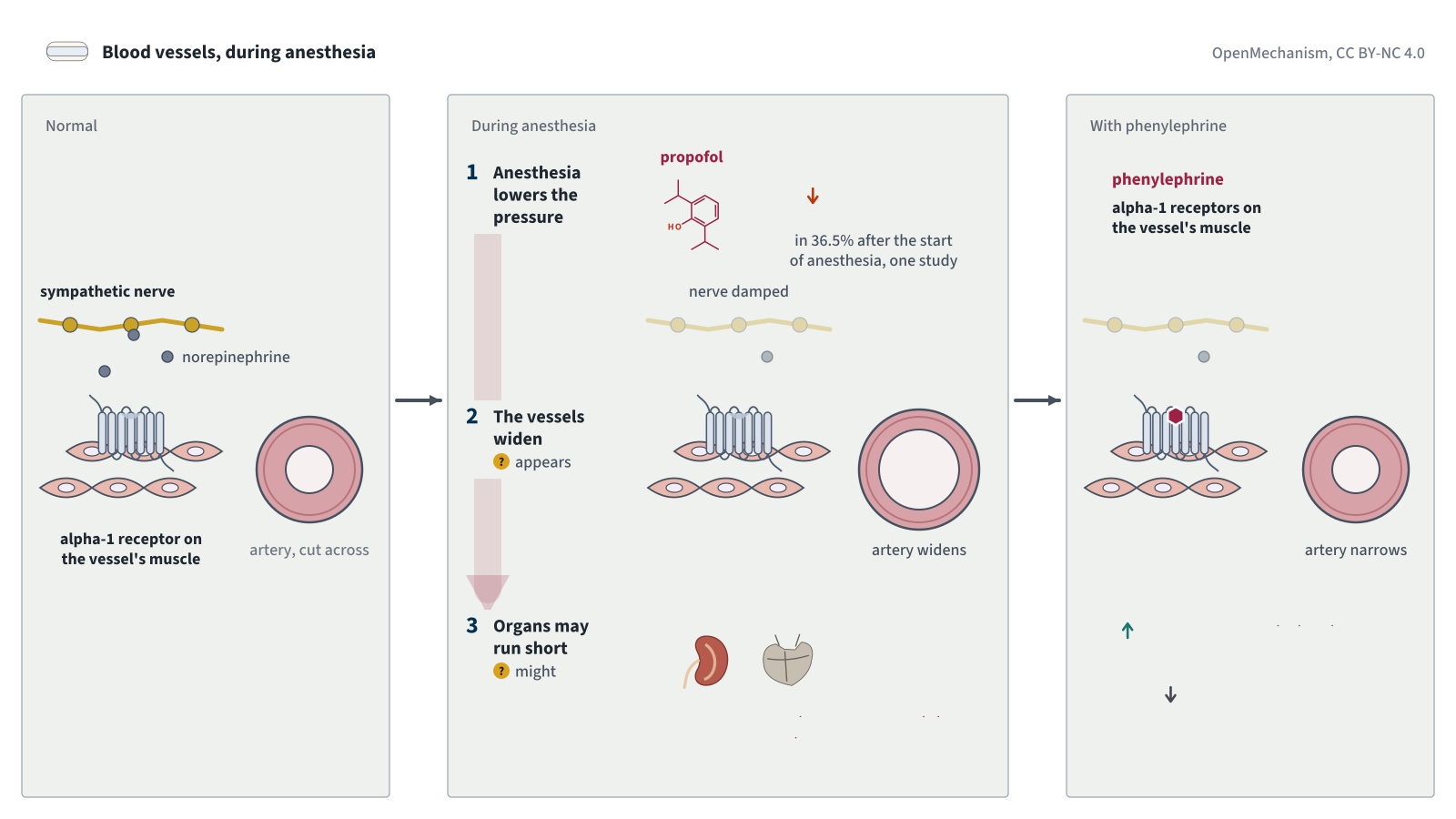
Low blood pressure is a common side effect of general anesthesia. After propofol it appears to come mostly from widened arteries, and propofol seems to damp the sympathetic nerves that keep vessels narrow. Short spells of very low pressure are linked to kidney and heart injury. Phenylephrine narrows the vessels again and raises the pressure.
- Where
- Blood vessels, during anesthesia
- Body system
- Heart, vessels & cholesterol
- Medicines
- 1 medicine
Step 2: appears
The Saugel 2022 study says: Post-induction hypotension therefore appears to result from arterial dilation with reduced systemic vascular resistance rather than venous dilation or reduced myocardial contractility.
Clinical study: In a study of 25 surgical patients, recording blood pressure, forearm vascular resistance and the activity of the sympathetic nerves while anesthesia was started with propofol or with etomidate: Etomidate induction preserved MSNA, forearm vascular resistance, and blood pressure, whereas propofol reduced MSNA by 76 +/- 5% (mean +/- SEM), leading to a reduction in forearm vascular resistance and a significant hypotension.
Ebert TJ et al., Anesthesiology 1992 (PMID 1575340)
This study was picked with a literature search and is not yet checked by our reviewer.
Step 3: might
The Wesselink 2018 review says: The reported associations suggest that organ injury might occur when mean arterial pressure decreases <80 mm Hg for ≥10 min, and that this risk increases with blood pressures becoming progressively lower.
Clinical study: In a randomized trial in 298 high-risk adults having major surgery (INPRESS), comparing blood pressure kept near each patient's own resting level with standard care; it measured organ dysfunction: The primary outcome event occurred in 56 of 147 patients (38.1%) assigned to the individualized treatment strategy vs 75 of 145 patients (51.7%) assigned to the standard treatment strategy (relative risk, 0.73; 95% CI, 0.56 to 0.94; P = .02; absolute risk difference, -14%, 95% CI, -25% to -2%). … Among patients predominantly undergoing abdominal surgery who were at increased postoperative risk, management targeting an individualized systolic blood pressure, compared with standard management, reduced the risk of postoperative organ dysfunction.
Futier E et al., JAMA 2017 (PMID 28973220)
This study was picked with a literature search and is not yet checked by our reviewer.
For teachers: download this drawing.
Key terms in this drawing
- alpha-1 receptor
- Alpha-1 adrenergic receptor. Alpha-1 adrenergic receptors come in at least three subtypes, A, B and D; alpha-1A may have a main role in prostate obstruction, alpha-1B in tightening arteries.
What goes wrong
Anesthesia lowers the pressure. Low blood pressure is a common side effect of general anesthesia. In one study it followed the start of anesthesia in 36.5% of people, more often with older age, high blood pressure on arrival and diabetes. When people breathe on their own, propofol's main effect on the circulation is a fall in arterial pressure, sometimes by more than 30%, with little change in heart rate.1,2,3
What the source says
“Intraoperative hypotension is a common side effect of general anaesthesia and might lead to inadequate organ perfusion.”
Source 1“In 36.5% of subjects, GAIH was observed at ≥ 1 of the assessed time points.”
Source 2“The probability of GAIH is raising with age, degree of hypertension at time of arrival to theatre and presence of diabetes.”
Source 2“If spontaneous ventilation is maintained, the major cardiovascular effect is arterial hypotension (sometimes greater than a 30% decrease) with little or no change in heart rate and no appreciable decrease in cardiac output.”
Source 3The vessels widen. Which mechanism matters most has been unclear. After induction with propofol, the fall appears to come from widened arteries, with less resistance to blood flow, rather than from widened veins or a weaker heart. A study suggests propofol damps the sympathetic nerves that keep vessels narrow, and another that it widens veins too.4,5,6
What the source says
“It remains unclear whether reduced myocardial contractility, venous dilation with decreased venous return, or arterial dilation with reduced systemic vascular resistance contribute most to hypotension after induction of general anesthesia.”
Source 4“Post-induction hypotension therefore appears to result from arterial dilation with reduced systemic vascular resistance rather than venous dilation or reduced myocardial contractility.”
Source 4“These findings suggest that propofol-induced hypotension is mediated by an inhibition of the sympathetic nervous system and impairment of baroreflex regulatory mechanisms.”
Source 5“Thus, one mechanism promoting hypotension during propofol anesthesia in humans seems to be related to its direct effects on venous smooth muscle tone and presumably venous return.”
Source 6Organs may run short. Low pressure might leave the organs short of blood. In 33,330 operations, even short spells of a mean arterial pressure below 55 mmHg were linked to kidney and heart muscle injury, and a review of 42 studies suggests injury might start below 80 mmHg held for 10 minutes or more. Because these studies were observational, how low is too low is not settled.1,7
What the source says
“Intraoperative hypotension is a common side effect of general anaesthesia and might lead to inadequate organ perfusion.”
Source 1“The authors obtained perioperative data for 33,330 noncardiac surgeries at the Cleveland Clinic, Ohio.”
Source 7“Even short durations of an intraoperative MAP less than 55 mmHg are associated with AKI and myocardial injury.”
Source 7“We present an overview of 42 articles on reported associations between various absolute and relative intraoperative hypotension definitions and their associations with postoperative adverse outcomes after noncardiac surgery.”
Source 1“The reported associations suggest that organ injury might occur when mean arterial pressure decreases <80 mm Hg for ≥10 min, and that this risk increases with blood pressures becoming progressively lower.”
Source 1“Given the retrospective observational design of the studies reviewed, reflected by large variability in patient characteristics, hypotension definitions and outcomes, solid conclusions on which blood pressures under which circumstances are truly too low cannot be drawn.”
Source 1
Where medicines act
Smooth muscle of blood vessels
- A
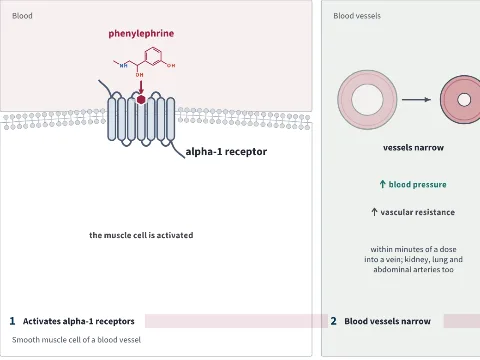
Phenylephrine targets Alpha-1 adrenergic receptors
Activates on vessel smooth muscle, so the vessels narrow and blood pressure rises.8,9
Used forLow blood pressure from widened vessels during anesthesia: given into a vein
What the label says
“BIORPHEN is indicated for the treatment of clinically important hypotension resulting primarily from vasodilation in the setting of anesthesia.”
Source 8“Interaction of phenylephrine with α-1 adrenergic receptors on vascular smooth muscle cells causes activation of the cells and results in vasoconstriction.”
Source 8“Following phenylephrine hydrochloride intravenous administration, increases in systolic and diastolic blood pressures, mean arterial blood pressure, and total peripheral vascular resistance are observed.”
Source 8“The onset of blood pressure increase following an intravenous bolus phenylephrine hydrochloride administration is rapid, typically within minutes.”
Source 8“As blood pressure increases following intravenous administration, vagal activity also increases, resulting in reflex bradycardia.”
Source 8“The literature support includes 16 studies evaluating the use of intravenous phenylephrine to treat hypotension during anesthesia. The 16 studies include 9 studies where phenylephrine was used in low-risk (ASA 1 and 2) pregnant women undergoing neuraxial anesthesia during Cesarean delivery, 6 studies in non-obstetric surgery under general anesthesia, and 1 study in non-obstetric surgery under combined general and neuraxial anesthesia.”
Source 9“Phenylephrine has been shown to raise systolic and mean blood pressure when administered either as a bolus dose or by continuous infusion following the development of hypotension during anesthesia.”
Source 9
See also
Body system: heart, vessels & cholesterol.
Also used for it: norepinephrine (for severe, acute low blood pressure: “LEVOPHED is indicated to raise blood pressure in adult patients with severe, acute hypotension.”11).
Can raise or cause it: propofol (“If spontaneous ventilation is maintained, the major cardiovascular effect is arterial hypotension (sometimes greater than a 30% decrease) with little or no change in heart rate and no appreciable decrease in cardiac output.”3).
Other conditions: shock and high blood pressure.
Interactions: reversing rocuronium with sugammadex or neostigmine.
Sources
- 1Intraoperative hypotension and the risk of postoperative adverse outcomes: a systematic reviewWesselink EM et al. Br J Anaesth 2018 (abstract). Saved copy
- 2Hypotension after induction of general anesthesia: occurrence, risk factors, and therapyJor O et al. J Anesth 2018 (abstract). Saved copy
- 3Diprivan (propofol): FDA label12.2 Pharmacodynamics. Saved copy
- 4Mechanisms contributing to hypotension after anesthetic induction with sufentanil, propofol, and rocuroniumSaugel B et al. J Clin Monit Comput 2022 (abstract). Saved copy
- 5Sympathetic responses to induction of anesthesia in humans with propofol or etomidateEbert TJ et al. Anesthesiology 1992 (abstract). Saved copy
- 6Venodilation contributes to propofol-mediated hypotension in humansMuzi M et al. Anesth Analg 1992 (abstract). Saved copy
- 7Relationship between intraoperative mean arterial pressure and clinical outcomes after noncardiac surgeryWalsh M et al. Anesthesiology 2013 (abstract). Saved copy
- 8Biorphen (phenylephrine hydrochloride injection): FDA label1 Indications and Usage; 12.1 Mechanism of Action; 12.2 Pharmacodynamics. Saved copy
- 9Biorphen (phenylephrine hydrochloride injection): FDA label5 Warnings and Precautions; 14 Clinical Studies. Saved copy
- 10Ketalar (ketamine): FDA label12.2 Pharmacodynamics. Saved copy
- 11Levophed (norepinephrine): FDA label1 Indications and Usage. Saved copy
- 12
Notes and limits
- Phenylephrine can bring on angina, worsen heart failure and raise the pressure in the lung arteries; it can narrow vessels so much that organs run short of blood, and it can slow the heart severely.9
- Not every anesthetic lowers blood pressure: ketamine's label says it raises blood pressure, heart rate and cardiac output.10
- Medicines are not the only fix: in one study, fluids given quickly were the most common treatment and worked 96.4% of the time.2
Notes that apply to every page are on How to read a page.
Spotted a mistake? Report an error (hello@openmechanism.com). Since launch, every published error we fix is listed on the corrections page.
Cite this page
Tran D. Low blood pressure during anesthesia [Internet]. OpenMechanism; 2026 [updated 2026 Oct 20; cited 2026 Oct 20]. Available from: https://openmechanism.com/conditions/hypotension-during-anesthesia