Milrinone
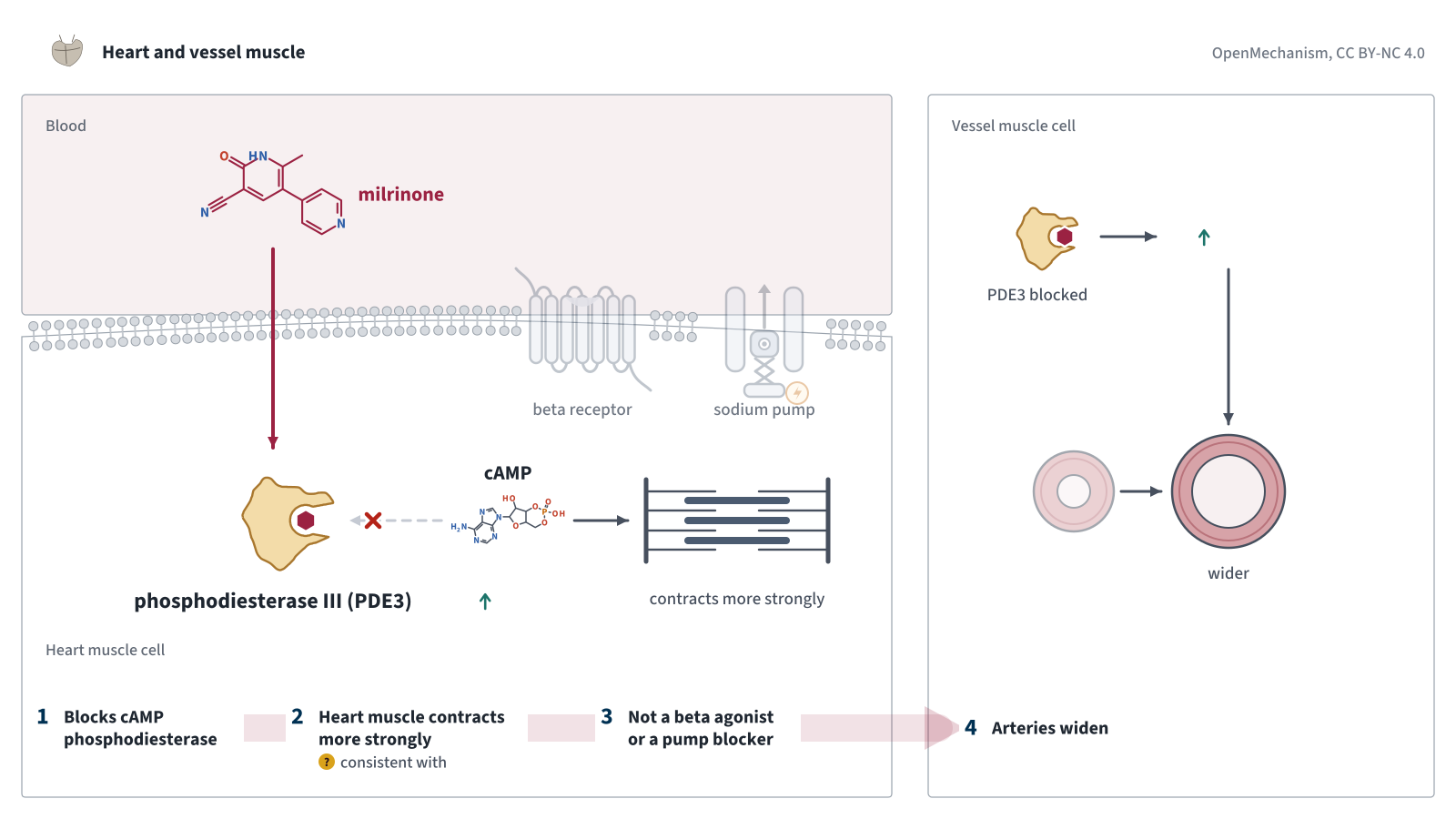
Milrinone blocks a phosphodiesterase () in heart and vessel muscle. The label says this fits with more cAMP, more calcium and stronger contraction in the heart, and relaxation in the vessels: in heart failure, the heart pumped more forcefully and the arteries widened. It is not a beta and does not block the sodium pump as digoxin does.
- Acts on
- Phosphodiesterase III (PDE3), which breaks down cAMP
- Where
- Heart and vessel muscle
- Medicine type
- Small molecule
- Used for
- Heart & circulation
- Drug class
- Inotropes and vasopressors
Step 2: consistent with
The milrinone lactate injection label says: This inhibitory action is consistent with cAMP mediated increases in intracellular ionized calcium and contractile force in cardiac muscle, as well as with cAMP dependent contractile protein phosphorylation and relaxation in vascular muscle.
Source 1: Milrinone lactate injection: FDA label, Clinical Pharmacology; Indications and Usage
Clinical study: In a randomized trial in 79 people with severe congestive heart failure (NYHA class III or IV), comparing intravenous milrinone with dobutamine; the trial measured the heart's output and pressures, not cAMP or calcium in the cells: Both agents significantly increased heart rate, cardiac index and stroke volume index and decreased pulmonary artery wedge pressure and systemic vascular resistance compared with baseline levels
Biddle TL et al., Am J Cardiol 1987 (PMID 3591689)
This study was picked with a literature search and is not yet checked by our reviewer.
Key terms in this drawing
- cAMP
- Cyclic adenosine monophosphate (cyclic AMP). A signaling molecule inside cells; a rise in it activates protein kinase A.
- PDE3
- Phosphodiesterase 3. An enzyme in heart and blood-vessel muscle that breaks down cAMP; milrinone blocks it.
How it works
Blocks cAMP phosphodiesterase. At the concentrations that strengthen the heart and relax vessels, milrinone selectively inhibits the peak III cAMP phosphodiesterase in heart and vessel muscle (phosphodiesterase III, PDE3: milrinone is a PDE3 inhibitor).1,2
Heart muscle contracts more strongly. This inhibition is consistent with cAMP-mediated increases in calcium inside heart muscle cells and in their force of contraction; in people with heart failure, milrinone increased the rate at which pressure rises in the left ventricle, in a dose-related way, and it also improved the ventricle's relaxation.1
Not a beta agonist or a pump blocker. Milrinone works differently from the catecholamines and the digitalis glycosides: it is not a beta-adrenergic agonist, and it does not inhibit the sodium-potassium pump (sodium-potassium ATPase) as the digitalis glycosides do.1
Arteries widen. In vessel muscle the inhibition is consistent with cAMP-dependent changes to the contractile proteins and relaxation; in people with heart failure, blood flow in the forearm rose with the dose, showing that milrinone widens arteries directly.1
For teachers: download this drawing.
See also
Condition pages: heart failure and shock.
Other inotropes and vasopressors: dobutamine, epinephrine, norepinephrine and vasopressin.
Body system: heart, vessels & cholesterol.
Sources
- 1Milrinone lactate injection: FDA labelClinical Pharmacology; Indications and Usage
- 2Development of decompensated dilated cardiomyopathy is associated with decreased gene expression and activity of the milrinone-sensitive cAMP phosphodiesterase PDE3ASmith CJ et al., Circulation 1997 (abstract)
- 3ChEMBL CHEMBL189Target and action classification: Phosphodiesterase 3A inhibitor
- 4Comparison of intravenous milrinone and dobutamine for congestive heart failure secondary to either ischemic or dilated cardiomyopathyBiddle TL et al. Am J Cardiol 1987 (abstract)
Also used for the drawing
The PDE3 outline is traced from the crystal structure below.
- 5The catalytic domain of human phosphodiesterase 3A (PDE3A) with an inhibitor (DNMDP)PDB 7KWE; Garvie, C.W. et al. Nat Commun 2021; 12:4375
Spotted a mistake? Report an error (hello@openmechanism.com). Since launch, every published error we fix is listed on the corrections page.
Notes and limits
- A schematic teaching drawing: not to scale, not exact structures, binding poses or a complete pathway, and not a guide to dosing, treatment or how a person will respond.
All recorded limits are on the evidence page, and notes that apply to every page are on How to read a page. Version 1.0.0, not yet medically reviewed.
Cite this page
Tran D. Milrinone [Internet]. OpenMechanism; 2026 [updated 2026 Oct 10; cited 2026 Oct 10]. Available from: https://openmechanism.com/medicines/milrinone