Succinylcholine and the BCHE gene
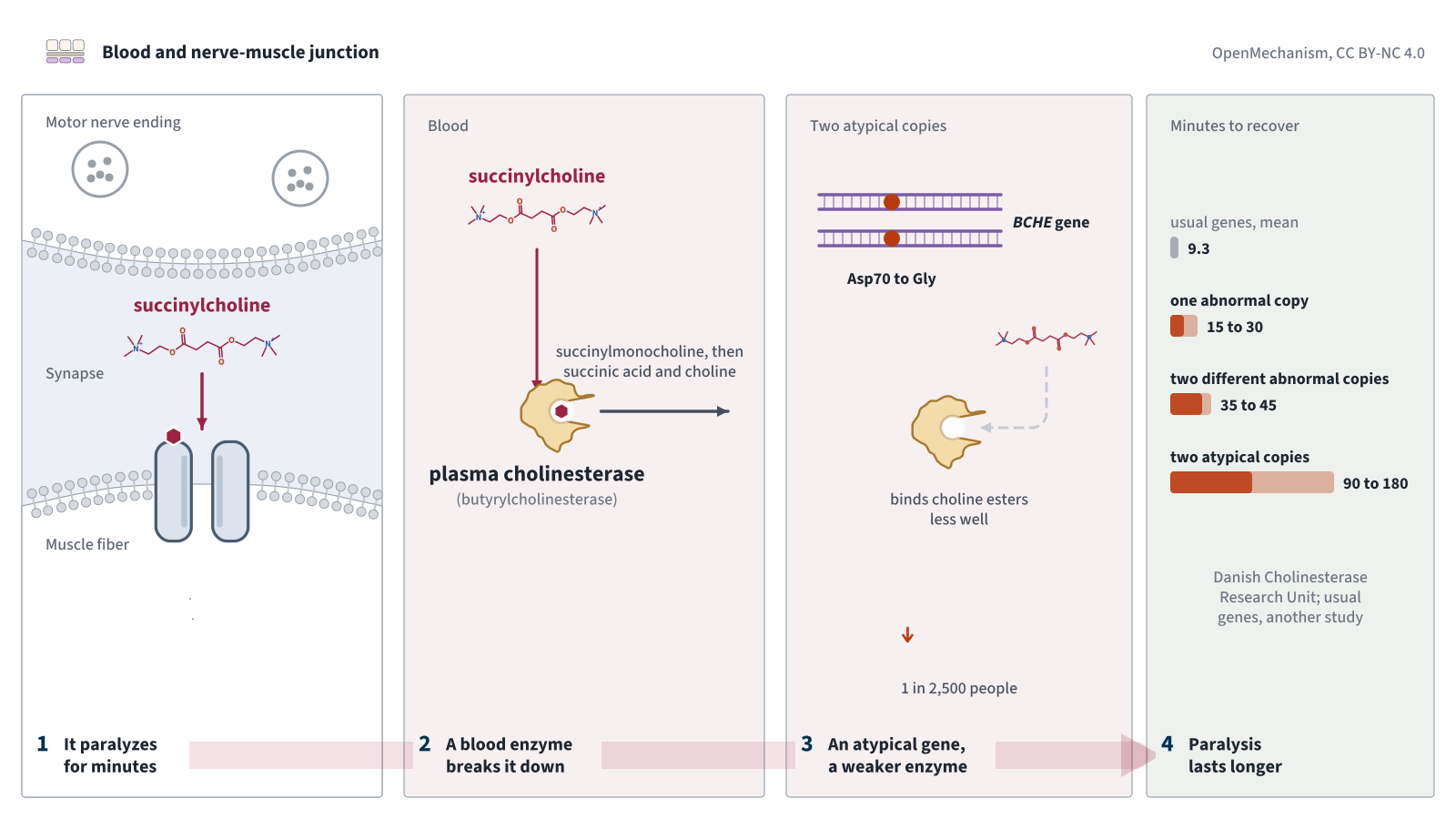
Succinylcholine relaxes muscles during surgery, and a single dose lasts about 4 to 6 minutes because plasma cholinesterase in the blood breaks it down. About 1 in 2,500 people has two copies of an atypical form of the enzyme's gene. Their enzyme binds less well, they are extremely sensitive to succinylcholine, and in one research unit's studies they took 90 to 180 minutes to recover.
- Kind
- In the body
- Medicines
- Succinylcholine
- Sources
- 8
For teachers: download this drawing.
Step by step
It paralyzes for minutes. Succinylcholine is used to relax muscles during surgery and to help place a breathing tube. Like acetylcholine, it acts on the receptors of the muscle's end plate and depolarizes it; nerve signals cannot pass while enough of it stays there. Paralysis comes in under a minute and, after a single dose, lasts about 4 to 6 minutes.1
What the source says
“ANECTINE is indicated in adults and pediatric patients: • as an adjunct to general anesthesia • to facilitate tracheal intubation • to provide skeletal muscle relaxation during surgery or mechanical ventilation.”
Source 1“Succinylcholine is a depolarizing neuromuscular blocker. As does acetylcholine, it combines with the cholinergic receptors of the motor end plate to produce depolarization.”
Source 1“Subsequent neuromuscular transmission is inhibited so long as adequate concentration of succinylcholine remains at the receptor site.”
Source 1“Onset of flaccid paralysis is rapid (less than one minute after intravenous administration), and with single administration lasts approximately 4 to 6 minutes.”
Source 1A blood enzyme breaks it down. Plasma in the blood, also called butyrylcholinesterase or pseudocholinesterase, quickly splits succinylcholine into succinylmonocholine, which barely relaxes muscle, and then more slowly into succinic acid and choline. When this enzyme is lacking, the effects of succinylcholine last longer.1,2,3
What the source says
“Succinylcholine is rapidly hydrolyzed by plasma cholinesterase to succinylmonocholine (which possesses clinically insignificant depolarizing muscle relaxant properties) and then more slowly to succinic acid and choline.”
Source 1“reduced plasma cholinesterase (pseudocholinesterase) activity”
Source 2“Butyrylcholinesterase deficiency prolongs the effects of the drugs it degrades; succinylcholine and mivacurium.”
Source 3An atypical gene, a weaker enzyme. Apnea after succinylcholine (breathing that stays stopped) can come from inherited variants of the enzyme's gene, BCHE. In the atypical form, one change in the gene swaps a single building block of the enzyme (aspartate 70 for glycine), and the enzyme binds choline esters less well. One atypical copy or two can lower the enzyme's activity, and the 1 in 2,500 people with two copies are extremely sensitive to succinylcholine.2,4,5
What the source says
“Butyrylcholinesterase (BCHE) genotyping”
Source 4“post-succinylcholine (SC) apnea attributable to inherited variants of the BChE enzyme”
Source 4“A point mutation in the gene for human serum cholinesterase was identified that changes Asp-70 to Gly in the atypical form of serum cholinesterase.”
Source 5“We conclude that the Asp-70----Gly mutation (acidic to neutral amino acid substitution) accounts for reduced affinity of atypical cholinesterase for choline esters”
Source 5“Plasma cholinesterase activity may be diminished in the presence of genetic abnormalities of plasma cholinesterase (e.g., patients heterozygous or homozygous for atypical plasma cholinesterase gene)”
Source 2“Patients homozygous for atypical plasma cholinesterase gene (1 in 2500 patients) are extremely sensitive to the neuromuscular blocking effect of succinylcholine.”
Source 2Paralysis lasts longer. In the studies of the Danish Cholinesterase Research Unit, recovery after succinylcholine took 15 to 30 minutes with one abnormal copy of the gene, 35 to 45 minutes with two different abnormal copies, and 90 to 180 minutes with two atypical copies. In another study, people with the usual genes recovered 90% of their muscle twitch strength in a mean of 9.3 minutes.6,7
What the source says
“For more than 20 years, the Danish Cholinesterase Research Unit (DCRU) has collected information about patients showing an abnormal response to succinylcholine.”
Source 6“Also, we wanted to evaluate the results of our prospective controlled studies of the effect of succinylcholine in patients with normal and abnormal plasma cholinesterase genotypes.”
Source 6“The time to sufficient recovery of neuromuscular function following succinylcholine 1.0-1.5 mg kg-1 was 15-30 min in patients heterozygous for one abnormal gene, 35-45 min in patients heterozygous for two abnormal genes and 90-180 min in patients homozygous for the atypical gene.”
Source 6“Mean time to 90 per cent recovery of twitch height in patients with genotypes E1uE1a, E1uE1s, and E1uE1f (14.6, 12.4, and 12.0 min, respectively) was significantly prolonged compared to patients with normal cholinesterase genotype (9.3 min).”
Source 7
See also
Medicine pages: succinylcholine.
Other pages on what the body does with a medicine (muscles, bones & joints): allopurinol and the HLA-B*58:01 variant; and all 16 pages on what the body does with a medicine.
Conditions: malignant hyperthermia and organophosphate poisoning.
Interactions: reversing rocuronium with sugammadex or neostigmine.
Sources
- 1Anectine (succinylcholine chloride): FDA label1 Indications and Usage; 12.1 Mechanism of Action; 12.3 Pharmacokinetics. Saved copy
- 2Anectine (succinylcholine chloride): FDA label5 Warnings and Precautions (Reduced Plasma Cholinesterase Activity). Saved copy
- 3Butyrylcholinesterase deficiency and its clinical importance in anaesthesia: a systematic reviewAndersson ML et al. Anaesthesia 2019 (abstract). Saved copy
- 4Butyrylcholinesterase (BCHE) genotyping for post-succinylcholine apnea in an Australian populationYen T et al. Clin Chem 2003 (abstract). Saved copy
- 5Identification of the structural mutation responsible for the dibucaine-resistant (atypical) variant form of human serum cholinesteraseMcGuire MC et al. Proc Natl Acad Sci U S A 1989 (abstract). Saved copy
- 6Plasma cholinesterase and abnormal reaction to succinylcholine: twenty years' experience with the Danish Cholinesterase Research UnitJensen FS et al. Acta Anaesthesiol Scand 1995 (abstract). Saved copy
- 7Succinylcholine neuromuscular blockade in subjects heterozygous for abnormal plasma cholinesteraseViby-Mogensen J. Anesthesiology 1981 (abstract). Saved copy
- 8Human butyrylcholinesterase (plasma cholinesterase); Ser198 marks the active sitePDB 1P0I; Nicolet, Y. et al. J.Biol.Chem. 2003;278:41141-41147. The plasma cholinesterase outline in the drawing is traced from this structure. Saved copy
Notes and limits
- Other things can lower plasma cholinesterase too, among them pregnancy, severe liver or kidney disease, burns, some medicines and organophosphate insecticides.2
- The recovery times compare different measures: the Danish unit's time to sufficient recovery and, for the usual genes, another study's time to 90% of twitch strength.6,7
Notes that apply to every page are on How to read a page.
Spotted a mistake? Report an error (hello@openmechanism.com). Since launch, every published error we fix is listed on the corrections page.
Cite this page
Tran D. Succinylcholine and the BCHE gene [Internet]. OpenMechanism; 2026 [updated 2026 Oct 20; cited 2026 Oct 20]. Available from: https://openmechanism.com/explained/succinylcholine-and-bche