Pralidoxime
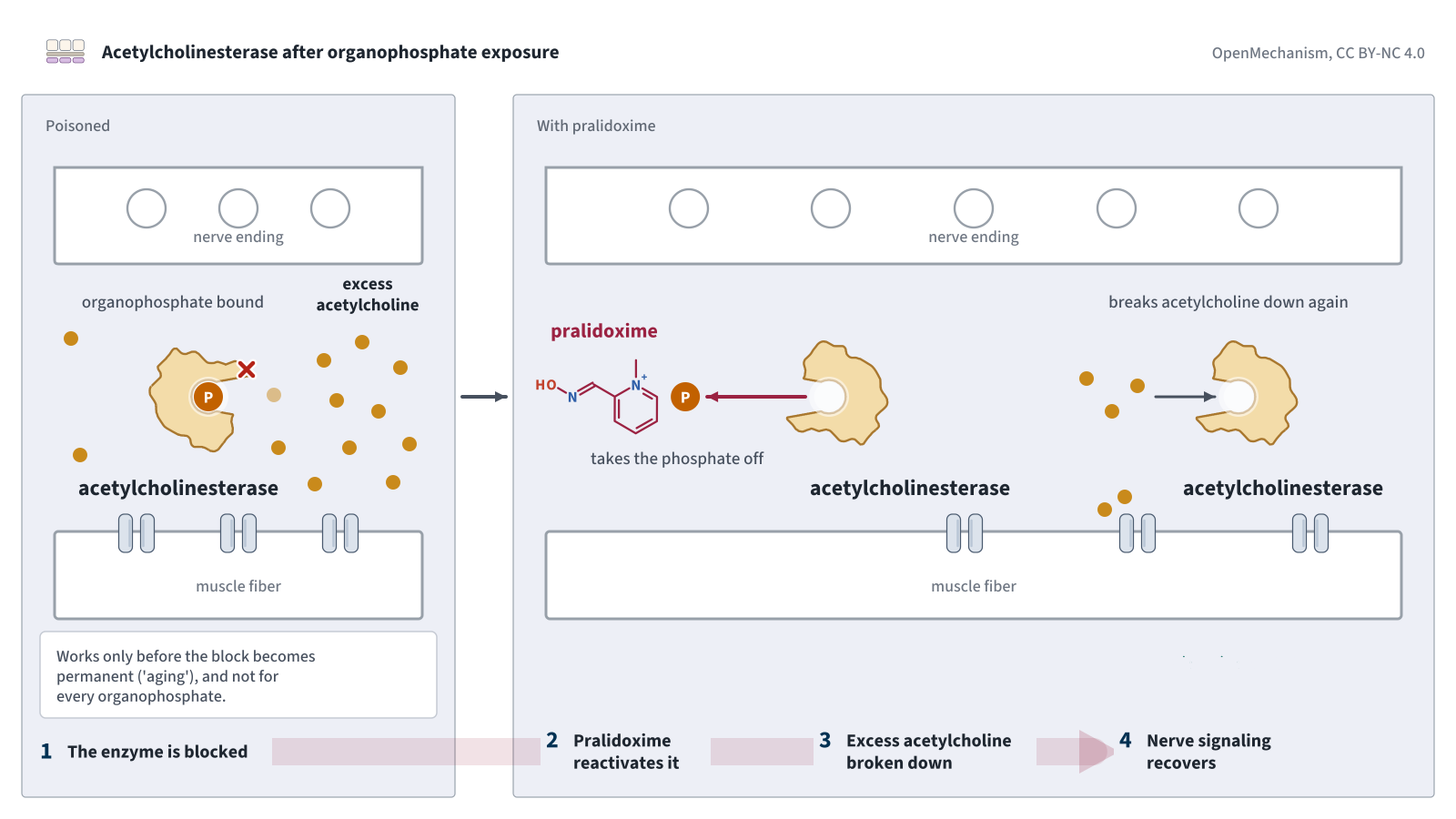
Organophosphate poisons block . Given before the block becomes permanent, pralidoxime reactivates the enzyme, which can again break down excess acetylcholine and help restore nerve function.
- Acts on
- Phosphorylated acetylcholinesterase
- Where
- Acetylcholinesterase after organophosphate exposure
- Medicine type
- Small molecule
- Used for
- Antidotes & reversal
Key terms in this drawing
- acetylcholinesterase
- Acetylcholinesterase. The enzyme that breaks down acetylcholine; blocking it raises the amount of acetylcholine.
How it works
The enzyme is blocked. Susceptible organophosphorus compounds inhibit acetylcholinesterase by phosphorylation.1
Pralidoxime reactivates it. Pralidoxime restores activity of susceptible phosphorylated enzyme before irreversible aging.1
Excess acetylcholine broken down. Reactivated acetylcholinesterase hydrolyzes excess acetylcholine.1
Nerve signaling recovers. Restored transmitter breakdown helps restore impaired cholinergic neural function.1
For teachers: download this drawing or build a slide deck.
See also
Condition pages: organophosphate poisoning.
More medicines for antidotes & reversal: acetylcysteine, atropine, digoxin immune fab, dimercaprol, flumazenil, fomepizole, glucarpidase, hydroxocobalamin and 7 more.
Sources
- 1ATNAA Auto-Injector (atropine and pralidoxime chloride): FDA label12.1 Mechanism of Action
- 2ChEMBL CHEMBL1420Target and action classification: Acetylcholinesterase activator
Also used for the drawing
The acetylcholinesterase outline is traced from the crystal structure below.
- 3Human acetylcholinesterase inhibited by paraoxon, an organophosphate, with pralidoxime (2-PAM)PDB 5HFA; Franklin, M.C. et al. Proteins 2016; 84:1246-1256
Spotted a mistake? Report an error (hello@openmechanism.com). Since launch, every published error we fix is listed on the corrections page.
Notes and limits
- A schematic teaching drawing: not to scale, not exact structures, binding poses or a complete pathway, and not a guide to dosing, treatment or how a person will respond.
- Other medicines in the same family may not follow every step or share the same clinical endpoint.
- The steps are in the order that explains them; one step is said to cause the next only where the source says so.
- Pralidoxime cannot reactivate every organophosphorus-inhibited enzyme or aged phosphorylated enzyme.
- The selected label also contains atropine; this recipe depicts the pralidoxime component only.
- Checked selected FDA product records are marked Discontinued. This mechanism-history example does not imply present availability or safety withdrawal.
All recorded limits are on the evidence page, and notes that apply to every page are on How to read a page. Version 1.0.0, not yet medically reviewed.
Cite this page
Tran D. Pralidoxime [Internet]. OpenMechanism; 2026 [updated 2026 Oct 15; cited 2026 Oct 15]. Available from: https://openmechanism.com/medicines/pralidoxime