Methocarbamol
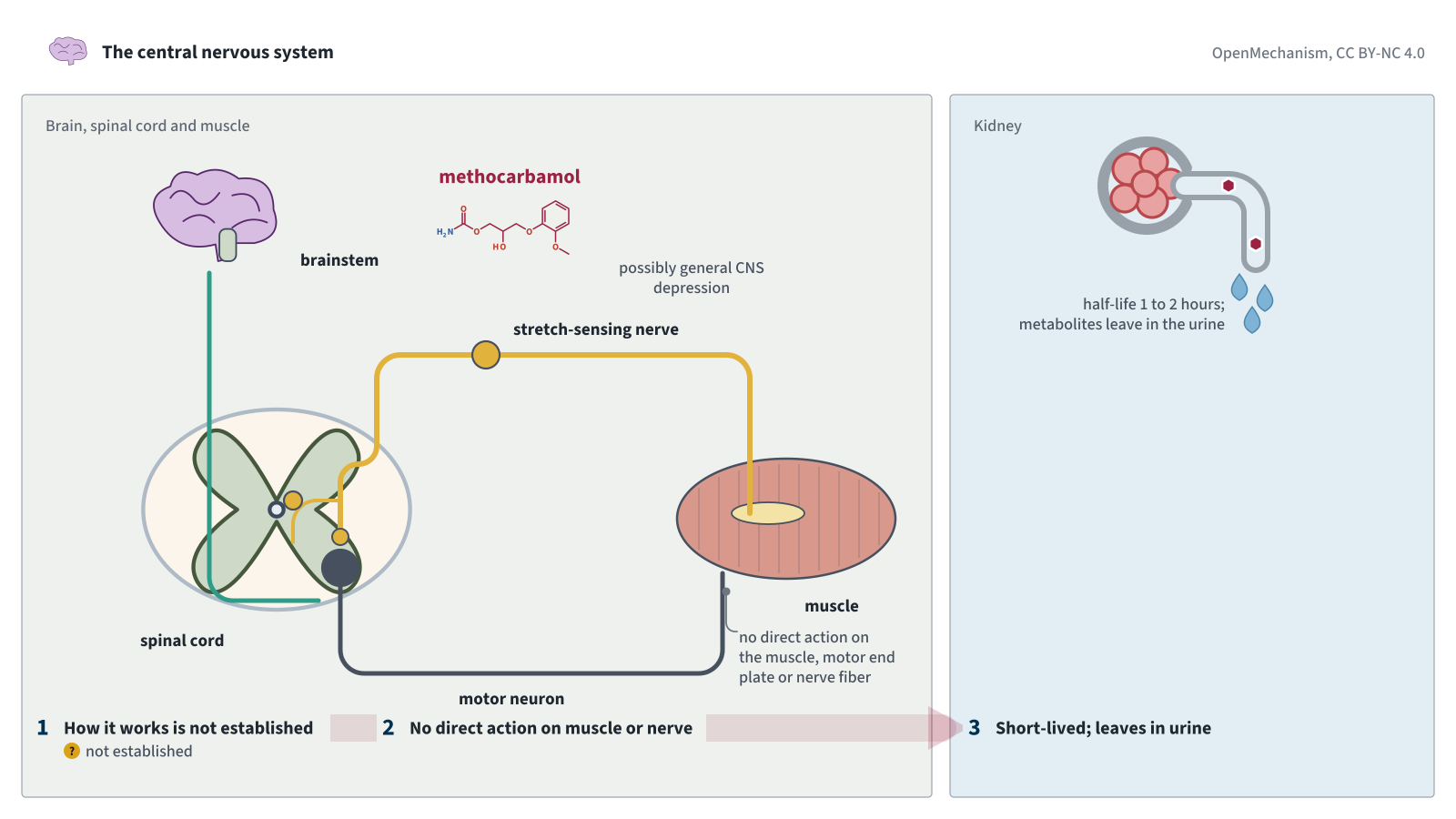
How methocarbamol works in people has not been established; it may be through general depression of the central nervous system. It has no direct action on muscle contraction, the motor end plate or the nerve fiber. It is short-lived ( 1 to 2 hours) and its metabolites leave in the urine.
- Acts on
- Not established; possibly general central nervous system depression
- Where
- The central nervous system
- Medicine type
- Small molecule
- Used for
- Muscles, bones & joints
- Drug class
- Muscle relaxants (centrally acting)
Also called Robaxin.
Step 1: not established
The Robaxin label says: The mechanism of action of methocarbamol in humans has not been established, but may be due to general CNS depression.
Source 1: Robaxin (methocarbamol): FDA label, Clinical Pharmacology
Clinical study: In a randomized, double-blind trial in emergency department patients with acute low back pain, all of whom took naproxen, methocarbamol or placebo was added; the trial measured function a week later, not how methocarbamol works: Among ED patients with acute, nontraumatic, nonradicular low back pain, combining naproxen with either orphenadrine or methocarbamol did not improve functional outcomes compared with naproxen+placebo.
Friedman BW et al., Ann Emerg Med 2018 (PMID 29089169)
This study was picked with a literature search and is not yet checked by our reviewer.
Key terms in this drawing
- CNS
- Central nervous system. The central nervous system; methocarbamol is a CNS depressant, with sedative and muscle-relaxing effects.
- half-life
- Half-life. The time it takes for the amount in the blood to fall by half.
How it works
How it works is not established. The mechanism of methocarbamol in humans has not been established, but may be due to general central nervous system () depression.1
No direct action on muscle or nerve. It has no direct action on the contractile mechanism of striated muscle, the motor end plate or the nerve fiber.1
Short-lived; leaves in urine. Its plasma half-life is 1 to 2 hours; it is metabolized by dealkylation and hydroxylation, and essentially all its metabolites leave in the urine.1
For teachers: download this drawing.
See also
Condition pages: muscle spasm.
Other muscle relaxants (centrally acting): baclofen, cyclobenzaprine and tizanidine.
Body system: muscles, bones & joints.
Sources
- 1Robaxin (methocarbamol): FDA labelClinical Pharmacology
- 2ChEMBL CHEMBL1201117Target and action classification: Carbonic anhydrase I inhibitor
- 3A Randomized, Double-Blind, Placebo-Controlled Trial of Naproxen With or Without Orphenadrine or Methocarbamol for Acute Low Back PainFriedman BW et al. Ann Emerg Med 2018 (abstract)
Spotted a mistake? Report an error (hello@openmechanism.com). Since launch, every published error we fix is listed on the corrections page.
Notes and limits
- A schematic teaching drawing: not to scale, not exact structures, binding poses or a complete pathway, and not a guide to dosing, treatment or how a person will respond.
- The label says the mechanism of action in humans has not been established, but may be due to general CNS depression.
All recorded limits are on the evidence page, and notes that apply to every page are on How to read a page. Version 1.0.0, not yet medically reviewed.
Cite this page
Tran D. Methocarbamol [Internet]. OpenMechanism; 2026 [updated 2026 Oct 11; cited 2026 Oct 11]. Available from: https://openmechanism.com/medicines/methocarbamol